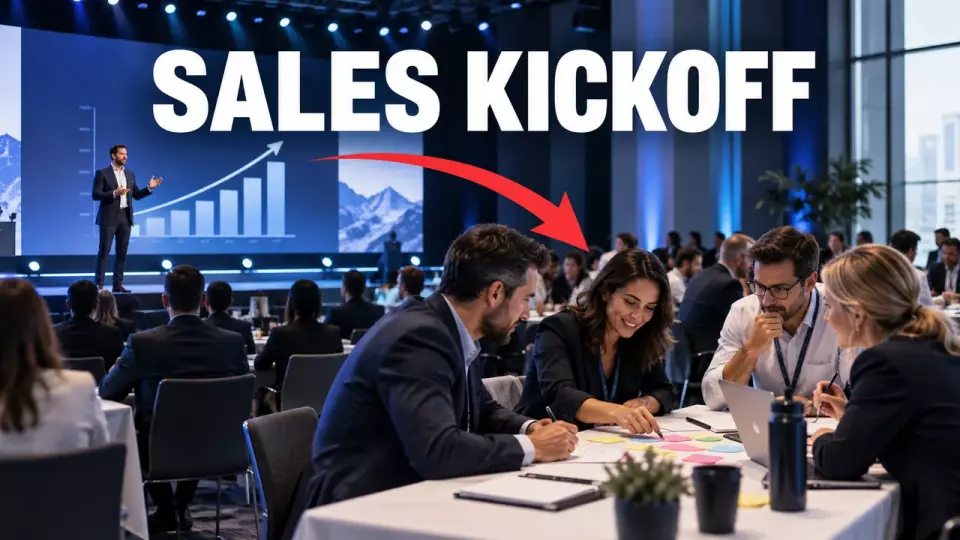
A practical breakdown of Sales Kickoff for the sales team: from tangible outcomes and preparation to the agenda, skill practice, production, budget, and measuring application afterwards.
A Sales Kickoff for the sales department is needed when a company needs more than just announcing the plan and showing new slides. The all-hands meeting should translate strategy into several working actions: how the salesperson conducts the conversation, demonstrates value, assesses deal risk, and agrees on the next step. At Aventura, we build the program around this transition, and we subordinate the stage and design to the task.
What should Sales Kickoff change?
Sales Kickoff should change the team's observable actions, not just the mood in the room. Before working on the program, specify what the salesperson will start doing differently after the meeting and how the manager will see it. A good goal describes behavior, situation, and a way to verify. The phrase "energize the department" is too vague for design.
Start with one working contradiction. For example, the product has been updated, but the conversation with the client remains the same. Or managers evaluate differently the meeting where the salesperson identifies the client's need. Perhaps regional teams hear the strategy but don't understand what step to take in their pipeline as early as next week.
Translate the task into a short results contract:
- What the team should know by the opening of the event.
- What action the salesperson practices in person.
- By what signs the observer evaluates the attempt.
- How the manager reinforces the action after the meeting.
- Which business metric will help decide whether to continue this practice.
We usually ask to choose no more than three outcomes per Sales Kickoff. The limitation protects the program from the habitual list of "telling everything for the year." What does not support the chosen action goes into pre-work materials, a separate webinar, or regular training.
Format boundary: conference and strategic session
In our project framework, Sales Kickoff combines overall direction, sales training, practice, and agreement on reinforcement. A corporate conference can work with a broader agenda, while a strategic session helps a small group align on decisions. A dealer conference is aimed at the external network. Mixing these formats creates an overloaded program and a fight for every time slot.
The table summarizes key points of the section: Format, Main participant, Business outcome. Use it as a quick reference when preparing the event.
| Format | Main participant | Business outcome | What happens after |
|---|---|---|---|
| Sales Kickoff | sales department and supporting functions | aligned priorities and a practiced action | manager's work with the team and application in deals |
| Strategic session | executives and decision owners | choice of direction and commitments | decision plan, owners, and checkpoints |
| Dealer conference | partners and sales channel | rules of engagement, product, and joint plan | partner support and agreements |
| Awards ceremony | employees or partners | recognition of contribution | communication of achievements and criteria |
One event can contain elements of all four formats. They should not be considered interchangeable. An awards ceremony does not replace practice, and an executive's presentation does not create the decision of a strategic session. The evening program supports team bonding but does not fix a weak learning component.
If the main task lies with the top team, first hold a separate strategic session, and bring the already agreed direction to Sales Kickoff. This way participants do not watch executives' internal debate from the stage.
What data to collect before the program?
Before writing the script, gather facts about sales, roles, product changes, and the team's real difficulties. A program built solely on managers' wishes often answers questions that salespeople no longer have. Diagnostics helps choose between a general presentation, role-playing track, practice, deal analysis, and self-study material.
You need a brief set of initial data:
- priorities of the commercial unit for the period;
- changes in segments, product, price, or process;
- recurring reasons for losses and delays;
- difficult client questions;
- participant roles and experience level;
- differences between regions and channels;
- availability, language, and connection method;
- restrictions on data and filming;
- decision calendar and material owners.
Do not display real client cards on the shared screen without anonymization and access control. For practice, it is enough to preserve the structure of the situation: company type, task, decision participants, risk, and next step. Contacts, names, amounts, and sensitive conditions should be removed before handing the material to the facilitator. This approach follows the principles of purpose limitation, data minimization, and confidentiality of processing from Articles 5 and 7 of Federal Law No. 152-FZ.
It is convenient to build the preparation calendar together with content owners. In the article about event approvals we discuss working versions, freeze points, and dependencies. For Sales Kickoff, the readiness dates of sales management, exercises, presentations, handouts, and rehearsal script are especially important.
We publish practical case studies of corporate and business formats in our Telegram channel. It is convenient to follow new materials and examples there.
Preliminary preparation and team roles
Preliminary work frees up shared time from information that the participant can study on their own. The short package includes the year’s direction, product changes, a shared vocabulary, and a check of basic understanding. Seismic and Highspot recommend distributing materials across the before, during, and after meeting stages. Participants’ answers tell the facilitator where brief alignment is enough and where a full breakdown and practice are needed.
Don’t send one heavy presentation with the words “get familiar by Friday.” Break the package into clear actions:
- Watch a short address from the leader.
- Read a one-page description of priorities.
- Study the updated working model or sales guide.
- Answer a few questions on basic concepts.
- Bring an anonymized situation from a current deal.
- Report accessibility and meal requirements through a private form.
Assign responsibility before production begins. We record the owner of each block in a shared spreadsheet.
The table collects key points of the section: Role, Before the event, On site. Use it as a quick reference when preparing the event.
| Role | Before the event | On site | After the event |
|---|---|---|---|
| Commercial director | approves the outcome and boundaries | explains the direction and resolves contradictions | reviews barriers and solutions |
| Sales enablement team | prepares preliminary materials and practice criteria | checks criteria and runs exercises | organizes repetition and evaluation |
| Group leaders | bring situations and attend the briefing | observe and provide feedback | reinforce the skill in regular work |
| Commercial operations analytics | defines metrics and data sources in advance | provides data without excessive reporting | compares application and dynamics |
| Product marketing | updates argumentation and materials | shows the standard and answers questions | edits the sales feedback guide |
| Event producer | assembles venue, equipment, flows, and reserve | keeps timing and transitions | hands over approved recordings, materials, and outcomes |
Each block should have one owner for the outcome. Several speakers can participate, but one person is responsible for content readiness, a clear outcome, and handover of materials to the venue team.
How to Build a Two-Day Program?
A two-day program works when the first day establishes a common language and a first attempt, while the second offers role-play practice, calibration, and a plan for transferring to work. First, the participant understands the direction. Then they try an action, receive specific feedback, and repeat the attempt. The entertainment part should not eat into recovery before complex practice.
Example of the program logic:
The table summarizes the key points of the section: Stage, Objective, Suitable format. Use it as a quick reference when preparing the event.
| Stage | Objective | Suitable format | Result |
|---|---|---|---|
| Opening | state priorities and working rules | short speech by the leader | common framework |
| Period results | review facts without complacency | data and two contrasting cases | common language of the problem |
| Voice of the customer | bring the conversation back to a real purchase | interview, recording, or panel | criteria of value and risk |
| Working model | demonstrate a new action | demonstration of a standard | clear standard |
| First practice | try safely | triads of seller, client, observer | feedback against criteria |
| Deal analysis | apply the model to a situation | role-play tables | risk map and next step |
| Role groups | account for different contexts | parallel workshops | action for each role |
| Cross-functional block | eliminate handover gaps | service map and procedure for escalating complex questions | agreements between functions |
| Final attempt | confirm the skill | simulation or short presentation | observable result |
| Transfer plan | assign reinforcement | seller and manager | action, date, and owner |
During the day, alternate short presentations, discussion, movement, and practice. The exact rhythm depends on the group composition and complexity of the material. We do not use a universal norm for session length: short updates and complex simulations require different time slots.
The scenario ties content to transitions. It includes start time, format, owner, technique, on-screen material, participant action, and a completion indicator. This document helps the director, speaker, and facilitator see the same day.
Practicing skills instead of a line of presentations
Participants practice on a specific task, in a clear role, and with a single observation sheet. In Aventura projects, the first attempt is followed by feedback, and then a repeat of the difficult segment. This way the person immediately checks the correction. We evaluate actions in the conversation, not charisma, a confident voice, or similarity to the manager's favorite salesperson.
For the role-play exercise, form groups of three:
- The salesperson performs one conversation task.
- The client receives a context card and objections.
- The third participant marks several actions to be checked.
- The salesperson first evaluates themselves.
- The client describes what helped and hindered decision-making.
- The third participant gives feedback based on the sheet.
- The salesperson repeats the difficult segment.
- Participants switch roles.
For example, for the first diagnostic meeting, the sheet may check the hypothesis, the question about business impact, the composition of decision participants, the link between need and value, and a concrete next step. The wording depends on the company's sales model. Managers need to understand the criterion in the same way.
Deal analysis works with a depersonalized situation. The group determines what information is missing, where the risk is, who is involved in the decision, and what to do next. The result is a working map, not a pretty poster. After the event, the manager returns to the same logic when analyzing a real deal.
How to include regions and make the event accessible?
A remote participant should perform the same meaningful actions as the audience in the room: hear questions, see materials, work in a group, and receive answers. A simple broadcast of the stage creates two audiences with different experiences. Accessibility is also planned in advance: needs are collected, materials are prepared, and the route, sound, subtitles, and alternatives for tasks are checked.
For a hybrid Sales Kickoff, decide in advance:
- which blocks run simultaneously for all;
- where regions need a separate facilitator;
- how a remote question reaches the speaker;
- who monitors the chat and technical assistance;
- a way to share materials beyond screen sharing;
- setting up breakout rooms and returning to the main broadcast;
- what happens if the connection drops.
W3C recommends sharing accessible materials in advance, using clear language, limiting slide overload, and repeating questions through the microphone. Separately, we collect only the necessary participation conditions and do not ask for a diagnosis if describing the needed assistance is sufficient. The form specifies the operator, purpose, scope of access, retention period, and legal basis for processing; health information is processed in accordance with Article 10 of Federal Law No. 152-FZ.
A detailed technical breakdown is available in the article about accessible event streaming. For a branch network, the hybrid conference scheme is also useful, but Sales Kickoff additionally requires designing practice and managerial reinforcement.
Production, Rehearsal, and Backup
On site, the training scenario becomes a sequence of team actions. Our production team checks timing, speakers, sound, screens, materials, transitions between the main hall and groups, catering, navigation, and communications. The rehearsal shows where instructions are unclear, format changes take too long, or equipment hinders participants from acting. Perfect text reading is not required for this.
At the technical rehearsal, go through the critical moments:
- Opening, first slide, and first sound.
- Handover between the leader and the facilitator.
- Starting the timer, poll, and breakout rooms.
- Bringing a remote question into the main room.
- Participants moving between zones.
- Microphones working during discussions.
- Backup material in case of network failure.
- Closing and issuing the next action.
The end-to-end technical run-through of all entrances and transitions can be checked against our material on technical rehearsal. HSE separately pays attention to clear routes, staff training, communication structure, and safe laying of temporary cables. This is an operational guideline. The requirements of a specific Russian venue are checked according to the contract, facility instructions, and applicable regulations.
Backup is built according to criticality. A failure of background animation will not stop the program. An inaudible assignment will stop the practice. Therefore, first protect power, sound, team communication, exercise materials, and a way to give instructions without the main platform.
What does the Sales Kickoff budget consist of?
The budget covers the full lifecycle: diagnostics, content, production, venue, practice, accessibility, recording, and post-meeting support. Venue rental and the evening program are visible immediately, but they don't reflect all the work. Compare proposals with the same scope and separately note what the company, venue, and contractor provide.
The table summarizes the key points of the section: Block, What to include, Common omission. Use it as a quick reference when preparing the event.
| Block | What to include | Common omission |
|---|---|---|
| Diagnosis | interviews, data, roles, working result | leadership time and collection of situations |
| Content | script, sales guide, exercises, criteria | material editing and calibration |
| Speakers | preparation, rehearsal, moderation | rework after late approval |
| Venue | halls, groups, catering, navigation | setup time and venue services |
| Equipment | sound, screens, lighting, recording, communication | backup and support for remote participants |
| Accessibility | subtitles, translation, materials, route | quality check and accessible recording |
| Event production | directing, management, staff | night hours and team shifts |
| Practice | facilitators, cards, observers | observer training and repeated run-through |
| Reinforcement | material repository, short sessions, report | manager time and guide updates |
| Reserve | equipment, logistics, urgent printing | decision owner and usage threshold |
We do not provide a universal per-person price. The budget is more strongly influenced by the number of roles, number of parallel groups, cities, connection format, complexity of practice, production volume, and recording level. First, define the composition of the result, then compare options.
How to measure results after the event?
The Kirkpatrick model separates reaction, learning, behavior, and results. These levels cannot be mixed: a high program rating shows participants' reaction but says nothing about behavior change. Sales growth after a meeting also cannot be entirely attributed to the event. For each metric, you need a starting point, an owner, a data source, and a review deadline.
Use four layers:
The table summarizes the key points of the section: Layer, Question, Check example. Use it as a quick reference when preparing the event.
| Layer | Question | Check example |
|---|---|---|
| Reaction | was the material relevant and applicable? | short evaluation and open barrier |
| Learning | did the person understand and demonstrate the action? | same sheet before and after practice |
| Behavior | did the action appear in work? | manager observation in a real situation |
| Result | did the work metric change in the desired direction? | agreed metric taking into account other factors |
Immediately after the event, hand over decisions and materials. At the next work meeting, the manager conducts a repeat practice. Then checks the action on a call, in a meeting, in an email, or in a demonstration. If the application does not appear, the team looks for a barrier: a complex model, low confidence, unsuitable material, lack of time, or a conflicting process.
Don't turn the system into surveillance. Only take the data needed for the stated purpose, limit access, and explain the rules to participants. If registration, filming, or the learning platform collects personal data, determine in advance the operator, purpose, fields, retention period, recipients, and legal basis for processing.
In our projects, participants are informed about audio, photo, and video recordings before the event. We set in advance the purposes, publication channels, and retention period, and obtain the necessary consents before recording and using the materials. We separate consent to data processing and consent to the use and publication of a person's image when required by law. Article 9 of Federal Law No. 152-FZ and Article 152.1 of the Civil Code of the Russian Federation apply here.
Launch Plan
Launching a Sales Kickoff starts with the working outcome and ends with assigned follow-up. In between lie diagnostics, owners, pre-work materials, scenario, production, rehearsal, and practice. If at least one of these blocks remains without an owner, the problem will show up at the venue or right after it, when the team returns to its usual rhythm.
Final sequence:
- Name one to three changes you want to see.
- Choose observable actions for each key role.
- Collect facts and anonymized work situations.
- Separate pre-work materials from live practice.
- Assign owners for content, production, availability, and data.
- Build a scenario with alternating formats.
- Prepare feedback criteria and a second run-through.
- Conduct a technical and content rehearsal.
- Record backup decisions and thresholds for triggering them.
- Assign post-meeting actions for managers and check-in dates.
Frequently Asked Questions
A Sales Kickoff should change the team's observable behavior, not just the mood in the room. Before working on the program, state what a salesperson will start doing differently after the meeting and how a manager will see it. A good goal describes the behavior, situation, and way to verify it. The phrase "energize the department" is too vague for design.
In our project framework, a Sales Kickoff connects overall direction, sales training, practice, and an agreement on reinforcement. A corporate conference can handle a broader agenda, while a strategic session helps a small group align on decisions. A dealer conference targets an external network. Mixing these formats creates an overloaded program and a fight for every time slot.
Before the scenario, collect facts about sales, roles, product changes, and the team's real difficulties. A program built only on managers' wishes often answers questions that salespeople no longer have. Diagnostics help you choose between a general presentation, a role-play track, practice, deal analysis, and self-study material.
Pre-work frees up shared time from information that a participant can study on their own. A short package includes the year's direction, product changes, a shared vocabulary, and a check of basic understanding. Seismic and Highspot recommend distributing materials across the stages before, during, and after the meeting. Participants' responses tell the facilitator where a brief alignment is enough and where a full breakdown and practice are needed.
A two-day program works when the first day creates a shared language and a first attempt, and the second provides role-play practice, calibration, and a plan for transfer to work. First, the participant understands the direction. Then they try the action, receive specific feedback, and repeat the attempt. The entertainment part should not eat into recovery before difficult practice.
Sources
- Salesforce: planning a Sales Kickoff
- Example of Sales Kickoff program logic from Salesforce
- Seismic: preparation, practice, and support for Sales Kickoff
- Highspot: agenda, role-playing tracks, and skill reinforcement
- W3C WAI: accessible meetings, training, and presentations
- HSE: crowd management inside the venue
- HSE: electrical safety of temporary infrastructure
- Kirkpatrick Partners: four levels of training evaluation
- Federal Law No. 152-FZ, Article 5: processing principles
- Federal Law No. 152-FZ, Article 7: confidentiality
- Federal Law No. 152-FZ, Article 9: consent
- Federal Law No. 152-FZ, Article 10: special categories of data
- Civil Code of the Russian Federation, Article 152.1: protection of a citizen's image
Contents
Was this article helpful?