How to organise photography at a corporate event: consents and refusals, the photographer's brief, reviewing the shots, publication, storage and deletion of materials.
A notice about photography does not grant permission for any method of publication. A refusal that exists only in a form is easily lost between registration, the photographer's work and shot selection. That is why the process needs to be put in place before the event, and roles and channels defined in advance.
If photography is already part of the event plan, we can link it to registration, the guest route and the publication plan. Request a quote or see how event photo and video coverage works.
When is consent required for photos and videos?
Consent for photos and videos from a corporate event is assessed based on the type of shot, the circumstances of filming and the intended channel. Publishing a recognisable portrait usually requires a stricter assessment than a general reportage shot. A closed corporate event cannot automatically be considered a public event, and a notice at the entrance does not confirm consent for any use.
The main basis is Article 152.1 of the Civil Code of the Russian Federation. As a general rule, the publication and further use of a person's image are permitted with their consent. The same article contains exceptions, but each depends on the circumstances.
An exception may apply when filming in a place open to free access or at a public event, provided that the specific person is not the main object of use. A general shot of the hall and a personal cover featuring an employee are therefore assessed differently.
If a person can be identified from a photo or video, the company's work with such files may fall under Federal Law No. 152-FZ "On Personal Data". For recording, storage, transfer and public dissemination, the purpose, legal basis and applicable regime are checked.
Before creating a consent form, draw up a list of purposes and publication channels. For each type of material, the team answers four questions: who is in the frame, why the material is needed, where it will appear and how long it will be available.
Disclaimer. This material explains the general logic of organising filming. It does not replace legal advice on a specific event, consent form, participant composition and publication channels.
Filming, storage and publication are different actions
A camera in the venue, a working archive and a public post create different tasks for the organiser. A filming notice does not automatically cover editing, transfer to contractors, advertising and reuse of footage. Each stage needs a clear purpose, restricted access, a retention period for files and a person responsible for decisions.
It helps to split the material's journey into three stages.
- Capture. A photographer or camera operator creates the source file.
- Internal processing. The team imports the material, selects and edits it, then stores or hands over the finished files.
- Publication. The finished version goes to an internal channel, the website, a social network or an ad account.
Article 152.1 of the Civil Code of the Russian Federation deals primarily with the publication and further use of an image. At the same time, a recording in which a person can be identified may already be personal data processing. So the phrase "we're not publishing anything for now" does not remove questions about the purpose, access and retention period for source files.
A sign at the entrance informs guests about cameras in advance and gives the contact of the responsible person. However, it does not show whether the person agreed to a portrait in an advertising banner, an interview for a public channel or the transfer of footage to a partner.
At Aventura, we separate the general shot, staged photography, a personal portrait and an interview as early as the brief. For each piece of material we specify the channel and the person who approves the release. That means fewer disputed situations for the photographer and fewer files with an unclear status for the editorial team.
Is a corporate event a public event?
A large number of guests does not in itself make a closed corporate event public. If entry is by guest list or invitation, the team separately verifies the grounds for using recognizable footage. What matters is the accessibility of the event, the person's role in the composition, the context of the shoot and the specific way the material will be used later.
Article 152.1 of the Civil Code of the Russian Federation does not grant a general permission to film and publish everyone at any mass event. The accessibility of the event and the person's role in the specific material must be assessed together.
In a wide shot, the hall, the stage and dozens of guests are visible, while no one is singled out by a caption, composition or editing. In a personal promotional post, an employee's face becomes the focus of the material. Even if both files were shot a minute apart, their use scenarios differ.
For a group staged photograph, consent may follow from the participants' behavior and the circumstances of the shoot. The Plenum of the Supreme Court allows one participant to use such a photo without new consent from the others, provided the participants clearly agreed to be photographed, did not prohibit publication, and the shot does not reveal private life. The scope of such consent is still assessed by context: it does not automatically cover any advertising, a new campaign or transfer to a third party.
If the format is debatable, the team settles the question before the event. The client's lawyer verifies the status of the event, the types of footage, the channels and the appropriate legal basis. The photographer should not be deciding this at the stage.
Photography is part of the overall event plan. When we organize a turnkey corporate event, the photo mode is linked to invitations, registration, navigation, the program and the content plan.
If you find short breakdowns of event planning useful, we publish them in the Aventura Telegram channel. The full workflow stays in the article.
A workable consent flow before registration
First define the purposes, types of materials and channels, then design the form. Event registration, organisational mailings and public use of an image should be clear to the person as separate decisions. The law does not prescribe a single interface, so the team chooses a suitable scheme together with a lawyer and checks whether optional consent has become a condition of access.
From 1 September 2025, consent to the processing of personal data is formalised separately from other documents and information that the person confirms. If public dissemination is based on the data subject's consent, the requirements of Article 10.1 of Federal Law No. 152-FZ must be checked separately; in other cases, the lawyer verifies the applicable legal basis.
We give the lawyer a brief for the consent form with the purposes, channels and operations. This is a project checklist, not a list of mandatory fields for any form:
- the operator and contact details for enquiries;
- specific purposes;
- types of materials: image; voice; name; job title; quote;
- operations: recording; selection; editing; storage; provision; dissemination; deletion;
- channels: intranet; closed gallery; website; the listed social networks; media; advertising;
- the circle of recipients and access conditions;
- the term or a clear condition for termination;
- the method of withdrawal;
- restrictions that the person can choose;
- the role of the photographer, videographer and editor.
One possible version of the registration interface looks like this:
- The person confirms participation and receives organisational messages.
- Separately chooses the permitted photo and video mode.
- If necessary, ticks the permitted channels.
- Sees how to change the decision before the event and on site.
- Receives a contact for enquiries after publication.
Leave the checkbox empty and put the option to decline in a prominent place. For new purposes, the company re-checks the basis and does not rely on a single earlier choice.
The legal document depends on the specific scheme. The organiser's task is to give the lawyer an accurate map of the processes, not to ask for a "consent to everything" without a list of channels and operations.
What to do if someone declines?
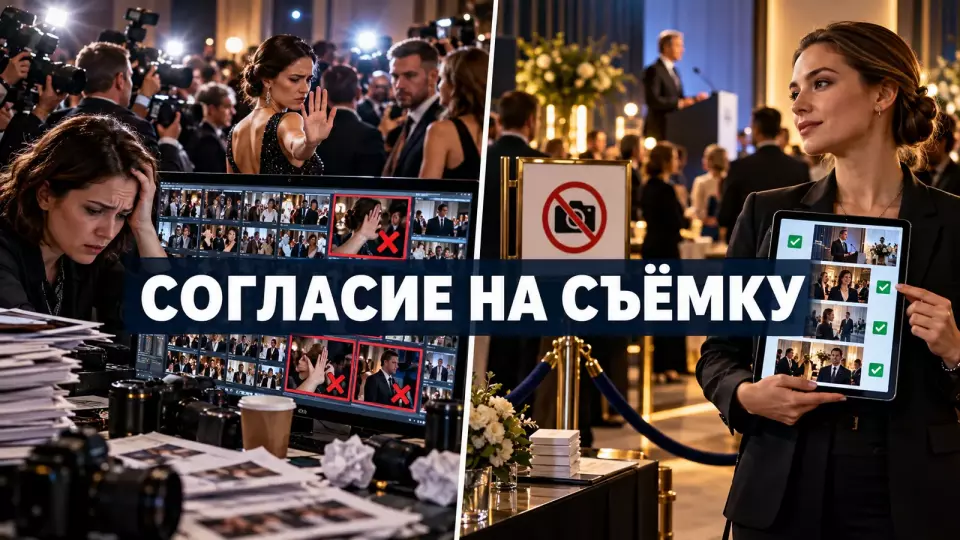
The refusal must travel the entire route from registration to filming, selection and publication. If the note stays only in the form, the photographer and editor will not know about it. We do not ask the person to publicly explain their decision to the manager, host or colleagues: this approach reduces pressure and does not disclose unnecessary information.
In the article about a corporate party without forced participation, we discuss voluntary participation in detail. The same organisational logic applies to filming: the choice must be visible, accessible and not create hidden pressure.
One workable process option:
- Add a separate choice to registration.
- Allow changing the decision before the programme starts.
- Appoint a coordinator who accepts verbal refusals on site.
- Choose a marker for the film crew.
- Create a no-filming zone.
- Give the photographer and editor a short list of restrictions.
- Check the selected files before publication.
- Record a contact for follow-up.
The marker can be on a badge, wristband, coordinator's card or in the guest's itinerary. The law does not establish a universal colour for a wristband or badge. We choose the signal taking into account lighting, venue design and other team designations.
By analogy with the WCAG principle for web content, we do not use colour as the only signal: we add text, shape or an icon. This is a practical solution for accessibility and working in challenging lighting, not a W3C requirement for physical badges.
The marker itself should not reveal the reason for refusal. It is enough for the photographer to understand the action: the person must not be photographed close-up or the material must not be released without additional verification.
It is convenient to build the logic of choice and status changes into event participant registration. Then the note is available to those responsible before the guest enters the hall and is not lost between the form, registration list and film crew brief.
Shoot map and team brief
The photographer's brief needs a list of mandatory shots, a zone map, restrictions on people and objects, file transfer rules and the contact person for disputed cases. This scheme helps choose the angle before the programme starts and does not shift legal decisions onto the crew while they are working.
We map the shooting regime onto the event route. A simple model has three levels:
The table summarises the key points of this section: Regime, What it means, Example. Use it as a quick reference when preparing your event.
| Regime | What it means | Example |
|---|---|---|
| May be filmed | The crew has a verified scenario and a clear channel | Stage; wide shot; decor; approved photo zone |
| By approval only | A check is needed before a close-up or interview | Senior executives; clients; personal comments |
| No filming | The camera stays put away | Rest room; medical area; private consultation |
The map helps choose the angle even before registration opens. It also protects documents, screens, badges and service areas from accidentally ending up in frame.
The crew brief includes:
- goals and future channels;
- mandatory wide and personal shots;
- a sample opt-out marker;
- a zone map;
- a list of closed screens, documents and objects;
- the procedure for a verbal refusal;
- a ban on publishing independently;
- approved devices and the transfer channel;
- the deadline for delivery and deletion of working copies;
- the contact person responsible for approving the release.
The contractor receives only the information needed for shooting. If they process data on the client's instructions, the content of those instructions is checked against Part 3 of Article 6 of Federal Law No. 152-FZ: the purposes, data categories, operations, prohibition on disclosure and file protection requirements are recorded.
For their own portfolio, the contractor may act as an independent operator, so this purpose is assessed separately. Publication by the photographer is not implied by default unless the contract and consent expressly provide otherwise.
How should footage be reviewed before publication?
Before release, the client's designated representative checks recognizable people, captions, badges, screens, documents and the chosen publication channel. A link to the folder with the source files does not yet mean the material is cleared for release. Each final version is checked separately against the agreed purpose, channel and restrictions.
First, the team filters out footage with clear restrictions. Then it checks the remaining files against the table.
The table summarizes the key points of this section: Field, What to record. Use it as a quick reference when preparing an event.
| Field | What to record |
|---|---|
| File | Name or version identifier |
| People | Who is recognizable and whether the person is the main subject |
| Basis | How the permitted scenario was confirmed |
| Channel | Intranet; newsletter; website; social network; media; advertising |
| Restrictions | No name; no job title; internal company use only; until a specified date |
| Decision | Release; return for revision; do not release |
| Release owner | Who confirmed the final version |
We use a single current version. If a frame was cropped, a badge was blurred or a caption was changed, the new version goes through review again. We do not treat a status of "generally fine" as permission to release.
Urgency after an event often breaks the process. Photos are wanted published the same evening, and the report video the next day. It is better to build speed into roles and timing in advance than to cut the review short.
This logic is useful not only for a corporate party. In the article about content after a conference, we look at who is responsible for materials, versions and release to different channels.
Employees, children, clients and senior executives
One form and one route rarely suit every participant. Employees, children, invited clients and contractors differ in context, signatory and permitted channels. The team separates these groups in advance, takes voluntary consent into account and refers disputed grounds and methods of confirmation for legal review.
Employees. An employment relationship does not give an employer a universal right to use an employee's image in PR and advertising. An HR purpose and an open marketing publication are different scenarios. Refusal of optional filming should not be linked to a bonus, access to the party or an assessment of behaviour.
Clients and partners. For invited guests, the operator, purposes, channels and method of refusal are stated in advance. A general phrase in the invitation does little to explain a personal portrait, an interview or advertising use.
Children. For footage featuring a child, the first step is to check whether consent is required under Article 152.1 of the Civil Code of the Russian Federation. If it is, the lawyer determines who gives it, taking into account the child's age and legal capacity, and how the authority of the legal representative is confirmed. We also take the child's opinion into account and do not add unnecessary details about school, place of residence or family to the caption.
Senior executives and well-known guests. A person's status does not automatically remove the right to their image. The existence of a state, public or other public interest is checked separately. A stage performance, a protocol shot, an interview and an advertising cover are assessed as different episodes.
Contractors and performers. Article 152.1 of the Civil Code of the Russian Federation separately names the case of posing for payment. Payment for a performance or participation cannot automatically be equated with paid posing. The terms of use of the image, the processing of personal data and the transfer of files are still checked against the contract and the actual purpose.
When does a photo become biometric data?
An ordinary photograph does not automatically become biometric personal data. The regime under Article 11 of Federal Law No. 152-FZ requires checking whether the operator uses a person's physiological or biological characteristics to establish identity. What matters is the purpose of processing and how the service actually works, not the marketing name of the feature.
Article 11 of Federal Law No. 152-FZ ties biometric personal data to physiological and biological characteristics that make it possible to establish identity and are used by the operator for that purpose. What matters is not only the file itself, but also the way it is processed.
Scenarios that require a separate review of biometrics and profiling:
- finding a person across all footage using a selfie;
- an automatic personal gallery based on face matching;
- face-based entry to a venue;
- automatic tagging of guests if the service establishes identity;
- emotion analysis linked to a participant's profile: this is not automatically biometric data under Article 11, but it is a separate processing and profiling risk;
- uploading source files to a service that creates facial templates: the purpose and use of the template require a technical review.
A standard photographer's brief is not enough here. A separate review by a lawyer and an information security specialist is needed. The team examines the service architecture, the contract, storage, data transfer and an alternative way to participate without facial recognition.
You cannot rely on the marketing name of a feature alone. A service may say "smart search" but in fact perform face matching. Ask the vendor for a technical description and the processing terms.
Revocation, deletion and storage of materials
Source files, working versions and finished materials are each assigned their own retention periods, access rights and responsible persons. Upon a revocation or request, the responsible person pauses the disputed publication while the applicable regime is reviewed. The lawyer then determines what must be stopped or deleted and whether there is another lawful basis for continuing the processing.
There is no universal retention period for event photographs. It is tied to the purpose. Source files, selected shots for the report, the closed gallery and the historical archive each serve different purposes.
A working table might look like this:
The table summarises the key points of this section: Material, Purpose, Access. Use it as a quick reference when preparing an event.
| Material | Purpose | Access | Condition for review or deletion |
|---|---|---|---|
| Source files | Selection and editing | Project team | After production is completed and accepted |
| Working versions | Approval | Limited group | After the final version is approved |
| Closed gallery | Participant access | Authorised users | At the end of the stated access period |
| Public material | Communication or advertising | Unlimited audience | At the end of the campaign; upon revocation or request - after review of the applicable regime |
| Historical archive | Company history | Restricted access | Periodic review of purpose and composition |
The phrase "stored indefinitely" is best not used as a standard. The principle of Federal Law No. 152-FZ requires that data that can identify a person not be stored longer than the stated purpose, unless another period is established by law or contract.
A single procedure is established for requests. The responsible person locates the material, checks the channel and the basis, pauses any further transfer, notifies the processors and records the decision on copies. If an image has been disseminated online in violation of Article 152.1(1) of the Civil Code of the Russian Federation, the person may demand its deletion and a ban on further dissemination.
It is impossible to promise the deletion of all third-party screenshots, reposts and caches. The company is responsible for its own channels and processors within the limits of applicable obligations. This limitation does not preclude claims against platform owners or other lawful means of protection.
Organiser's checklist
Work through this list before approving registration and repeat the check before handing files over to the editorial team. The checklist helps connect the goals of the shoot, guests' decisions, contractors' work and the release of materials. Pass disputed grounds, consent forms and the requirements for the customer's personal data operator to the responsible lawyer.
Before the event
- Write down why the shoot is needed.
- List the formats: wide shot; portrait; interview; video; advertising.
- Name all publication channels.
- Separate registration, mailing and use of the image.
- Send the consent form for legal review.
- Define how to refuse and change a decision.
- Create a map of "allowed / by arrangement / no filming".
- Appoint the person responsible for approving the release.
- Set the rules for contractors' work and portfolios.
- Set access and retention periods for each group of files.
On site
- Display a clear notice about filming and the contact of the responsible person.
- Give guests the opportunity to change their choice.
- Use a marker with text or a pictogram; keep colour as an additional signal.
- Brief the photographer and coordinators.
- Exclude filming of private areas and closed screens.
- Confirm the specific scenario before interviews.
- Record verbal refusals with the coordinator.
After the event
- Remove restricted footage before handing over to the editorial team.
- Check people, captions, badges, documents and screens.
- Match the material to the permitted channel.
- Approve one final version.
- Agree the contractor's right to a portfolio separately.
- Separate public files, private recordings and source files.
- Record the decision and the review deadline.
- Handle requests through a single responsible person.
Frequently asked questions
The main basis is Article 152.1 of the Civil Code of the Russian Federation. As a general rule, the publication and further use of a person's image are permitted with their consent. The same article sets out exceptions, but each depends on the circumstances.
A camera in the room, a working archive and a public post create different tasks for the organiser. A notice about filming does not automatically cover editing, transfer to contractors, advertising and reuse of a shot. Each stage needs a clear purpose, restricted access, a retention period for the files and a person responsible for decisions.
A large number of guests does not in itself make a closed corporate party a public event. If entry is by list or invitation, the team separately verifies the grounds for using recognisable footage. What matters is the accessibility of the event, the person's role in the composition, the context of the filming and the specific way the material will be used going forward.
First define the purposes, types of material and channels, then design the form. Event registration, organisational mailings and public use of an image must be clear to the person as separate decisions. The law does not prescribe a single interface, so the team chooses a suitable approach together with a lawyer and checks that optional consent has not become a condition of access.
A refusal must travel the whole route from registration to filming, selection and publication. If the note stays only in the questionnaire, the photographer and editor will not know about it. We do not ask the person to explain their decision publicly to a manager, host or colleagues: this approach reduces pressure and does not disclose unnecessary information.
The photographer's brief needs a list of mandatory shots, a map of zones, restrictions on people and objects, rules for transferring files and the contact of the person responsible for disputed cases. This approach helps choose the angle before the programme starts and does not shift legal decisions onto the film crew while they are working.
If you need to link filming, registration, the guest journey and the release of materials into a single plan, request a quote. We will put together the operational plan for the event and pass the legal wording to the client's responsible specialists for review.
Sources
- GARANT: Article 152.1 of the Civil Code of the Russian Federation, “Protection of a Citizen’s Image”.
- GARANT: Federal Law No. 152-FZ of 27.07.2006 “On Personal Data”, current text.
- GARANT: Resolution of the Plenum of the Supreme Court of the Russian Federation No. 25 of 23.06.2015.
- W3C WCAG 2.1: color must not be the only means of conveying information.
Contents
Was this article helpful?