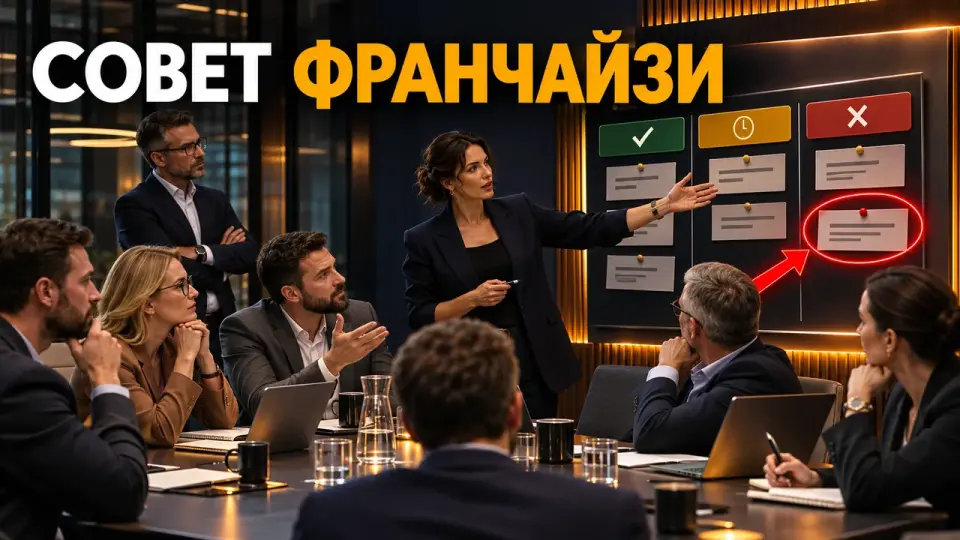
A practical framework for a working session of the franchisee council: mandate, agenda, roles, minutes, network feedback and inputs for the budget.
A franchisee council is useful when network representatives discuss issues before changes are launched and understand what will happen to their recommendations. If the decision has already been made, the status of the topic is hidden, and no one comes back after the meeting with an answer, participants quickly start to see the council as a formality.
At Aventura, we design such a meeting as a working feedback cycle. Before the session, the team collects signals from operating locations and consolidates them into anonymised cards. At the meeting, participants separate facts from individual cases and formulate a recommendation or next step. After the session, the network receives an approved version of the outcomes without the confidential data of individual partners.
How does a franchisee council differ from a network convention?
A franchisee council is a small group of representatives from an existing network. The working session focuses on systemic issues, the consequences of changes and recommendations for the management company. A convention brings together a broad audience and addresses different tasks: informing the entire network, exchanging practices, training and a general programme. The client defines the council's powers in a separate provision or working regulation.
At a council session, a participant brings more than their own situation. They gather their colleagues' positions in advance, understand the limits of their representation and, after the meeting, report back a confirmed status. That is why the meeting is smaller and the requirements for preparing each issue are higher.
It is convenient to distinguish the neighbouring formats in advance:
The table summarises the key points of this section: Format, Who participates, Central task. Use it as a quick reference when preparing your event.
| Format | Who participates | Central task | What remains after the meeting |
|---|---|---|---|
| Franchisee council | representatives of existing partners and the management company | discuss systemic topics and give recommendations | issue statuses, next steps and owners |
| Annual franchisee meeting | a broad audience from the existing network | communicate changes, exchange practices, run a general programme | materials, contacts, working group topics and a general cascade |
| Onboarding day for new franchisees | owners and teams of new locations | prepare a specific location for its first launch | a readiness map and pre-opening actions |
| Strategy session | management and owners of selected business lines | choose priorities and the company's way forward | decisions on business lines and a work plan |
A council should not be described as a governing body unless the network's documents give it such powers. The safe working formula is simple: representatives form a position, the management company reviews it and confirms the next steps.
Mandate and composition of the representative body
A short set of rules for the working session is needed before the programme. It explains the council's purpose, the topics that are allowed, and the principle for selecting representatives. It also sets the term of participation, the replacement procedure and access to materials. It separately specifies where the council makes a recommendation, where it helps choose an option, and where it discusses the consequences of a change that has already been made.
We start with a map of powers. For each type of topic, the client marks the permissible outcome: recommendation, prioritisation, data request, pilot proposal, referral to the relevant owner, or information. Such a map protects the meeting from promises that participants cannot keep.
Composition is checked against the working context, not against how loud a voice is. It is useful for representatives to cover different types of locations, stages of development and working conditions. At the same time, a person must be able to gather colleagues' positions, separate a shared issue from a personal dispute, and report the outcome back to their group.
The rules should set out:
- the purpose of the council and the list of permitted topics;
- the principle of representation and the rotation procedure;
- the roles of the management company and the franchisee;
- how questions are submitted, selected and prepared;
- the rules for the participation of subject-matter specialists;
- the limits on recording, quoting and distributing materials;
- the minutes format and the feedback channel between sessions;
- the procedure for reviewing previous commitments.
If the network already has a customer advisory council, some of the process logic may be familiar: a standing membership, rules of procedure, prepared topics and subsequent status reporting. The subject of discussion here is different. A franchisee works within the network's model, so the issues concern standards, operations and interaction between the parties.
How to collect network questions before the session?
Questions should be collected using a single form and checked for systemic relevance before being added to the agenda. The representative describes the observed context, the roles affected and the desired outcome. The team consolidates recurring signals, removes personal data and refers individual financial or contractual situations to a separate consultation.
The open field "what concerns you" usually yields a mix of complaints, ideas and support requests. A working session needs a card that helps compare topics and prepare an answer owner.
The table summarises the key points of this section: Card field, What to record. Use it as a quick reference when preparing the event.
| Card field | What to record |
|---|---|
| Signal source | aggregated channel: representative, survey, support or regional group |
| Systemic question | one wording without naming a specific location |
| Observed context | where the situation arises and which roles it affects |
| Confirmed data | available facts, documents and constraints |
| Status before the session | decision made, options available, pilot needed, data needed or separate review of an individual issue |
| Expected outcome | recommendation, clarification, data collection plan or handover to the owner |
| Owner from the centre | the person who will confirm the status and follow-up |
| Access mode | general, council only, limited group or individual consultation |
We use three filters. First, we check whether the topic affects several locations or a shared process. Then we look for an owner who can confirm the facts and the next step.
After that, we assess how ready the materials are. If there is little data, the agenda item ends with a plan to collect it rather than a vote on assumptions.
The working collection procedure is as follows:
- The management company announces the topic categories and the boundaries of discussion.
- Representatives collect franchisees' positions using a single form.
- The council secretary consolidates duplicates and anonymises the material.
- Function owners verify the facts, constraints and status of the topic.
- The chair and facilitator assemble the draft agenda.
- Participants receive the materials, questions and access rules in advance.
This preparation reduces the time spent reconstructing context and leaves the meeting for choosing a position and the next action.
Agenda: informing, consulting and deciding
Each agenda item should show in advance why it is being discussed and what outcome is acceptable. Honest labelling is especially important for changes that have already been approved: the council can review the consequences and the implementation approach, but it should not present them as a joint choice. On open topics, participants compare options, risks and pilot conditions.
The table summarises the key points of this section: Item status, What the council does, Work output. Use it as a quick reference when preparing your event.
| Item status | What the council does | Work output | Who prepares the materials |
|---|---|---|---|
| Decision made | reviews the consequences for different types of locations | implementation risks, communication and support issues | change owner |
| Options available | compares impact and selection criteria | recommendation with rationale and unresolved disagreements | relevant manager and analyst |
| Pilot needed | defines the testing conditions | proposal covering composition, criteria and checkpoint | initiative owner |
| Data needed | clarifies what information is missing | data collection plan and responsible person | analyst or process owner |
| Specific issue | takes the topic out of the general discussion | arrangements for a separate consultation | relevant specialist |
| Outside the mandate | identifies the correct channel | addressee and handover procedure | council secretary |
The agenda for a single topic can follow the same logic:
- Name the decision or issue to be considered.
- Present the confirmed data and constraints.
- Gather experience from representatives of different contexts.
- Highlight risks, options and selection criteria.
- Formulate the area of agreement and open disagreements.
- Record the recommendation, data request or next step.
- Confirm the owner and how the network status will be reported back.
At Aventura, we define the specific outcome of each block in advance. Organising a business event is well suited to this task: content, facilitation, venue, equipment and recording of outcomes are brought together in a single production plan.
We publish useful programme, facilitation and business event frameworks in the Aventura Telegram channel. You can save the channel for preparing the network's next meetings.
How to run a closed working session
The session is run using prepared cards, with clear timing and agreed ground rules for the discussion. The facilitator gives every participant an equal opportunity to speak, separates facts from assumptions and steers the group back to the intended outcome. Sensitive topics are discussed with a limited group, and the approved wording of the conclusions is confirmed before the meeting ends.
It is useful to review the previous log at the start. Participants see what has been done, what has changed and where a blocker has arisen. This step builds trust better than a long speech about the value of dialogue.
The main work is built around one card at a time. First, the topic owner briefly confirms the context. Then representatives add the experience of their groups. After that, the facilitator collects the differences, checks the grounds and helps formulate the outcome.
For a contentious topic, you can use the following process:
- Record the facts that participants recognise as shared.
- Separate the consequences for different types of points.
- Name the interests of the parties without personal accusations.
- Check the options against pre-agreed criteria.
- Write down the recommendation and the arguments for it.
- Separately record unresolved disagreements and missing data.
- Confirm who will return the status and when.
We do not recommend treating quick consensus as the only goal. Sometimes a quality outcome is a precise description of the disagreement and a plan for checking it. That is better than a vague formulation that the parties understand differently after the meeting.
The access mode also requires specifics. Participants know in advance which information can be returned to the network, what stays within the council and what is available only to a limited group. A raw transcript and a photo of the board do not replace an agreed summary.
Roles of the facilitator, experts and decision secretary
Roles need to be separated before the meeting so that facilitation is not mixed with defending the management company's position. The facilitator is responsible for the flow of discussion, while the topic owner confirms the facts and their authority. Franchisee representatives bring the network's positions and explain the working conditions of their groups. This way every participant has a clear task and a clear boundary of responsibility.
The secretary records the final wording. A subject-matter specialist is brought in only for matters within their expertise.
The table summarises the key points of this section: Role, Task at the session, What the role does not do. Use it as a quick reference when preparing the event.
| Role | Task at the session | What the role does not do |
|---|---|---|
| Internal client | confirms the goal, authority and decision-making procedure | does not change the rules mid-discussion without explanation |
| Council chair | keeps the process aligned with the rules and membership | does not speak for all franchisees without a collected position |
| Franchisee representative | brings the experience of their group and reports back the outcome | does not disclose private data of other locations |
| Topic owner | provides context, constraints and the status of follow-up | does not promise action beyond their authority |
| Facilitator | manages the process, participation and focus | does not push their own preferred solution |
| Decision secretary | confirms the wording and keeps the log | does not turn the minutes into a verbatim transcript |
| Subject-matter specialist | checks the legal, financial or technical question | does not stay for the whole meeting if access should be restricted |
| Event team | is responsible for the programme, venue, connectivity and materials | does not make the network's business decisions |
At Aventura we run a role alignment session in advance. Participants know who opens the topic, who answers questions, who receives feedback and who has the right to confirm the next step. If an expert joins remotely, the team checks their window, access to materials and a backup channel.
With several themed tables, the forums and seminars format is useful. Each group needs identical outcome templates, a moderator, a note-taker and a clear procedure for bringing results back to the main room.
Decisions, owners and deadlines in a single log
The log preserves the link between the question, the confirmed wording and the follow-up after the meeting. It records board recommendations, management company decisions, data requests and open topics. Each entry gets an owner, a condition for the next review, an access level and an audience for the message. A full transcript of every remark is not needed for this.
The table summarises the key points of this section: Log field, What to record. Use it as a quick reference when preparing your event.
| Log field | What to record |
|---|---|
| Question | a short, systematic wording |
| Outcome type | recommendation, decision, pilot, data request or handover |
| Basis | confirmed facts and substantive arguments |
| Wording | text that all participants understand the same way |
| Owner | the function or person responsible for the follow-up |
| Checkpoint | a date or an observable condition for the next status |
| Dependency | the material, decision or participant without which the work cannot continue |
| Access level | full version, board, working group or the whole network |
| Status | open, in progress, blocked, done, changed or closed with an explanation |
Minutes are best structured around the problem, the discussion and the conclusion. The phrase "discussed marketing" does not help anyone continue the work. An entry should show the subject of the question, the outcome available and the next checkpoint.
We separate a board recommendation from a management company decision. If management takes time to assess it, the log shows that status explicitly. If a proposal is rejected or changed, the network receives a confirmed explanation to the extent permitted.
The next session starts from the same log. The team does not rebuild the history from scratch and does not lose unfinished topics in email threads. Participants can see what happened to previous items and can check the quality of the feedback.
How can feedback be returned to the entire network?
After the session, the network should receive an agreed summary: which topics were reviewed, what the council recommended, which decisions were confirmed, and when the next status update will appear. Confidential data about specific franchisees is not included in this version. Representatives use a single text and a single channel so that different groups do not receive conflicting interpretations.
It is useful to prepare two levels of the document:
- The full working version contains the rationale, limitations, confidential details and is available only to designated participants.
- The summary for the network shows the topic, the confirmed status, the next step, the owner and the update method without third-party data.
Before distribution, the secretary checks the wording with the topic owners. Council representatives receive material that can be retold without guesswork. If a decision has not yet been made, the summary says so: the matter is under review, the missing data is named and the next checkpoint is set.
The channel depends on the structure of the network. It could be a portal, an email, a closed meeting, a regional call or a combination of several formats. There is one criterion: the recipient understands what has happened with the issue and where the update will appear.
Common mistakes after a session:
- sending out the full transcript instead of the agreed outcome;
- presenting a council recommendation as a mandatory decision;
- hiding an open status behind a general formulation;
- giving different groups different versions;
- forgetting to report a change of owner or deadline;
- starting the next meeting without reviewing previous items.
The council retains its working purpose when feedback flows in both directions. Representatives bring signals from the locations, and the management company returns a verified status and explains what happens next.
How do you choose a venue and access mode?
The venue is chosen based on the discussion scenario and access modes. You need a room for the full group, the ability to restrict a sensitive block, legible materials and conditions for a calm conversation. If some representatives join remotely, they must be able to hear the discussion, see working documents, request the floor and take part in drafting the conclusions on an equal footing.
For an initial estimate we clarify:
- the participant list and roles in each block;
- the number of topics, working groups and closed sessions;
- seating and the need for separate rooms;
- how materials are shown and edited collaboratively;
- requirements for recording, storage and remote access;
- microphones, screens, internet and backup communications;
- the procedure for admitting subject-matter experts;
- catering, breaks, signage and the work of coordinators;
- how outcomes are recorded and confirmed.
For a hybrid working session we assign a separate moderator for remote participants. They monitor the speaking queue, the chat, access to files and technical failures. A wide-angle camera does not solve this task: a remote participant may see the room but not understand which document is being discussed or when their position will make it into the minutes.
Before the session the team runs a technical rehearsal. We check participant entry, access rights and the presentation of materials. We separately test microphones, moving into the closed room and the backup channel.
If the session is recorded, participants and speakers are notified in advance of the purpose of the recording. The client confirms the necessary consent or other applicable legal basis, determines who has access, the storage period and how the material will be distributed. Before materials are handed over, a check is made as to whether faces, names, remarks and closed data can be left in. The detailed production logic is set out in the material on the technical rehearsal of an event.
Brief and budget for a working session
The preliminary budget depends on the programme, the composition and the access arrangements. A simple session takes place in a single meeting room. A more complex scenario requires parallel groups, a secure connection and a separate room for a closed topic. That is why the estimate starts with the goal, the board's authority and a map of the issues, and is then translated into rooms, equipment, people and materials.
The brief includes:
- The goal of the session and the outcome the management company needs.
- The board's current regulations or its working draft.
- The composition of the representatives and the principle of representation.
- A draft agenda with the status of each topic.
- The owners of the issues and the limits of their authority.
- The format of participation: in person, remote or hybrid.
- Access, recording and distribution arrangements for materials.
- Requirements for facilitation, minutes and a summary for the network.
- The venue, rooms, equipment, catering and logistics.
- The proposed date and preparation constraints.
The budget is best divided into several parts. We cost the development of the programme and materials, the venue with technical production, the work of the facilitators and coordination separately. Another block covers minute-taking, catering and logistics.
If the budget is cut, we keep what affects the working outcome: the right owners, audibility, access to materials and the privacy of sensitive blocks. Recording statuses also remains mandatory.
We also define the boundary of responsibility in advance. We can put together the programme and the organisation of the meeting, facilitation, rooms, the hybrid connection and the procedure for preparing the final documents. The content of the standards, commercial decisions and the board's authority are confirmed by the client.
Frequently asked questions
The franchisee council is a small group of representatives from the existing network. The working session focuses on systemic issues, the consequences of changes and recommendations for the management company. A convention brings together a broad audience and serves different purposes: informing the entire network, sharing practices, training and a general programme. The council's mandate is defined by the client in a separate regulation or working procedure.
Before the programme, a short working session regulation is needed. It explains the purpose of the council, the topics that are allowed and the principle for selecting representatives. It also sets the term of participation, the replacement procedure and access to materials. It separately states where the council gives a recommendation, where it helps choose an option and where it discusses the consequences of a change that has already been made.
Questions should be collected using a single form and checked for systemic relevance before being added to the agenda. A representative describes the observed context, the roles affected and the desired outcome. The team consolidates recurring signals, removes personal data and refers individual financial or contractual situations to a separate consultation.
Each agenda item should show in advance why it is being discussed and what outcome is acceptable. Honest labelling is especially important for changes that have already been made: the council can discuss the consequences and the implementation approach, but it should not pretend that a joint choice is being made. On open topics, participants compare options, risks and pilot conditions.
The session is run using prepared cards, with clear timing and agreed rules of conversation. The facilitator gives participants an equal opportunity to speak, separates facts from assumptions and brings the group back to the expected outcome. Sensitive topics are discussed with a limited group, and the approved wording of the conclusions is confirmed before the meeting ends.
Roles should be separated before the meeting so that facilitation is not mixed with defending the management company's position. The facilitator is responsible for the course of the discussion, while the topic owner confirms the facts and their authority. Franchisee representatives bring the network's positions and explain the working conditions of their groups. This way, each participant has a clear task and boundary of responsibility.
Sources
- International Franchise Association: Leveraging Franchisee Associations and Advisory Councils to Strengthen Relationships
- International Franchise Association: Responsible Franchising
- International Association of Facilitators: IAF Core Competencies
- International Association of Facilitators: Statement of Values and Code of Ethics
- Australian Competition and Consumer Commission: Acting in good faith under the franchising code
- GOV.UK: Guide to taking minutes
Contents
Was this article helpful?