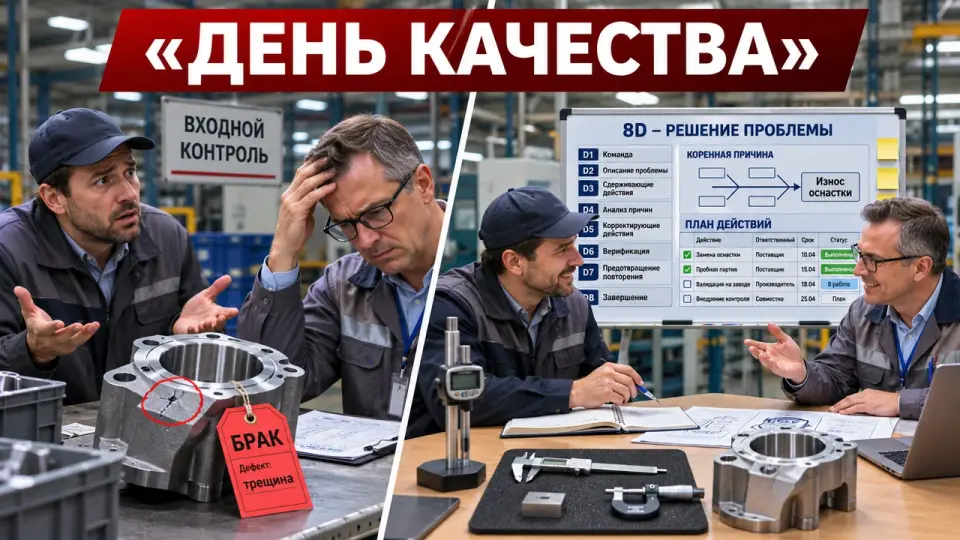
The Supplier Quality Day programme: case preparation, 8D clinics, metrology, evidence and a single register of post-meeting actions.
A defect can rarely be analysed from the stage. One party needs the batch number, another the measurement method, and a third the status of the temporary measure. If these questions are gathered into a single flow of presentations, participants will hear a lot of data but will not get an agreed next action.
At Aventura, we design the Supplier Quality Day as a working meeting between the manufacturer and its current partners. The content rests on pre-selected problems, evidence and the participants' authority. We are responsible for the programme, routes, rooms, moderation, equipment and documentation. The technical conclusions remain with the manufacturer's and supplier's specialists.
Leave a request and we will discuss your task
We will clarify the event format and suggest the next step.
What is Supplier Quality Day?
Supplier Quality Day is a working meeting between a manufacturer and its current external suppliers. Teams address pre-selected issues, verify facts, identify missing evidence, and assign next steps. The main outcome is expressed in documents and decisions, while the exchange of presentations supports this work but does not replace it.
The format is needed when a single issue spans multiple functions and organizations. The discussion may involve the supplier quality service, production, engineering team, metrology, laboratory, procurement, and supplier specialists. The composition depends on the case and the authority of the people involved.
The ISO Auditing Practices Group writes about the management of products, services, and processes that an organization obtains from external providers. The document does not prescribe an event scenario. It confirms the management framework itself: requirements, the external party's process, and the method of verification must be linked.
An internal Quality Day at the enterprise works primarily with employees and production culture. A Supplier Day may include market familiarization, a category agenda, and general presentations. Here, the core is the existing relationships and specific quality gaps.
Scope of the format: audit, Supplier Day, and award
The working day does not replace an audit, acceptance, official investigation, or contractual procedure. It also does not select new counterparties or rank partners for awards. The task of the format is narrower: to bring the necessary roles together around prepared cases, separate facts from hypotheses, and hand over follow-up to the process owners.
The table summarizes the key points of the section: Format, Main task, What remains after the meeting. Use it as a quick reference when preparing the event.
| Format | Main task | What remains after the meeting |
|---|---|---|
| Supplier Quality Day | joint work on defects, measurements, and improvements | case status, evidence, actions, and checkpoint |
| General Supplier Day | communication with the market and partners | general agenda, contacts, and thematic meetings |
| Internal Quality Day | work with enterprise employees | knowledge, observations, and internal initiatives |
| Audit | formal assessment against established criteria | audit conclusions and documents |
| Supplier Award | recognition of partners' results | nominations, jury decisions, and ceremony |
If an audit is scheduled nearby, we separate the goals, participants, and protocols. Participants must understand where a formal assessment takes place and where the team collects data and plans joint work. This separation reduces the risk of promises that the moderator or organizer is not authorized to make.
The general hall also has its boundaries. The stage can present a common language for the problem, working rules, and safe outcomes. Sensitive details of a batch, process, measurement, or sub-supplier remain in the closed working room.
What outcome should be set before choosing a venue?
The outcome of a Supplier Quality Day is framed through working artifacts. Each case needs a clear problem status, a list of available evidence, an interim measure, testable hypotheses, an owner for the next action, and a checkpoint. You cannot promise an automatic reduction in defects after a single event. Verification of effectiveness continues in the working process.
We start with the question: what should change in the documents and actions of the participants by the end of the day? The answer "improve quality" is too broad. It cannot be verified at the venue. A working goal sounds more specific: agree on the boundaries of the defect, determine how to verify the cause, or assemble a plan for the missing measurements.
Official 8D guidelines link problem closure to consistent work. The team describes the problem, introduces interim containment, confirms the causes, selects a permanent action, and verifies effectiveness. Part of this work can be ready before the meeting. The rest will continue after it.
For organizing a business event, we translate the substantive goal into the program, rooms, routes, and recording tools. The manufacturer retains the right to confirm the technical conclusion and make a decision on the supplier's process.
Leave a request - let's discuss your task
We'll clarify the event format and suggest the next step.
Roles of the manufacturer, supplier and organiser
The manufacturer owns the requirements, the disclosure boundaries and the final decision. The supplier is responsible for the data on its own process, for explaining the evidence and for carrying out the agreed actions. At Aventura, we design the event and make sure it runs. The moderator leads the discussion, but the technical verdict is confirmed by the designated specialists from both sides.
It is best to lock down the roles before the programme is put together. Otherwise a case may end up with someone who lacks the necessary authority, and the working group will end the conversation with “we'll clarify after the meeting”. Sometimes that outcome is honest. But it must name an owner, a data request and the next point of contact.
The table summarises the key points of this section: Role, What they are responsible for, What they must not do. Use it as a quick reference when preparing the event.
| Role | What they are responsible for | What they must not do |
|---|---|---|
| Manufacturer's executive | sets priorities and the boundaries of the day | personally work through every technical case |
| Supplier quality function | selects cases and confirms the working framework | replace the owners of production and metrology |
| Production, engineering function, laboratory | explain the process and verify technical conclusions | make decisions beyond their authority |
| Procurement | holds the contractual and partnership context | conduct a technical dispute in place of the relevant specialists |
| Supplier | brings the data, explains the process and commits to actions | hide uncertainty behind a general presentation |
| Moderator | separates fact from version, keeps the order of questions | choose the cause by voting |
| Aventura team | assembles the programme, streams, equipment and minutes | confirm the cause of a defect or the quality of a measurement |
We appoint an owner for each block and one person responsible for the current programme of the day. If a case, the composition of the group or access to materials changes, that person updates the route and communicates the changes to registration, the coordinators and the moderators.
What cases and evidence should be collected in advance?
The programme includes a case with a neutral description of the defect, the affected population, the status of the temporary measure, available measurements, an open question and the permitted level of disclosure. The technical committee reviews the package before the event. Unprepared material is returned for revision or the session's task is limited to collecting missing data and assigning responsible persons.
The case passport helps all parties discuss the same problem. It does not require disclosing anything unnecessary. The manufacturer determines in advance which fields can be shown to the general audience, which are available only to the working group and which materials must not be brought to the venue.
The passport can include:
- A neutral name for the problem.
- The product or process within the permitted scope.
- The observed defect and the boundaries of the affected population.
- The status of temporary containment.
- Available measurements, records and samples.
- An open technical question.
- The required roles on the manufacturer's and supplier's side.
- The level of data access.
- The expected outcome of the working session.
We also recommend preparing an evidence card separately. It states which claim is being verified, what confirms it, under what conditions the result was obtained, where the record is stored and who can explain the data. If the evidence has a limitation or uncertainty, this is also recorded.
It is better to accept materials through a single channel and in an agreed format. A case that appears on a flash drive just before the speaker's presentation cannot be properly checked for disclosure, readability and readiness for discussion. For technical substance, the logic of the enterprise technologists' forum is useful: a common case template, clear roles and a pre-agreed session outcome.
Supplier Quality Day Agenda
The agenda moves from shared language and ground rules to closed technical sessions, and then to a safe, shared sync. There is no universal timing. The number of blocks depends on how ready the cases are, the mix of specialists, parallel tracks and venue constraints. Each block ends with a record that can be handed over to the process owner.
The table summarises the key points of this section: Block, What happens, Work output. Use it as a quick reference when preparing the event.
| Block | What happens | Work output |
|---|---|---|
| Entry and registration | verification of role, route and access rights | up-to-date participant route |
| Joint kick-off | goals, boundaries, disclosure rules and shared language | clear working framework |
| Brief case introduction | groups receive validated briefs | agreed subject of the session |
| 8D clinics | review of the problem, temporary measures, causes and actions | 8D status and next step |
| Metrology stations | cross-check of method, equipment, conditions and records | comparison plan or specialist conclusion |
| Improvement plan session | actions are tied to specific gaps | owner, criterion and checkpoint |
| Joint sync | a safe level of results is shared with the room | single continuation register |
For parallel tracks we build a participant matrix. One specialist cannot simultaneously explain a measurement in one room and make a decision on an action in another. The matrix surfaces such conflicts before the schedule is issued.
When designing a conference agenda and working sessions, we count more than topics. We need room capacity, transitions, access to files, time for documentation, a buffer for a late case and a channel for quick changes.
How to run an 8D clinic without looking for someone to blame?
The 8D clinic moderator separates observed facts from hypotheses about causes and asks for a way to verify them. The group does not have to complete the entire 8D during the event. Acceptable outcomes of the session are a confirmed cause, a plan to test a hypothesis, a list of missing data, or an agreed action with an owner and a checkpoint.
8D is a structured problem-solving path. ASQ and MAHLE training materials distinguish between problem description, temporary containment, cause analysis and confirmation, permanent action, effectiveness verification, and prevention of recurrence. Therefore, the label “8D” on a slide does not yet mean that the team has followed this path.
A working session can be run in the following order:
- Record the observed defect without a blaming formulation.
- Clarify the affected batch, period, product, or process.
- Check the status of temporary protection for the current flow.
- Separate confirmed facts from hypotheses about causes.
- For each hypothesis, specify the required observation, measurement, or test.
- Link the action to a confirmed cause or note that the cause is still being verified.
- Record the owner, missing data, and checkpoint.
EOS requires relying on facts, measurements, records, and test results. For the moderator, this means a simple set of questions: “What did we observe?”, “Which record confirms this?”, “What would disprove the hypothesis?”, “Who will bring the data?”. The speaker's persuasiveness is not evidence.
A public search for someone to blame almost always leads the group away from the data. We set the rules in advance: we discuss the process and evidence, we do not remove closed materials, and we do not transfer technical details into the general summary without the permission of the information owner.
Metrological station and trust in measurements
A metrological station is needed when the parties obtain different results or interpret their applicability differently. Specialists verify the method, equipment, condition of measuring instruments, conditions, sample, records and the traceability chain. A certificate or report number by itself does not explain a specific result and the conditions under which it was obtained.
NIST defines metrological traceability through a documented, unbroken chain of calibrations and the associated uncertainties. NIST separately warns that a report number alone is not sufficient to claim traceability. In Russian practice, the legal framework for the uniformity of measurements is set by Federal Law No. 102-FZ. The applicability of specific requirements is confirmed by the customer's metrology and legal departments.
The station's checklist can be built around the following questions:
- What exactly was measured, and which result became the subject of the dispute?
- By what method and under what conditions was the result obtained?
- What equipment was used, and how is its condition confirmed?
- Can the record be linked to a specific sample, batch or period?
- What uncertainty or limitation affects the conclusion?
- Is a comparative measurement, re-test or additional record needed?
Bosch includes measurement system analysis in its supplier quality requirements. Texas Instruments describes measurement system management through qualification, verification and calibration procedures. These documents reflect the requirements of specific manufacturers, so they cannot be declared a single standard for all companies.
The event team provides the room, screen, secure access to files, equipment connection and minutes. The conclusion on the suitability of the method or measurement is made by the customer's and supplier's specialists.
How do you separate temporary containment from permanent action?
Sorting, quarantine and enhanced control protect the current flow while the investigation continues. These measures do not prove that the cause has been eliminated. In the case card and the final register, temporary containment must be recorded separately from permanent action, and verification of completion separately from proof of the effectiveness of the chosen solution.
The table summarises the key points of this section: Work layer, What question it answers, Example wording in the minutes. Use it as a quick reference when preparing your event.
| Work layer | What question it answers | Example wording in the minutes |
|---|---|---|
| Temporary containment | how the current flow is protected | an additional check was introduced before the cause is resolved |
| Cause verification | how we will confirm or refute the hypothesis | carry out a comparative measurement using the agreed method |
| Permanent action | what changes in the process once the cause is confirmed | the action is determined by the authorised technical team |
| Effectiveness check | how we will know that the action works | the criterion and verification period are set by the process owner |
Bosch describes additional checks and controlled shipping as separate control measures. ASQ and MAHLE also distinguish between containment and permanent action. In the event programme, this distinction protects against a premature declaration that "the problem is closed".
The facilitator asks the group to state the status of each layer. If the cause has not yet been confirmed, that is a normal working record. It is far worse to hide the uncertainty behind a general promise to "strengthen control".
Confidentiality, access and disclosure levels
Real technical data is shown only to the participants who need it to solve the problem. The main hall receives an anonymised summary, the closed group receives an approved evidence package, and restricted materials remain in the client's secure system. Access rules are agreed before files are uploaded, rooms are assigned and invitations are issued.
The table summarises the key points of this section: Level, What can be shown, Where to discuss. Use it as a quick reference when preparing your event.
| Level | What can be shown | Where to discuss |
|---|---|---|
| General | the class of problem, the working rule, the safe outcome | plenary session |
| Restricted | data needed by the assigned group | closed working room |
| Anonymised | a process diagram without sensitive identifiers | training or general review |
| Closed | material that cannot be brought into the event | only in the client's system and under the client's procedure |
Each room needs a list of roles and a recording rule. A photo of the whiteboard, a screen recording or a shared cloud folder can reveal more than intended. We agree in advance on permission to film, the method of transferring files, the access period and the person who resolves access disputes.
The general sync does not repeat the entire technical review. The group reports the class of problem, the agreed action, the owner and the next checkpoint. The details remain in the closed minutes.
What should remain after working sessions?
After each session, the single register records the problem, the boundaries of the affected scope, the status of the cause, the temporary measure, the permanent action or the plan for selecting it, the owner, the effectiveness criterion and the next checkpoint. The register preserves the continuation of work and separates a decision made from a promise to clarify later.
The table summarises the key points of this section: Register field, What to record. Use it as a quick reference when preparing your event.
| Register field | What to record |
|---|---|
| Problem | a neutral wording and a case ID |
| Cause | confirmed, under review, or insufficient data |
| Temporary measure | what protects the current delivery |
| Permanent action | an agreed action or the procedure for selecting it |
| Owner | a person or function with the authority to continue the work |
| Effectiveness criterion | what evidence will be used to verify the result |
| Checkpoint | the next event, condition or agreed date |
| Evidence | a link to an approved record, test or document |
Volvo links improvement plans to the gaps identified. EOS requires clear owners and target dates for open actions. In this article we use these principles as the basis for an editorial template, while the client adapts the fields and statuses to their own system.
After the event, the content owner verifies the decisions through their own channels. The event report answers a different set of questions: how the flows, rooms, equipment, moderation and recording worked. The two reports can be linked by session ID, but they should not be mixed.
Routes, technology and hybrid participation
The venue must separate shared context from closed technical sessions. The team checks files, screens, sound, connectivity, interpretation, access rights, room transitions and remote expert participation in advance. The rehearsal covers critical actions, not just the order of stage presentations and the general programme.
We start with a flow map. A participant must quickly find their workroom and receive only the materials they are permitted to access. The moderator must have a protocol template. The technical specialist must have a clear list of files and connections. The command centre must have a channel for urgently changing the route.
A remote expert needs a full working environment. A simple broadcast of the main hall will not allow them to examine a measurement record or take part in a closed session. For hybrid participation of remote experts, we design access to materials, question moderation, room audio and backup connectivity separately.
The W3C recommends taking into account the accessibility of in-person, remote and hybrid meetings in advance. Materials are prepared in an accessible format, significant visual information is voiced, and participants' needs are collected before the event. A detailed procedure for checking the venue and equipment is available in the material on the technical rehearsal of an event.
During the rehearsal, it is useful to run through several chains:
- Registration issues the correct route and access level.
- The working group opens the required version of the case.
- The remote specialist sees the data and hears the discussion.
- The moderator records the outcome in a single template.
- The command centre changes the room or composition without losing participants.
- The outcome is entered in the register with the permitted level of detail.
Backup actions are best recorded in the event crisis plan. It needs decision owners, communication channels and an notification procedure, not just a general list of possible troubles.
Brief, budget and project preparation
To calculate a project, we need the participant mix, the number and readiness of cases, parallel tracks, data access rules, the venue, equipment, translation, hybrid participation and the format of the final materials. Cost cannot be derived from the number of guests alone. Two meetings of the same size may require a different number of rooms, specialists and technical setups.
At the first brief, we ask you to describe the manufacturer's task and the boundaries of the event. We then clarify who owns the content, who approves the cases, what data can be brought to the venue and what decisions participants are authorised to make. After that, we calculate the programme and production.
For the budget, it helps to break things down:
- development of the programme and working session templates;
- venue, breakout rooms and catering;
- sound, screens, communications, recording and hybrid;
- registration, navigation and access control;
- facilitators, coordinators and the control centre;
- translation and preparation of materials;
- rehearsal, contingency and the final event report.
Freeze points are also part of the plan. Once the set of cases is agreed, the programme changes. Once the rooms are approved, a late change to the access level may require a different route or equipment. We record these dependencies in the decision calendar and state in advance who signs off on a change.
Frequently Asked Questions
A Supplier Quality Day is a working meeting between a manufacturer and its current external suppliers. Teams work through pre-selected issues, verify facts, identify missing evidence and assign next steps. The main outcome is expressed in documents and decisions, and the exchange of presentations supports this work but does not replace it.
The working day does not replace an audit, acceptance, official investigation or contractual procedure. It also does not select new counterparties or rank partners for awards. The format's task is narrower: bring the right roles together around prepared cases, separate facts from hypotheses and hand over the follow-up to the process owners.
The outcome of a Supplier Quality Day is defined through working artifacts. Each case needs a clear problem status, a list of available evidence, an interim measure, verifiable hypotheses, an owner of the next action and a checkpoint. An automatic reduction in defects after a single event cannot be promised. Effectiveness is verified further in the working process.
The manufacturer owns the requirements, the disclosure boundaries and the final decision. The supplier is responsible for the data of its process, explaining the evidence and carrying out the agreed actions. At Aventura, we design the event and ensure it runs. The moderator leads the discussion, but the technical verdict is confirmed by the designated specialists of both parties.
The programme includes a case with a neutral description of the defect, the affected population, the status of the interim measure, available measurements, an open question and the permitted level of disclosure. The technical committee reviews the package before the event. Unprepared material is returned for revision, or the session's task is limited to collecting the missing data and assigning those responsible.
The programme moves from a shared language and rules to closed technical sessions, and then to a safe joint sync. There is no universal timing. The number of blocks depends on the readiness of the cases, the composition of specialists, parallel streams and venue constraints. Each block ends with a record that can be handed over to the process owner.
Leave a request and we'll discuss your task
We'll clarify the format of the event and suggest the next step.
Sources
- ISO 9001 Auditing Practices Group: External Providers
- ASQ community: Eight Disciplines 8D Model
- MAHLE: 8D Process
- EOS: Supplier 8D Requirements
- Bosch: Supplier Quality Requirements
- Volvo Group: Supply Partner Quality Assurance
- NIST: Metrological Traceability
- Texas Instruments: Supplier Quality Manual
- W3C WAI: Making Events Accessible
- ConsultantPlus: Federal Law No. 102-FZ
Contents
Was this article helpful?