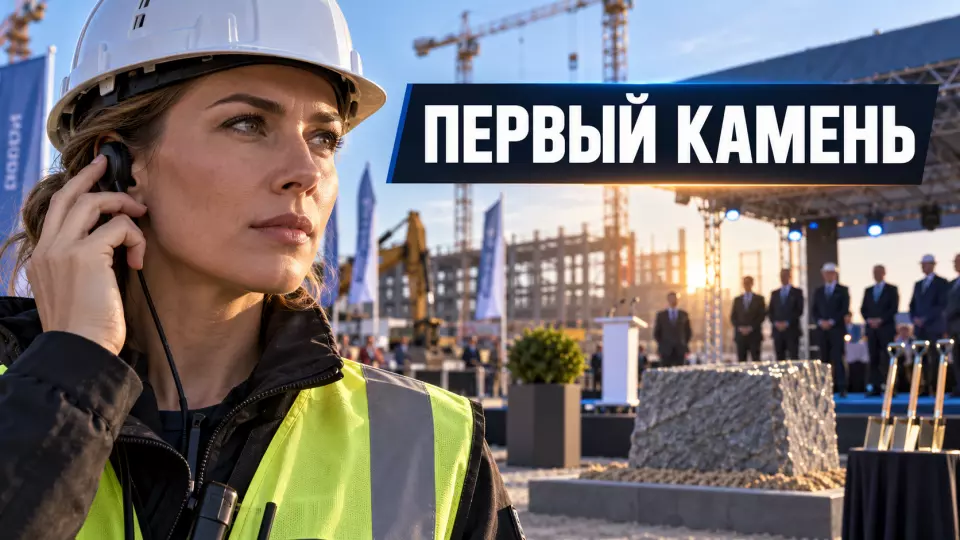
A practical plan for a plant foundation stone laying ceremony: roles, guest route, central moment, filming, rehearsal and backup.
Laying the foundation stone of a plant publicly marks the start of the construction phase. The site does not yet have a finished plant, an operating line, or the usual infrastructure for guests. So first we clarify the meaning of the event, build a safe route, agree on the protocol and prepare a backup version of the program.
At Aventura, we start with the question: what fact is the company entitled to announce today? Then we link the decisions of the investor and the construction team with the work of occupational safety, protocol and public relations (PR). Décor and the stage appear after the boundaries are confirmed. By that point, the route and access conditions are already known.
Recommendations from the UK regulator Health and Safety Executive (HSE), the US National Weather Service, and the American ADA accessibility rules are used as operational guidelines. They do not replace the requirements of Russian legislation, the construction management plan, the general contractor's rules, and local instructions on occupational safety, fire and industrial safety.
If the ceremony is already in the plan, submit a request to discuss it and get a preliminary estimate. For a first conversation, it is enough to state the region, the current stage of the project, the expected guest list, and the desired public outcome.
What does the first stone laying confirm?
In short: the ceremony confirms the public transition of the project to the construction stage in a wording agreed upon by the investor and the construction team. It does not prove the readiness of the building, equipment installation, product release, or the enterprise reaching its capacity. All speeches, invitations, and captions must state the same factual status.
The main task of the ceremony is to give guests a clear answer about what has happened with the project. The wording may be 'the first stone has been laid,' 'the project of the future enterprise has been presented,' or 'the start of the construction stage has been marked.' The exact words are approved by the client together with the relevant departments, because the actual and legal stages of projects differ.
We record the wording in the event passport. The same version is given to the host, speakers, press service, photographers, and the team that prepares the captions. If the invitation says 'start of construction,' the host should not amplify the meaning to 'launch of the plant' for the sake of ceremony.
The event passport includes:
- confirmed stage of the project;
- the official role responsible for the wording;
- the main message for guests and the media;
- permissible facts about the future facility;
- information that cannot yet be disclosed;
- the next stage that can be spoken about publicly.
Figures about investments, area, capacity, jobs, and timelines are included in speeches only after confirmation by the client. If there is no source, we remove the figure rather than replace it with an approximate estimate.
Event boundary: first stone, opening, and launch
The first stone relates to public communications during the early construction stage, the plant opening to a separate ceremony at a completed facility or one being commissioned, and the line launch to the confirmed operation of a specific technological circuit. Neither the name “opening” nor the ceremony itself confirms that the facility has been commissioned or that the enterprise has reached design capacity. These events have different facts, guests, footage, and risks.
The table summarizes the key points of the section: Event, What can be confirmed, What guests see. Use it as a quick reference when preparing the event.
| Event | What can be confirmed | What guests see | What cannot be claimed without a separate fact |
|---|---|---|---|
| Laying of the first stone | the start or public designation of the construction stage | a prepared site; a model; a commemorative object; a symbolic action | that the plant is open; the line is operating; products are being produced |
| Plant opening | official presentation of the facility in a status agreed with the client | buildings; guest areas; an approved route around the facility | commissioning of the facility, operation of all lines, or reaching design capacity without separate supporting documents and facts |
| Production line launch | operation of a specific technological circuit in a confirmed mode | an approved process; a status screen; the result of the operation | readiness of the entire enterprise when only one line is confirmed |
For a completed facility, a different scenario scale is needed: entrance areas, guided tour routes, several zones, catering, and a production demonstration. This outline is discussed in more detail in the article on plant opening and guest safety.
If the key fact relates to equipment and the observable result of its operation, the reference point will be the material on the production line launch ceremony. Laying the first stone should not borrow the language of a technological start-up.
For a ceremony at an early stage, we describe the future cautiously. The model shows the concept, not a completed facility. A product sample speaks to the direction of the enterprise, but by itself does not confirm production at this site.
Who is responsible for the site and the ceremony?
The construction team confirms the suitability of the area and the permitted works. Health and safety sets the restrictions for guests. Protocol is responsible for officials, the public relations service for facts and materials, and the directing team assembles the programme. Together these roles prepare a single working plan. The central episode begins once the site-side person in charge is confirmed.
The project has two linked tracks. The site track is responsible for the territory and the movement of machinery. Its area also covers temporary structures, electrics and the right to halt access. The ceremonial track manages the programme, appearances and filming. It covers speeches, sound and the symbolic act.
The table brings together the key points of this section: Role, Decision area, What it hands to the event team. Use it as a quick reference when preparing the event.
| Role | Decision area | What it hands to the event team |
|---|---|---|
| Investor or client | the meaning of the ceremony; the list of facts; the line-up of key guests | the approved public wording |
| Construction manager | site boundaries; works; machinery; site readiness | the permitted area and restrictions |
| Health and safety | the route; escorting; protective equipment; the right to stop | guest access conditions |
| Protocol or government relations (GR) | titles; greeting; order of speeches; escorting | briefing cards for officials and the sequence |
| Public relations service | press backgrounder; questions; captions for materials | verified key messages and the publication map |
| Directing team | timings; cues; stage; sound; screen; transitions | the working script and back-up |
The MC does not assess site readiness by appearance. He receives the cue from the rehearsal director. The rehearsal director, in turn, waits for confirmation of the designated site-side person in charge.
We separately record who has the right to stop the central episode. The reason may be a change in conditions, the closure of an area or the absence of confirmation. In public, the MC uses a short neutral line and moves the programme to the back-up block. Internal reasons and working discussions never make it on air.
If you need to bring the site, official guests, public relations and technical equipment together in one plan, request a scenario map and estimate. We will start with the project status, the route and the decision owners, and then put together the programme and the technical brief.
Preparation: From Concept to Guest Admission
We start preparation with the project status and the actual site. The client approves the concept, and the parties appoint responsible persons. After a general walk-through, we put together the movement plan and protocol. Then we issue working documents and hold a rehearsal. Invitations and installation begin after decisions on access, surface and backup zone.
It is convenient to organize the workflow into a single sequence:
- Confirm the event's occurrence. The client determines which stage of the project can be announced publicly and who confirms the information.
- Appoint decision owners. The venue, occupational safety and security appear in the role map. The client separately appoints those responsible for protocol and public relations, while we name the technical director and stage director.
- Conduct a joint site visit. The team walks the transport and guest routes. We separately walk the routes for officials, press and staff. The technical team checks the installation path.
- Select the ceremonial zone. The venue confirms the ground conditions and boundaries. The venue then checks temporary structures, access roads and exit routes.
- Design flows. Buses, official guest cars and pedestrians get their own routes. For cameras, catering and construction equipment, separate paths or movement windows are defined.
- Approve the protocol. The protocol service checks titles and how the host will announce the guests. Then the client approves the greeters, the order of speeches, the group shot and short media interaction.
- Assemble the central episode. We lock the concept and participant list before producing the decor. The client approves props in advance, and we approve cues and camera positions.
- Prepare a backup. The team knows in advance how the program will be shortened and where it will be moved.
- Issue working documents. The site plan, timing and responsibility matrix are versioned. The same rule applies to the fact sheet with verified facts and instructions.
- Conduct a run-through and acceptance. Issues are closed with a repeat test, and the venue makes the decision on guest admission.
A joint site visit is needed before the final estimate. On the plan everything may look compact, but on site it turns out that the suitable point is farther from the entrance, the surface requires decking, cameras conflict with the officials' route, or noise interferes with speech.
If the project includes several business blocks, negotiations and a large number of partners, a separate service for organizing business events is useful. The cornerstone laying ceremony can be the central episode of a broader program, but its site restrictions are still calculated separately.
How to plan a route at a temporary venue?
We design the route from the drop-off point to the organized departure and walk it under conditions close to those on the day of the ceremony. The construction site separates guests, machinery and unloading. Before releasing the instructions, we check the surface, lighting and fencing. Together with the venue, we assess accessibility, protective equipment and escort for each guest.
The basic sequence is as follows:
- checkpoint (KPP) or list verification point;
- parking or safe drop-off;
- registration and waiting;
- issuance of personal protective equipment if required by the venue;
- short briefing;
- escorted transition;
- ceremonial area;
- symbolic point;
- brief media interaction or a separate business segment;
- boarding transport and exit check.
The route runs through the permitted area. We check it after precipitation and at the time of day when guests will be present. Loose gravel, mud, cables, sharp changes in level and unlit sections cannot be covered up by the host's words or additional signage.
The venue's specialist determines protective equipment based on the risks of the area. A hard hat and vest do not become a universal kit just because they look good on camera. The team communicates footwear and clothing requirements in advance, keeps a stock of sizes and shows how to use the issued equipment correctly.
Accessibility applies to the entire sequence. You need a suitable drop-off, a solid route, a place next to an escort, accessible registration, a restroom and an equivalent position for speaking or observing. If part of the territory is inaccessible, the team prepares a video screening or moves the official segment to a suitable area.
Protocol and the Central Episode
The protocol determines the order of officials, while the venue ensures the safe mechanics of the symbolic action. We select props after the fact, the list of participants and the camera position have been approved. The central episode must read in a single frame. It does not require a dangerous operation and does not create the impression that the production is already running.
There is no universal order of speeches for all positions. The customer's protocol services and the invited agencies confirm seniority, the form of address, greeters, escorts and sequence. In a working scenario, the host of the event usually speaks first, followed by invited officials, but the specific order may differ.
For each key guest, a card is prepared:
- full name and position as of the event date;
- the form of introduction by the host;
- time and place of the meeting;
- escort person;
- position during speeches and the symbolic action;
- topic of the speech;
- participation in the group shot and communication with the media;
- filming restrictions;
- contact of the protocol representative.
It is better to separate the roles of the speeches. The investor explains the meaning of the project. The regional representative speaks about the significance for the territory within confirmed facts. The construction or technical manager names the next stage. Thus, several speeches do not repeat the same set of facts.
A memorial plaque, capsule, prepared stone, a short gesture with soil or the signing of a document can become the symbolic action. The mechanics are confirmed by the designer, the construction site and occupational safety. The stone must not arbitrarily become part of a load-bearing structure, and honored guests are not offered to work next to operating machinery.
The organization of such an event can be included in the project of presentation and official opening. We adapt the format to the early construction stage and do not transfer elements designed for a finished building to the site.
What should the press and photographers receive?
The press needs an approved shooting map and a fact sheet with verified facts. Positions and clean sound are prepared for cameras. Photographers receive a list of must-have shots and the placement of participants. Official documents and passes must not appear in the frame. The same rule applies to blueprints, vehicle numbers, and restricted areas.
The press zone is separated from guest and construction equipment traffic. Camera operators must have a solid platform for tripods, visibility of the stage and the symbolic point, a safe cable route, and access to the agreed sound signal. The photographer's passage must not change the route of officials at the last moment.
The shooting map shows approved positions and directions. It is needed even with a small number of journalists: one camera operator who stands in a service passage can stop the entire procession. A detailed procedure for preparing a route for the media is in the article about a press tour to a production facility.
The basic shot list includes:
- arrival and welcome of key guests;
- a general view of the future facility and the prepared area;
- speeches by speakers;
- a symbolic action in a wide shot;
- hands, props, or a commemorative detail in close-up;
- an official group shot;
- a model or visualization of the future enterprise;
- short comments at the prepared press point.
The media fact sheet contains the project name, current stage, and an approved description of the future facility. Any figure is stored together with the client's source. For the full cycle of filming, video editing, and distribution of materials, you can engage photo and video production.
Weather, ground and temporary structures
The forecast provides initial data for the weather plan. The ground is checked on site, even if the site looks level. Those responsible determine in advance who monitors conditions, when the programme is shortened, where the shelter is located and how long it will take guests to move. Threshold conditions are set by specialist engineers and the documentation for the structures.
For open areas we prepare three versions of the programme:
The table summarises the key points of this section: Mode, What happens, What is checked in advance. Use it as a quick reference when preparing the event.
| Mode | What happens | What is checked in advance |
|---|---|---|
| Main | speeches and the symbolic act take place in the open area | route; surface; sound; structures; electrics; evacuation |
| Shortened | the official part is reduced or moved under a designed canopy | safe capacity; transitions; audibility; new shot order |
| Full backup | the programme takes place indoors; the site is shown via a model or video | room readiness; materials; transport; an honest remark from the presenter |
The decision is made by a designated person appointed in advance. The document specifies the cut-off time for switching, notification channels, the new movement plan and changes for transport, security, media and the technical team. The presenter receives a ready-made wording and does not explain the weather on their own initiative.
The ground affects the stage and the canopy. The screen, acoustics, fencing and route also depend on it. Before installation, the slope and drainage are checked. Specialist engineers separately assess subsidence, underground utilities and the feasibility of anchoring. The construction team confirms access for machinery. After heavy precipitation, a repeat inspection is required.
Temporary power supply is designed by a qualified specialist. Cables are protected from water and mechanical damage, transitions are covered, generators are separated from the public. Emergency access to equipment is kept clear.
How do you run a cue-to-cue rehearsal?
A rehearsal tests the actual route and the central episode, not just the host's script. We walk the route from the checkpoint, then separately rehearse the key cues of the symbolic action. In a professional team this format is called cue-to-cue, that is, a run-through of the key cues. We check the start moment, the participants' entrance, the microphone, the camera position and the backup. After every correction we run the segment again.
First we hold a table-top run-through based on the plan. Participants test decisions for a late arrival of an official, closure of a zone, a change in the weather, a sound failure and a switch to the backup. After that the team goes to the venue and physically walks the same points.
The cue-to-cue run-through of the central episode can be set out in a table:
The table brings together the key points of this section: Field, What we record, Readiness criterion. Use it as a quick reference when preparing the event.
| Field | What we record | Readiness criterion |
|---|---|---|
| Trigger | who confirms the zone is ready | there is a single, clear source of the decision |
| Working cue | what the director receives | the cue is audible and does not get into the public sound |
| Participants' entrance | from where and along which path they come | the route is clear, positions are marked |
| Symbolic action | who does what | the mechanics are permitted by the venue |
| Speech and sound | key lines and microphones | words are intelligible against background noise |
| Filming | main and backup shot | cameras do not enter the closed zone |
| Completion | the participants' next transition | no oncoming flow and no empty pause |
| Backup | replacing an unavailable action | the version is ready to be switched on without false words |
The phrase "we fixed it" does not close an issue. If the decking was moved, the team walks that section again. If a microphone was replaced, the speaker repeats the key line. We described the full run-through system in the article on technical rehearsal of an event.
Brief, estimate and document package
At the briefing we gather facts and constraints, and then calculate people, equipment and works. Cost is affected by the venue, routes and temporary structures. We also factor in filming, transport and a reserve. Until these parameters are confirmed, an exact sum would be a guess. That is why we first walk the site together with the client and the construction team.
At the first briefing we ask questions:
- Which stage of the project does the ceremony mark?
- Who confirms the wording and the facts?
- Which areas of the site are accessible to guests and cameras?
- Who has the authority to stop access or the central episode?
- Which categories of guests are expected?
- What requirements apply to passes, escorting and protective equipment?
- Who is part of the protocol party and who confirms the order?
- What symbolic action is permitted?
- Where do the main, shortened and backup versions take place?
- What materials should the media and internal channels receive?
The estimate may include several cost groups:
- site preparation, decking and temporary structures;
- stage, sound, screen and power supply;
- navigation, transport and registration;
- escorting, protective equipment and catering;
- photo, video, staff, communications and reserve.
The scope depends on the project. We do not add a line item just because it is customary for ceremonial events.
The working package is divided into several parts. The event passport and site plan set the foundation. The role matrix, work schedule and flow plan allocate actions. Protocol cards and timing manage the official programme. The command sheet, filming map, media backgrounder, weather plan and acceptance sheet help run the event according to the agreed scenario. Each document gets a date, version and owner.
If the programme includes negotiations or a delegation visit, transitions and escorting are designed as carefully as the speeches. An additional framework is available in the article on hosting a business delegation at an enterprise.
Checklist before guests arrive
The venue admits guests after checking the territory and route. Responsible persons separately accept structures, protocol, communications, and backup. Each item has a specific owner. A general mark of 'ready' is not sufficient. If an area has changed after acceptance, we check it again before registration begins and update the documents.
- The public wording of the event is approved and consistent across all materials.
- The construction manager has confirmed the guest and ceremonial zones.
- Hazardous work is separated or stopped for the agreed time.
- Routes for pedestrians, vehicles, installation, and press are separated.
- Surfaces, decks, lighting, fences, and exits have been checked.
- Protective equipment, briefing, and escort are prepared as decided by the venue.
- Positions, announcement forms, and the order of officials have been confirmed.
- The symbolic action is permitted, participants know their positions and cues.
- Main and backup sound have been checked against background noise.
- Cameras are placed at permitted points, press information and captions are ready.
- The weather responsible person and decision owner are available to the team.
- The shortened and full backup versions can be activated without rebuilding from scratch.
- After the last corrections, a re-test has been conducted.
- The host has received only the current script without old versions.
Frequently asked questions
The main goal of the ceremony is to give guests a clear answer about what has happened with the project. The wording may be 'the first stone has been laid', 'the project of the future enterprise has been presented', or 'the start of the construction phase has been marked'. The exact wording is approved by the client together with the relevant departments, because the actual and legal stage differs from project to project.
The first stone relates to public communication of the early construction stage, the opening of the plant to a separate ceremony at a completed or commissioned facility, and the launch of a line to the confirmed operation of a specific technological circuit. Neither the name 'opening' nor the ceremony itself confirms the commissioning of the facility or the enterprise reaching its design capacity. These events have different facts, guests, footage, and risks.
The construction department confirms the suitability of the area and permissible works. Occupational safety sets restrictions for guests. The protocol service is responsible for officials, the public relations service for facts and materials, and the directing team assembles the program. Together these roles prepare a single working plan. The central episode begins after the site's responsible person confirms it.
We start preparation with the project status and the actual site. The client approves the meaning, and the parties appoint responsible persons. After a joint walkthrough, we put together the movement plan and protocol. Then we issue working documents and hold a rehearsal. Invitations and installation begin after decisions on access, coverage, and the backup area.
We design the route from the drop-off point to the organized exit and walk it on foot under conditions close to the day of the ceremony. The construction department separates guests, equipment, and unloading. Before issuing the memo, we check the surface, lighting, and fencing. Together with the site, we assess accessibility, protective equipment, and escort for each guest.
The protocol determines the order of officials, and the site determines the safe mechanics of the symbolic action. We select props after the fact, the list of participants, and the shooting point have been approved. The central episode must be readable in a single frame. It does not require a dangerous operation and does not create the impression that production is already running.
At Aventura, we can link the meaning of the ceremony with the decisions of the construction site. The program will include protocol, a guest route, sound, light, and other technical equipment. We will also organize filming and backup. Submit a request for preparing the script and budget if the date and guest list are already being discussed or the project is just reaching its first working brief.
Sources
- BMW Group: Foundation stone laid for plant in Debrecen
- LEGO Group: groundbreaking of new factory in Vietnam
- HSE: site rules and visitor briefing
- HSE: design of site and temporary zones
- National Weather Service: Event Ready Guide
- U.S. Department of Justice: accessibility of temporary events
- Basingstoke and Deane Borough Council: protocol for official events
- LEGO Group: opening of factory in Vietnam in 2025
- HSE: safe organization of transport on work site
- HSE: temporary power supply for events
- HSE: fencing on temporary sites
- HSE: personal protective equipment at work
- Durham County Council: protocol and procedure for official guests
- City of San Diego: host roles and dry run
- Northern Ireland Assembly: rules for media, photos and video
- HSE: safety management at all stages of the event
Contents
Was this article helpful?