Working program for receiving a business delegation at the enterprise: access, safe route, production, negotiations, signing, catering, and exit.
Receiving a business delegation at an enterprise is a program with two equal circuits. The first is responsible for the business goal: showing production, holding negotiations, signing documents, or giving a press comment. The second is responsible for the actual site: passes, route, safety, restricted areas, translation, catering, and guest exit.
At Aventura, we first collect the enterprise's restrictions and then build the program. This order protects the meeting from a typical mistake: the meeting room and presentation are ready, but the entry list does not match, the route passes through a restricted area, or the filming crew learns about the prohibition only at the workshop.
Leave a request - let's discuss the task
We will clarify the event format and suggest the next step.
What to decide before inviting the delegation?
In short: Before sending invitations, the client approves the purpose of the visit, the composition of the delegation, open topics, confidential information, and the expected decision after the meeting. The company separately determines the accessible areas, requirements for lists and escorts. We translate these inputs into the program, but we do not promise guests visits to areas that have not yet been approved by the facility owner.
The first document of the project is a short visit card. It does not include decor and menu. It answers the questions on which the entire route depends:
- why the delegation is coming specifically to the enterprise;
- who makes decisions on behalf of the facility owners;
- who is in the guest list and what roles the participants have;
- what can be shown, discussed, and filmed;
- whether translation is needed;
- whether a signing, press approach, or group photo is planned;
- what action should continue the meeting after the guests depart.
The goal is better formulated through a decision. 'Show the factory' is too broad. The working formulation sounds more precise: familiarize partners with the production chain, agree on the next stage of the project, and record agreements during negotiations.
If the task includes a public signing, this episode is designed separately. In the article about the agreement signing ceremony we analyze documents, the movement of signatories, the photo moment, and press work. In the reception program, only the place of the episode and the connection with the general route remain.
Roles and Boundaries of Responsibility
In short: A delegation visit should have one program manager and separate decision owners for access, production route, negotiation content, translation, filming, and catering. At Aventura, we consolidate their decisions into a single scenario. The company's services retain the right to stop the passage, change the route, or remove material if security or site regulations require it.
The allocation of responsibilities is fixed before developing a detailed schedule. Otherwise, one team promises guests filming, another blocks cameras, and a third learns about the interpreter just before the start of negotiations.
The table summarizes the key points of the section: Scope, Who approves, What is passed to the scenario. Use it as a quick reference when preparing the event.
| Scope | Who approves | What is passed to the scenario |
|---|---|---|
| Purpose and composition of the meeting | project manager on the client's side | expected outcome, list of participants, agenda |
| Access and security regime | security and facility administration | list fields, internal approval deadlines, checkpoint rules, prohibitions |
| Production route | production manager and occupational safety | open areas, stops, risks, requirements for escort and personal protective equipment (PPE) |
| Business part | management, lawyers, protocol, and PR | key points, negotiation participants, documents, public statements |
| Organization | director and coordinators | overall scenario, transitions, inter-service communication, contingency actions |
| Services | transport, translation, catering, filming crew | readiness time, work locations, restrictions, and contact persons |
For such a project, the mechanics of a business event are suitable: a single headquarters, scenario, decision owners, and change log. We do not replace the security service, production, or lawyers. Our task is to ensure that their approved decisions coincide in time and space.
Each block has its own stop signal: the coordinator does not lead guests to the checkpoint without a confirmed list, the group does not go on the route without production approval, and the presenter does not announce the signing or press block without agreed formulations.
What does a site visit program look like?
In short: The basic program takes the guest from entry screening to a brief briefing, an authorized production showcase, negotiations, a public segment, meals, and an organized departure. Transitions are just as important as the content blocks. The scenario specifies escorts, assembly points, permitted photo zones, and the person who authorizes the group to move on.
The working sequence looks like this:
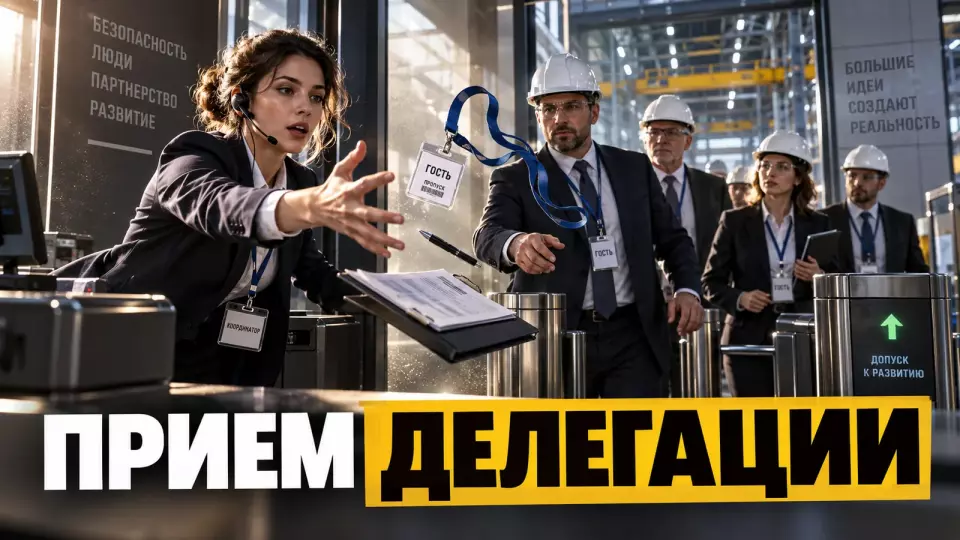
- Meeting at the checkpoint. The coordinator checks arrivals against the list, assists with passes, and gathers the group at a safe point without blocking the entrance for employees.
- Guest briefing and route preparation. The company representative explains movement boundaries, stop signals, emergency procedures, and filming rules. If the route requires personal protective equipment, the team issues it and checks the fit.
- Production showcase. The escort leads the group only through approved areas. At each stop, the topic, speaker, explanation duration, and permitted viewing angle are predetermined.
- Moving to the meeting room. Guests turn in unneeded protective equipment, receive water and materials. The coordinator checks the readiness of the presentation, translation, and participant list.
- Negotiations and recording decisions. The moderator keeps the agenda, and those responsible record agreements and questions that will need follow-up after the meeting.
- Signing, press approach, or group photo. This block is only held when documents are ready, the public statement is agreed upon, and filming is permitted.
- Meals, closing, and departure. The coordinator provides the next contact, escorts guests to transportation, ensures temporary passes are returned, and gives the team a list of follow-up actions.
For the production part, it is useful to separately check the material on a press tour of the production facility. Even if there are no journalists, the logic remains similar: the route is built around permitted content, clear stops, and safe group movement.
Leave a request - let's discuss your task
We will clarify the event format and suggest the next step.
Checkpoint, passes, and personal data
In short: The list for the security checkpoint is compiled for a specific admission purpose and is not expanded 'just in case.' The company specifies the mandatory fields, the transfer format, and the person responsible for verification. We check that the program matches the guest list, but the legal basis for processing and the data retention period are determined by the customer's responsible department.
Article 5 of the personal data law ties processing to a predetermined purpose and prohibits excessive data composition. Therefore, the registration form should not automatically request all possible information. Name, organization, position, contact, and document details are added only when each field is needed for admission, communication, or protocol.
It is useful to separate files by purpose: the guest list is needed for the checkpoint, protocol seating is for the business program organizers, and the contact list is for communication coordinators. They may overlap, but they do not have to contain the same set of information and circulate in a common chat.
Before the day of the event, we verify the spelling of names, organization, role, transportation, and special route conditions. At the checkpoint, the coordinator works with the latest approved version. If an unannounced participant arrives, the team does not promise immediate entry. The decision is made by the company employee responsible for admission.
The invitation explains in advance which document is needed, where the meeting point is, and what will happen if you are late. This information reduces disputes at the entrance and helps the security service follow the facility's procedure.
Who needs guest induction and PPE?
In short: Guests are only explained the rules that relate to their route, behavior, and possible risks. A full employee induction cannot automatically be declared mandatory for every visitor. The format of the guest brief, the need for personal protective equipment, and the right to enter the production area are determined by the enterprise according to local rules and route assessment.
We ask the production site to prepare a short safety card for guests. It indicates the group's boundaries, prohibited actions, the escort's signals, the evacuation route, and the procedure for stopping the tour. The Ministry of Emergency Situations advises visitors to public places to know the way to the exit and to navigate by the evacuation plan. On site, this information is linked to the actual location of the delegation.
Personal protective equipment is selected not by the guest's status, but by the risks of the area. If the enterprise needs helmets, goggles, vests, hearing protection, or special footwear, the site service determines the set, sizes, procedure for issuing, and disposal of disposable items. We allocate time and place for this procedure, but do not determine the PPE composition ourselves.
The public rules of industrial tours 'Rostec Promtour' show a similar organizational logic: participants undergo induction and follow the guide along a designated route. In the article, this is an example of a specific program's practice, not a single requirement for any enterprise.
The escort goes with the group from start to finish of the production area. He knows the permitted route and can stop the movement. The organizer does not replace this employee: the coordinator monitors the group composition and timing, while safety decisions remain with the enterprise.
Foreign guests, interpretation, and facility access
In short: For a foreign delegation, migration documents, the site access list, the program language, the spelling of names, and access restrictions are checked separately. An electronic visa describes the right to enter and stay in Russia for permitted purposes, but does not replace the enterprise pass. Facility access is confirmed by the site owner after their own checks and internal approvals.
The Consular Department of the Russian Ministry of Foreign Affairs lists the purposes for which the unified electronic visa can be used, including business contacts. This page relates to entry and stay. Access to a specific enterprise depends on the facility's rules, the composition of the delegation, and the nature of the areas visited.
The public regulation of Pirogov University demonstrates a useful organizational model: the reception program, delegation composition, responsible persons, and premises are prepared in advance. We use this document only as an example of an institution's internal procedure. A production facility has its own procedure.
The interpreter receives the program, list of names, production terms, presentations, and negotiation talking points before the rehearsal. If consecutive or simultaneous interpretation is needed, we engage an event interpreter and check the equipment, specialist placement, and backup communication method in advance.
Names and titles are verified in the form approved by the parties. Nameplates, captions, passes, and the host's card use one version. Unconfirmed transliteration is not corrected on the spot from memory.
We write about working observations, preparation, and new business formats in the Aventura Telegram channel.
How to conduct negotiations, signing, and the press segment?
In short: The business portion is structured around the decision that the parties need to make or prepare. Negotiations have an agenda, a moderator, and a minutes owner. The signing and press segment are separated from the discussion: documents are confirmed by lawyers, public statements are approved by PR, and we coordinate entrances, microphones, translation, filming, and transitions in the director's script.
The meeting room should be ready before the group returns from the production site. Only approved materials are on the table. The presentation is open to the right file, participant name cards are placed according to the approved layout, water does not block the view, and the interpreter can hear every speaker.
The moderator opens the meeting, states the objective and the order of topics. If the production tour is delayed, he is given the new time before the executives enter, not during the first remark. The meeting minutes record decisions, unanswered questions, and owners of the next step.
The signing should not be merged into the negotiations. The documents, copies, authorities, and public name are confirmed by the responsible parties. We prepare the table, lighting, microphones, folders, movement of participants, and the shot, but we do not determine the legal meaning of the document.
The press segment also gets a separate point. Journalists are informed of the access time, permitted positions, and question format. If there is no press, the same approach helps to deliver a short statement for an internal video without accidental improvisation and confidential information in the frame.
Photos, video, and consent to distribution
In short: Filming is coordinated on two levels. The enterprise determines where cameras may be used and what must not appear in the frame. The client separately checks the legal basis for publishing recognizable images of people. A general notice about the photographer's work does not replace a separate consent to the distribution of personal data when such consent is required for public publication.
Before the visit, a filming map is prepared. It marks permitted areas, required shots, closed screens, documents, equipment labels, and people who must not be filmed. The filming crew receives this map along with the script, not after arriving on site.
Article 10.1 of the personal data law states that consent to distribution is issued separately from other consents. In it, a person can set conditions and prohibitions. The specific form and legal basis are checked by the client's responsible team. We do not replace a legal assessment with a general announcement by the host.
For the project, you can add photo and video shooting of the event. The technical specification includes not only a list of shots but also the approval process for materials. The photographer does not publish production shots in their portfolio by default.
After the meeting, the files are first received by a designated representative of the client. They check security restrictions, captions for people, and public wording. Only then do the materials go to the mailing list, press release, internal channels, or a public case study.
Food, Accessibility, and Practical Route
Summary: Food and practical details are part of the guest's overall route. The team checks the coffee break area, delivery, allergy requests, drinking water, cloakroom, restrooms, and accessibility of transitions in advance. For participants with reduced mobility, a continuous safe path from the entrance to all designated areas is required, and the digital invitation and registration form must be clear and accessible.
Rospotrebnadzor clarifies a separate rule for the sale of catering products outside the establishment without providing catering services: such products must be accompanied by documents confirming compliance with mandatory requirements. For our project, this is a signal to check in advance with the supplier the applicable set of documents, storage conditions, delivery, and issuance. The responsible person on site receives the order in the agreed area.
We collect dietary restrictions in advance only to the extent needed to serve the guest. This information is not forwarded to the entire team. Catering receives the task without unnecessary personal details. For a business meeting, event catering with a clear serving time and a backup plan in case of program changes is suitable.
SP 59.13330.2020 describes accessible routes for low-mobility groups. For the reception, this means checking the entrance, level changes, doors, elevators, restrooms, meeting room, and vehicle boarding point. If the declared production site is inaccessible, the enterprise offers an equivalent safe viewing format, such as an overview from an authorized area or a demonstration in the meeting room.
The WCAG 2.2 web content accessibility recommendations also apply to the guest's digital journey. The invitation, registration form, directions map, and program should support keyboard navigation, be correctly interpreted by assistive technologies, have clear field labels, and sufficient contrast. An unstructured PDF and a scan with small text create a barrier even before the delegation arrives.
How to Check the Program Before the Delegation Arrives?
In short: The rehearsal repeats the guest's route from the drop-off point to the exit. The team goes through the checkpoint, briefing, production route, meeting room, signing, catering, and boarding transport. At each transition, they check the readiness time, the decision owner, and the backup. Desk reading of the scenario is not enough if people, files, and equipment have not been checked at the actual points.
The run-through is conducted without attempting to create the appearance of a working production facility. The route is confirmed by a representative of the site, and the organizational team checks transitions and communication. If an area cannot be walked through during the rehearsal, the enterprise provides an exact layout and schedules an additional check before the guests arrive.
At the technical rehearsal, we verify:
- the current list at the checkpoint and the contact of the access officer;
- the meeting point, cloakroom, storage of belongings, and issuance of PPE;
- the audibility of the escort in the production area;
- presentations, videos, microphones, and interpretation;
- the readiness of documents and folders for signing;
- the permitted positions for the photographer and videographer;
- catering service and cleaning of the area;
- the exit route, transport, and return of passes;
- actions in case of a guest's late arrival, closure of an area, or delay of a document.
We described the full approach to the run-through in the article about the technical rehearsal of an event. For an enterprise, restricted points are added to the usual check: access, closed areas, PPE, escort, and filming permission.
After the rehearsal, one version of the scenario remains. It marks the service communication phones, decision-making points, and the time of the last update. Edits are communicated to all departments in one message so that the coordinator, checkpoint, meeting room, and transport do not work from different files.
Frequently Asked Questions
Briefly: Most often, clients ask about the duration of the visit, the composition of data for admission, the right to take photos, and the procedure for dealing with an unannounced guest. There is no universal answer: the regime is determined by the enterprise. The working principle is one: appoint the owner of each decision in advance, confirm restrictions in writing, and do not promise the delegation what the facility has not yet agreed to.
How long should the reception program last?
The duration depends on the purpose, territory, number of transfers, language of communication, and composition of the business part. We first design the route without timing, then get production restrictions, and only after that set the schedule. It is not necessary to artificially extend the show for the sake of richness.
Can the passport data of guests be transferred in a common file?
The composition of fields and the transfer channel are determined by the responsible team of the enterprise. Article 5 of the personal data law requires conformity to the purpose and prohibits excess. We advise separating the admission list from protocol and working files and restricting access to it.
Is it necessary to conduct a full introductory briefing for each guest?
We do not assert such a rule for all facilities. The enterprise determines the format based on local procedures and route risks. In any case, the guest needs clear rules of conduct, actions in case of alarm, movement boundaries, and requirements for protective equipment.
Can a guest take photos with a phone?
Only if the enterprise has permitted photography in a specific zone. Permission for a camera does not automatically mean the right to publish any frame. Separately check restricted information, images of people, and conditions for distributing materials.
What to do if a participant is not on the list at the checkpoint?
The coordinator informs the person responsible for admission and waits for their decision. The guest is not promised passage and is not attempted to be taken through using someone else's pass. If necessary, the program is adjusted so that the rest of the group does not stand at the entrance.
Who accompanies the delegation at the production site?
The accompanying person is appointed by the enterprise. This person knows the route, restrictions, and conditions for stopping the group. Our coordinator keeps the composition of the delegation, the scenario, and communication of services, but does not make decisions about the safety of the production area.
If the visit is already on the calendar, at Aventura we can combine admission, route, negotiations, translation, photography, and catering into one scenario. Request a quote via the form to discuss the composition of the delegation, the facility's regime, and the meeting objectives.
Sources
- Ministry of Emergency Situations of Russia: fire in a public place, office
- W3C: Web Content Accessibility Guidelines 2.2
- Rospotrebnadzor: amendments to SanPiN 2.3/2.4.3590-20
- Consular Department of the Russian Ministry of Foreign Affairs: unified electronic visa
- Pirogov University: regulations on hosting foreign delegations
- Rostec Promtur: industrial tours and visiting regulations
- FAU FCS: SP 59.13330.2020 "Accessibility of buildings and structures for people with limited mobility"
- ConsultantPlus: Federal Law No. 152-FZ, Article 5 "Principles of personal data processing"
- ConsultantPlus: Federal Law No. 152-FZ, Article 10.1 on personal data permitted for dissemination
Contents
Was this article helpful?