
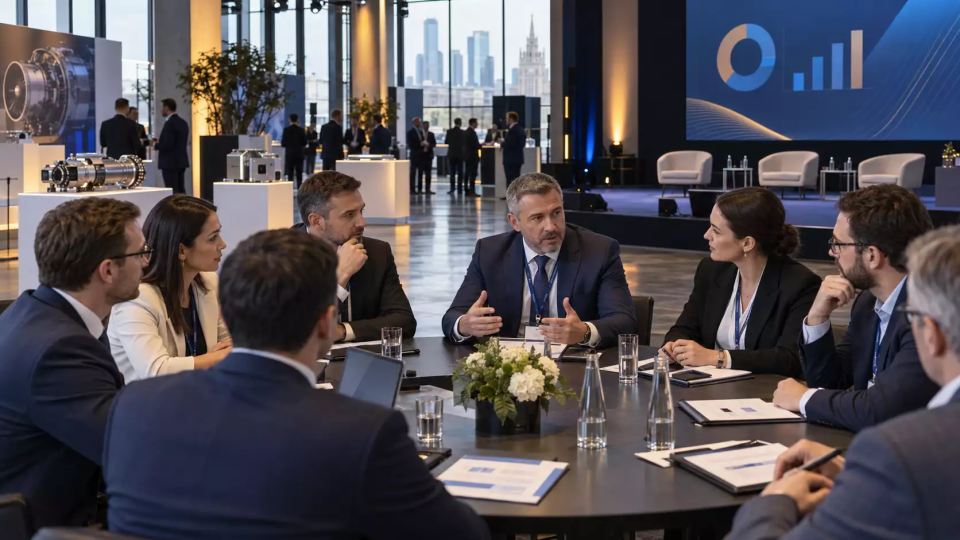
A Supplier Day connects procurement, technical experts, and market companies. We break down the program, scheduled meetings, the demo zone, the budget, and results evaluation.
A company needs to organize a Supplier Day when a regular procurement newsletter is not enough. The procurement department explains needs and rules. Technical specialists discuss the applicability of solutions, and suppliers get a clear path to a substantive conversation. At Aventura, we start such a project with the goal, categories, and a meeting map. Only after that do we assemble the stage, demonstrations, streaming, and guest services.
Мы публикуем практические разборы деловых событий в Telegram-канале «Авентуры». There you can follow new materials about the program, venue, and work with participants.
What does a company address on Supplier Day?
A Supplier Day helps a company explain its needs to the market, introduce procurement and technical specialists to suitable suppliers, and collect questions by category. It is better to choose one goal: expand the pool of procurement participants, prepare the market for future tasks, or hold meetings in specific areas.
TEK-Torg includes Q&A sessions with customers, supplier presentations and one-on-one negotiations in its program. The U.S. Department of Energy's Supply Chain Management Center describes Supplier Industry Day with educational sessions, one-on-one meetings between suppliers and facility representatives, and networking. These examples show two parts of the format: general information and substantive dialogue.
Before choosing a venue, decide what should change after the event. The supplier should understand the requirements and participation procedure. The technical customer needs solutions for its category, and the procurement department needs questions collected by topic. These outcomes determine the guest list, the program and the report format.
Outcome and scope of the event
Supplier Day helps participants get acquainted and discuss challenges, but it does not replace the procurement procedure, qualification, vetting or contract. We state this boundary in the brief, invitation, moderator's speech and meeting card. The participant should understand where to turn after the conversation, without promises of a contract or special conditions.
For procurements under Federal Law No. 44-FZ, this boundary is especially important: Article 8 requires equal conditions of competition and prohibits actions that unreasonably restrict the number of participants. The customer checks the applicability of the law and the event wording with its legal department.
A one-page results passport is useful for the project:
The table summarizes the key points of the section: Question, Working wording. Use it as a quick reference when preparing the event.
| Question | Working formulation |
|---|---|
| Main objective | introduce technical customers to solutions in selected categories |
| Participant action | complete the relevant track, meeting, or demo |
| Team action | log the question and specify the official channel for follow-up communication |
| Boundary | do not evaluate a commercial proposal outside the procedure |
| Report | show relevant contacts that took place and follow-up statuses |
If there are several goals, prioritize them. An event can educate and introduce at the same time, but its timing cannot accommodate many equally important tasks.
The table summarizes the key points of the section: Format, Why it is needed, What the participant gets. Use it as a quick reference when preparing the event.
| Format | What it is for | What the participant gets | How we capture the result |
|---|---|---|---|
| general session | explain needs and rules | unified baseline information | topic-based questions |
| scheduled meeting | discuss a specific category or solution | conversation with a suitable expert | neutral status and next channel |
Whom to invite and how to split the flows?
We divide guests by procurement category and meeting goal. Procurement teams, technical experts, existing suppliers, and new companies need different routes. This determines the questionnaire, schedule, meeting zones, expert lineup, and post-event materials. For each track, we define the valuable action and next step in advance.
In the registration form, ask participants to specify their solution profile, category of interest, and purpose of participation. Article 5 of Federal Law No. 152-FZ requires that the scope of personal data correspond to predetermined processing purposes and not be excessive. The legal basis, consent text, and form retention period are checked by the client with a lawyer.
On the company side, the program usually involves procurement, category owners, technical departments, compliance, and business leaders. They do not need to be brought onto the stage in one long block. Some issues are better addressed in thematic tracks or at a scheduled meeting.
For free communication, our breakdown of networking at a business event will be useful. But free communication does not replace pre-matched pairs: the right supplier should not have to randomly search for an expert among all participants.
Supplier Day program
The program moves from general to specific. First, the company explains the goals, rules, and boundaries of communication. Then category owners present the challenges. After that, suppliers move on to short presentations, demos, and scheduled meetings. The final block explains where the materials will be and how to continue the conversation through the official channel.
A working sequence might look like this:
- Registration, navigation by category, and checking the meeting schedule.
- Opening with the supplier day objective and participation rules.
- Overview of the procurement system and interaction channels.
- Thematic sessions for technical departments.
- Short presentations of pre-selected solutions.
- Scheduled business meetings and demo zone operations.
- A general answer to recurring questions and an explanation of the next step.
Leave transitions between blocks. If the general session runs long, negotiations will start conflicting with demos and meals. The program should have a shortened version in case of delays.
How to organize subject-specific meetings?
The subject meeting starts before the event. The supplier reports the category, the task, and the readiness of the solution for implementation. The customer selects a suitable specialist, and we draw up the schedule and leave time for transitions. After the conversation, we record only a neutral outcome. Such preparation saves the main time for substantive questions.
Before the event, we collect short cards. They include the company, solution profile, category of interest, participants, questions, and permitted materials. The procurement team confirms the pairs. The organizer does not decide for the customer who meets the requirements of the future procedure.
At meetings, we assign a coordinator, not a moderator of the conversation. They monitor the time and record a neutral outcome: "information received", "technical clarification needed" or "the material must be sent through the official channel".
The grid can be built with short sequential slots or thematic tables. The first option is suitable for precise pairs. The second helps gather several suppliers around one task if the rules and boundaries of the conversation are the same for all.
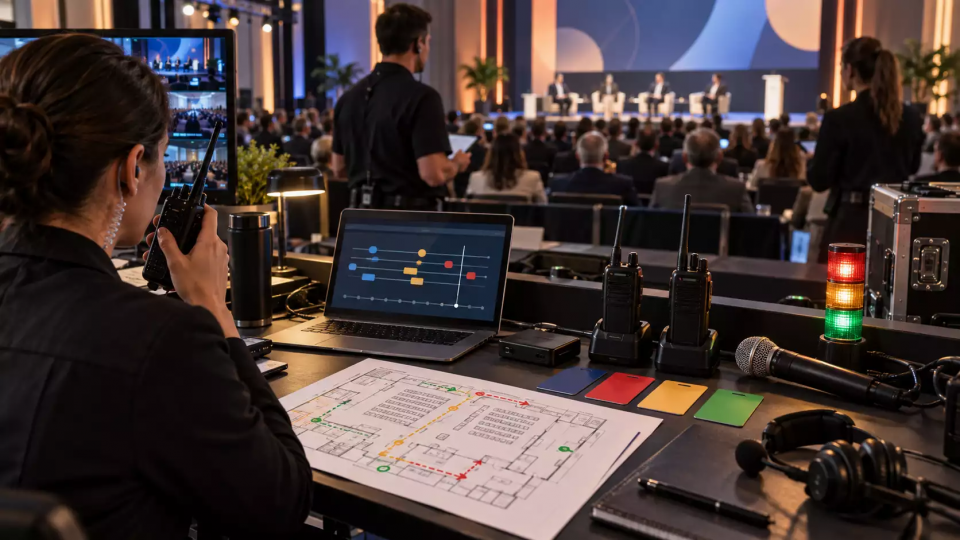
Team roles and a single command center
Procurement determines the rules and procedure for further communication; technical specialists formulate tasks by category. Lawyers check public wording. We consolidate their decisions into a single event plan: program, registration, venue, negotiations, and technical part. This is enough for every team member to understand their area before setup.
Roles and dependencies should be documented in the technical specification for the corporate forum, adapting the document to the procurement categories and negotiations of the supplier day.
Minimum role map:
The table summarizes the key points of the section: Function, Responsibility. Use it as a quick reference when preparing the event.
| Function | What they are responsible for |
|---|---|
| client-side project owner | goal, decisions, and boundaries |
| procurement team | categories, rules, official next step |
| technical experts | subject-matter questions and applicability assessment |
| program producer | логика сессий, спикеры и тайминг |
| session logic, speakers and timing | meeting coordinator |
| technical director | questionnaires, pairs, grid and statuses |
| sound, screens, network, recording and backup | монтаж, маршруты, доступ и безопасность объекта |
All decisions converge in one command center. Parallel chats of procurement, stage, and registration without a shared picture quickly create different versions of the schedule.
What to include in the venue and technical setup?
The venue must separate three processes: the general program, negotiations, and demonstrations. We check acoustics, guest routes, power supply, network, and equipment load-in conditions. For a hybrid event, we separately prepare a technical test, an online moderator, and backup communication. The plan also takes into account the accessibility of rooms and materials for participants.
Negotiation rooms are not placed next to a loud stage. In the demo zone, dimensions, weight, power, connectivity, noise, network requirements, and photo policy are collected in advance. Heavy or dangerous demonstrations require separate approval with the venue and responsible specialists.
W3C advises designing accessibility for in-person, remote, and hybrid events in advance. For supplier day, this means a clear route, a microphone for questions, accessible materials, sound quality, and a way to communicate needs before the event.
We check backup at the venue. The backup computer must have the necessary files, and the backup network must work in the halls. The team knows in advance who switches the system and how the program changes during that time.
Budget without hidden blocks
We divide the budget by functions: venue and program, participant management, equipment, security, and reporting. This way the client immediately sees mandatory costs and items that depend on the format. We disclose details within each block so that changes are not lost in a general support line. We explain every dependency before approving the estimate.
The table contains the key points of the section: Block, What to check before the estimate. Use it as a quick guide when preparing the event.
| Table. Budget without hidden blocks | Что проверить до оценки |
|---|---|
| What to check before estimating | число потоков, допуск, печать бейджей, стойки и персонал |
| number of streams, access control, badge printing, desks and staff | число залов, спикеры, модерация, презентации и репетиция |
| number of halls, speakers, moderation, presentations and rehearsal | анкеты, матчинг, расписание, комнаты, координаторы и протокол |
| questionnaires, matchmaking, schedule, rooms, coordinators and minutes | застройка, электричество, сеть, ввоз, охрана и демонтаж |
| build-up, electricity, network, move-in, security and dismantling | платформа, съёмка, звук, онлайн-модератор, тесты и запись |
| platform, filming, sound, online moderator, tests and recording | статусы встреч, вопросы, обратная связь и передача материалов |
Late changes almost always increase the budget. If the client decides to add negotiations, we re-assemble the questionnaires, pairs, schedule, and coordinator team.
meeting statuses, questions, feedback and handover of materials When choosing an organizer, use. In the technical specification, separately describe the procurement boundary: the agency organizes communication and production of the event, but does not make decisions for the procurement function.
How to measure event results?
We measure the result by the event goal: how many of the needed meetings took place, how many have a clear outcome, and what questions arose by category. The number of registrations alone does not show this. The client evaluates the procurement procedure metrics separately. Our report describes the quality of the route and the organization.
Before the event, determine who sets the meeting status and who receives the report. After the event, combine recurring questions, but do not disclose participant data beyond the agreed circle. In the final report, we show the participant journey, the meetings that took place, and the quality of the organization. The decision on qualification, admission, and further work remains with the client.
We divide the feedback form into two parts. Suppliers evaluate the clarity of the rules and the quality of the meeting; the client's representatives evaluate whether the pair matches the task and the sufficiency of materials. An overall coffee rating does not answer these questions.
. In the technical specification, separately describe the procurement boundary: the agency organizes communication and event production, but does not make decisions on behalf of the procurement function. Event crisis management plan. It breaks down roles, backup, and a single decision channel at the venue.
Preparation by work stages
Подготовка начинается с цели и категорий, затем переходит к аудитории, программе и производству. Точные сроки зависят от масштаба, процедуры заказчика, площадки и объёма демонстраций. Вместо универсального календаря используйте контрольные точки: согласованная цель, готовые правила, подтверждённые участники, собранные пары и проверенная площадка.
Рабочий порядок:
- Approve the goal, project owner, and scope of the supplier day.
- Assemble categories, technical tasks, and the expert lineup.
- Describe the audience, registration form, and selection criteria.
- Design the overall program, tracks, meetings, and demo zone.
- Confirm the venue, equipment, security, and accessibility.
- Collect supplier profiles and coordinate pairings.
- Run a rehearsal for the stage, registration, meetings, and backup.
- Prepare a single working brief for the team.
- Run the event with a central command and decision log.
- Deliver the report, questions, and next-step statuses to the client.
Frequently asked questions
A Supplier Day helps a company explain its needs to the market, introduce procurement and technical specialists to suitable suppliers, and collect questions by category. It is better to choose one goal: expand the pool of procurement participants, prepare the market for future tasks, or hold meetings in specific areas.
Supplier Day helps participants get acquainted and discuss challenges, but it does not replace the procurement procedure, qualification, vetting or contract. We state this boundary in the brief, invitation, moderator's speech and meeting card. The participant should understand where to turn after the conversation, without promises of a contract or special conditions.
We divide guests by procurement category and meeting goal. Procurement teams, technical experts, existing suppliers, and new companies need different routes. This determines the questionnaire, schedule, meeting zones, expert lineup, and post-event materials. For each track, we define the valuable action and next step in advance.
The program moves from general to specific. First, the company explains the goals, rules, and boundaries of communication. Then category owners present the challenges. After that, suppliers move on to short presentations, demos, and scheduled meetings. The final block explains where the materials will be and how to continue the conversation through the official channel.
The subject meeting starts before the event. The supplier reports the category, the task, and the readiness of the solution for implementation. The customer selects a suitable specialist, and we draw up the schedule and leave time for transitions. After the conversation, we record only a neutral outcome. Such preparation saves the main time for substantive questions.
Procurement determines the rules and procedure for further communication; technical specialists formulate tasks by category. Lawyers check public wording. We consolidate their decisions into a single event plan: program, registration, venue, negotiations, and technical part. This is enough for every team member to understand their area before setup.
At Aventura, we can deliver a turnkey supplier day: from the procurement brief and scenario to registration, meeting rooms, demo zone, broadcast, and on-site control. Запросите предварительную смету and specify the industry, city, format, and expected number of streams.
Sources
- TEK-Torg: TEK Supplier Day 2026 program
- SCMC of the U.S. Department of Energy: Supplier Industry Day
- ConsultantPlus: Article 8 of Law No. 44-FZ on the principle of competition
- ConsultantPlus: Article 5 of Law No. 152-FZ on the principles of personal data processing
- W3C: Making Events Accessible
- W3C: Accessibility of Remote Meetings
Contents
Was this article helpful?
Looking for an idea or someone to bring your vision to life? Event Agency Aventura has been organizing events in Moscow and across Russia for 16 years. Leave your number and our manager will call you back.
