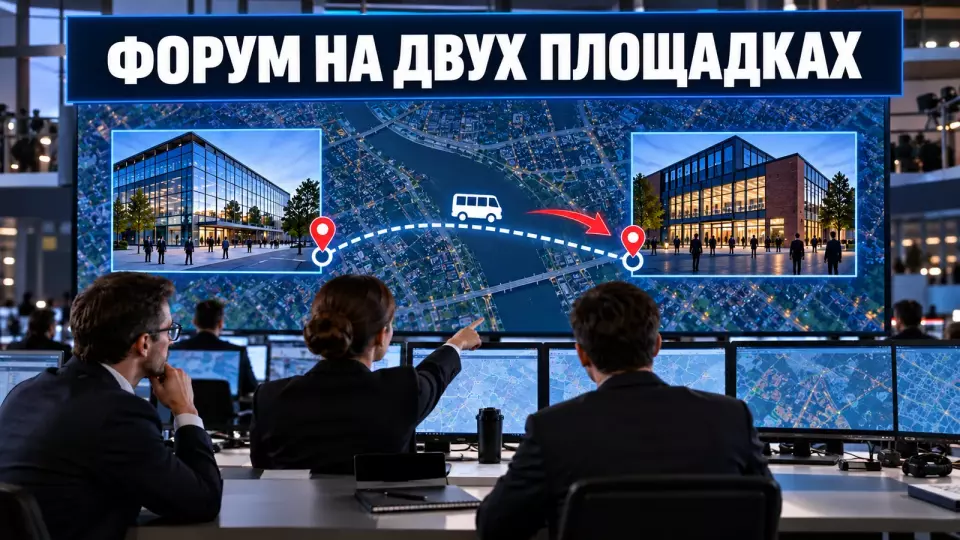
A forum held across two physical locations requires a single programme, shared accreditation, managed transfers and one central command centre. We break down how to connect the schedule, participant routes and team operations.
Organising a forum across two venues gets more complicated between sessions. A group needs to leave the building, board transport, pass security at the second site and reach the hall on time. If the programme, transport and access are managed separately, one delay shifts the schedule in both buildings.
At Aventura, we bring two venues together into a single operational plan: a shared business objective, master timing, participant register and command centre. If you are already considering two sites, send us the addresses, audiences and a draft programme. We will check the participant route and prepare questions for the estimate.
When does a forum need two venues?
A second venue is justified if it removes a limitation of the first: it provides the required type of space, separates incompatible flows, or becomes a standalone part of the content. If the second location only adds scale but forces most guests to constantly travel between buildings, it is worth reworking the programme first and testing the single-venue option.
Organising a forum across two venues starts with a reason. We do not look for a second building until we understand which task cannot reasonably be solved by zoning the first property.
Valid grounds usually fall into one of five groups:
- Capacity and flows. A single building cannot handle the simultaneous load together with the lobby, registration, catering, service areas and safe routes.
- Incompatible formats. A plenary session, an exhibition, closed negotiations or a practical demonstration require different conditions.
- Different access modes. A large-scale business programme, a protocol segment, the press and closed meetings do not fit into one clear perimeter.
- Content tied to the property. A production facility, laboratory, campus or exhibition space offers an experience that cannot be transferred to an ordinary hall.
- Project resilience. The second property is needed as a standalone operational perimeter, not as a decorative extension of the first.
We compare the "one venue" and "two venues" options using the same criteria. Such a table is more useful than a general debate about the prestige of addresses.
The table summarises the key points of the section: Criterion, What we check, Signal to drop the two-venue option. Use it as a quick reference when preparing an event.
| Criterion | What we check | Signal to drop the two-venue option |
|---|---|---|
| Content value | What the second property adds to the programme | The guest experience barely changes |
| Mandatory transfers | Who needs to change location and why | A large group travels for a short block |
| Total transition time | Exit, queue, journey, check-in, walk to the hall | The schedule only works without traffic jams and queues |
| Accessibility | The entire route, including drop-off and pick-up | Accessible transport is not confirmed |
| Management | Who sees the big picture and makes decisions | Local teams change plans independently |
| Contingency | What remains if a route or property fails | A failure of one link stops the entire forum |
| Total cost | Transport, staff, communications, navigation, contingency | Only the rental of two halls is counted |
The UK Health and Safety Executive (HSE) recommends managing internal flows, avoiding bottlenecks and maintaining a central control point. That is why, before signing a second contract, we first check whether the task can be solved within a single property.
If two venues are needed, it is useful to immediately prepare a dedicated technical brief for a corporate forum. For a project that requires a full programme and production perimeter, we also link this work to organising forums and seminars.
Four programme models across two venues
The models that work most reliably are those in which attendees spend the bulk of the day at a single venue. The programme can be split by function, audience, time waves or pre-selected tracks. Shared blocks preserve the unity of the forum, while mandatory transfers remain rare and take place between major parts of the programme.
Two venues cannot be planned as adjacent rooms that you can move between in a minute. We build two full programmes and determine in advance where they connect.
The “anchor and satellite” model
The main venue hosts the opening, the plenary programme and general announcements. The second venue takes an independent track, an exhibition, demonstrations, closed-door meetings or a hands-on component. Guests can spend most of the day in one place and move once, if their route calls for it.
Splitting by audience
The venues host different stable groups: for example, executives and experts, partners and the internal team, or an open and a closed programme. Each group has its own core of the day. Shared messaging, a joint opening, closing materials or a coordinated finale keep the overall meaning intact.
Cohort waves
Groups move between venues in pre-assigned time slots. This approach suits situations where both parts are mandatory but a simultaneous mass transfer would cause congestion. Each cohort gets its own colour, departure time, boarding point and host team.
Choosing a track
Attendees choose their track in advance and receive a personalised schedule. Free choice is preserved only where it does not affect capacity, catering, transport or access arrangements. If a guest changes their route on the day of the forum, the system should show whether there is space and how to get to the next block.
The table summarises the key points of this section: Model, When it fits, Main risk. Use it as a quick reference when preparing your event.
| Model | When it fits | Main risk |
|---|---|---|
| Anchor and satellite | The second venue has a distinct function | The satellite is perceived as secondary |
| By audience | Groups need different conditions and content | The forum splits into two separate events |
| Cohort waves | Both venues are mandatory for everyone | A delay in one wave affects the next |
| Choosing a track | Guests can choose their programme in advance | Too much freedom to switch tracks undermines forecasting |
We use identical session names, a single version of the schedule and shared rules for changes. For large business programmes, this logic is part of conference management. The difference between two physical venues and a hybrid online/offline model can be explored further in the article “A hybrid conference for branch offices”.
How do you build a single master timing plan?
A single master timing plan links the public programme to the participant journey, transport, entry, technical readiness and command-centre decisions. Both local schedules are built from one master timing plan. A transfer is only complete when the participant has passed the check, reached the right hall and is ready to continue the programme without having to look for the entrance again.
We build the timing plan in layers. If you keep only the start and end of sessions, the document loses the processes that most often pass delays between venues.
- Participant programme. Sessions, plenary blocks, parallel tracks, catering and the finale.
- Routes. Leaving the hall, walking to boarding, waiting, the journey, disembarking, the check and entry.
- Operations. Registration, cloakroom, wayfinding, cleaning, catering and help desks.
- Production. Sound checks, loading materials, stage readiness and technical changeovers.
- Management. Command-centre check-ins, decision deadlines and messages to participants.
Each block is given an operational status:
fixed- the time cannot be changed due to access, an external speaker, security or a shared start;flexible- the block can start within an agreed window;with a short version- the team has prepared a shortened version in advance;backup- the block replaces a cancelled or delayed part of the programme.
We place buffers where a delay could spill over to another venue: after general registration, before a mass exit, after a transfer, before the shared finale and before a speaker who is changing venues. The team determines the buffer size after a test run. A universal number without a route, entry procedure and traffic conditions would be guesswork.
In the public schedule, guests need the block name, venue, hall, time and route. The operational version also includes door opening, group assembly start, boarding close, the last permissible departure and the decision checkpoint.
Before approving the grid, we check the conflict for each audience: can a person finish a mandatory block at the first venue and physically get to the next one? If not, we change the programme first. An extra bus will not fix two sessions scheduled without a realistic transition window.
If the programme and logistics are already being discussed by different teams, request a combined plan and preliminary estimate. We will bring the timing plan, routes, roles and checkpoints together into one working framework.
How do you calculate transfers between venues?
We calculate transfers based on the full route and peak load. First, we account for exiting the hall, walking to the boarding point and waiting. Then we add the ride, the second security check and the walk to the next session. We compare capacity against the busiest wave of participants. This gives us a realistic window in the programme.
First, we build a demand map by time intervals. For each window, four answers are needed: how many people will leave, what share will take the transfer, how many seats are available and how long the full vehicle cycle takes.
The basic formulas are simple:
cycle time = round-trip travel time + boarding + alighting + standing time;interval = cycle time / number of vehicles in service;window capacity = number of trips × usable capacity;shortfall = peak demand - available seats;projected queue = accumulated demand until the balance is restored.
Usable capacity is not always equal to the maximum in the vehicle documents. We take into account the cabin layout, escorts, equipment, luggage and wheelchair spaces. The carrier confirms the specific figures for the selected vehicle model.
The US Federal Highway Administration (FHWA) recommends calculating trip time including boarding, alighting and standing time, and matching transport requirements to the peak passenger arrival rate. For a forum, this means that the hourly average is of little help after the plenary session ends, when a large group leaves almost simultaneously.
Boarding point
The station must not block the main entrance, the fire lane or a pedestrian route. It needs clear directions, a physical queue, an accessible boarding area, a point supervisor and communication with the dispatcher. Opposing flows are best kept separate.
Dispatch
The transport dispatcher sees the vehicles, actual arrival times, the queue at both venues, the main and backup routes. The driver does not change the route on their own unless this is provided for by the carrier's safety rules and the operational regulations.
Different groups
Participants, speakers, staff, VIP guests and people with special requirements may have different routes. We calculate the demand of each group separately so that a company car or accessible transport does not disappear in the general flow.
For a project with several boarding points, we include logistics and transfers in the overall production plan. We check the return route separately: guests may finish the programme at different times, and part of the team will stay for the dismantling.
Important. The window in the programme must accommodate the full transition with an operational margin. If the scheme only works with an empty road, instant boarding and no second security check, it is not ready yet.
Unified accreditation and participant journey
Two venues require a single participant profile and a unified access rights model. The registration team records the role, permitted zones, validity period, and chosen route in it. Local points work with one current status, and the backup mode must not create duplicate passes or disclose unnecessary personal data.
One badge can open different zones, but the color of the plastic does not replace the access system. We build a matrix of roles and venues: participant, speaker, press, partner, employee, contractor, protocol guest. When a role changes, the registration team updates the existing record and does not create a second profile.
Federal Law No. 152-FZ requires linking data processing to specific, pre-defined purposes, not collecting excessive information, and not storing it longer than necessary. For a forum, this translates into several practical rules:
- Collect only the fields needed for admission and service.
- Define the legal basis for each processing purpose. When consent serves as the basis, formalize it separately from other documents. Obtain consent for the dissemination of personal data separately.
- Do not print information on the badge that is not needed for navigation and communication.
- Limit employee access to data based on their role.
- Establish procedures for blocking, returning, and deleting records.
- Do not forward lists between venues via personal chats.
Health information belongs to special categories of personal data. The registration team separates requests for accessibility, special meals, or medical restrictions from the public profile. Only employees who arrange the required service receive this information.
The World Wide Web Consortium (W3C) recommends short forms with clear labels, instructions, and understandable error messages. If a form is long, it is better to divide it into logical steps. We discuss the detailed organization of the entrance area in the article “Event Participant Registration”.
We prepare the backup registration mode before the forum together with the client and security service. It must answer four questions:
- how to verify a confirmed guest without central communication;
- how to prevent double issuance of a pass at different venues;
- how to record a temporary decision and synchronize it after restoration;
- who has the right to change access manually.
The working scheme may include a local secure list with timestamps, different ranges of emergency passes, an offline operations log, and mandatory reconciliation after restoration. The client's information security and personal data specialists choose the technical solution and confirm the legal basis.
The participant journey begins before entry. The confirmation must include the address, the correct entrance, how to get there, the boarding point, departure time, access rules, and a help contact. After moving, a person should not have to figure out again where to go and whether their badge is valid.
One central command and local teams
A forum needs one main command centre, two local operations teams and unified transport control. The main command centre keeps the overall picture and makes cross-venue decisions. Local leads manage entry, halls, equipment and services at their own site within pre-agreed authority.
Two autonomous command centres quickly create two versions of what is happening. If Venue A delays a session, the Venue B team may send a group according to an already outdated plan. The same happens when an entrance is relocated: without a shared decision, guests will keep heading to the old point. That is why we separate local execution from central decisions.
The table summarises the key points of this section: Contour, What it is responsible for. Use it as a quick reference when preparing the event.
| Contour | What it is responsible for |
|---|---|
| Main command centre | overall programme, priorities, cross-venue resources, transport, public messages, stopping or changing the overall scenario |
| Venue A | entry, halls, equipment, services, security and medical support at site A |
| Venue B | the same functions at site B |
| Transport control | vehicles, stations, queues, routes, delays and backup |
HSE recommends a central control point for data on headcount, queues and incidents. The US Federal Emergency Management Agency (FEMA) uses an incident management system with forms for objectives, roles, communications, the medical plan and an action log. We take its clear structure from it rather than copying the system in full.
In the command kit we keep:
- tasks for the next stage of work;
- the team chart and list of responsible people;
- primary and backup communication channels;
- contacts for venues and services;
- medical and evacuation procedures;
- the status of critical resources;
- a log of events, decisions and instructions;
- shift handover rules.
A log entry contains the time, source of information, confirmed fact, decision, owner and next checkpoint. A screenshot of a long chat does not provide that clarity.
A short operational message answers two groups of questions. First we state the sender, location and confirmed fact. Then we explain the impact, the required action, the person responsible and the deadline for the next check. For a serious incident we add the priority and the log entry number.
A general chat can be used for reference information, but not as the only management channel. The radio network, dedicated mobile communications and local announcements must have a clear backup. Before the forum, the team tests communications specifically between venues and along the transport route.
Every critical function has a deputy and a list of decisions that person is authorised to make independently. A station lead can stop boarding when the receiving point is overcrowded. A local lead can close off entry to a danger zone. The decision to change the overall programme is made by a pre-appointed main command centre lead.
Safety, accessibility and catering
We check safety and accessibility along the entire route between buildings. We also make sure that the transfer queue does not obstruct evacuation and that transport is accessible to guests with limited mobility. Each venue needs its own plan for catering delivery, storage and distribution. We carry out the checks together with the responsible services.
Each venue has its own procedures, systems and responsible persons. The overall forum plan defines the signs of a serious failure, the procedure for escalating an issue to the manager, the conditions for stopping the programme and transport, communication with the services and unified messages to participants.
During inspections of places of mass gathering, the Russian Ministry of Emergency Situations (MChS) pays attention to fire alarms and warning systems, evacuation routes, firefighting equipment, smoke removal and evacuation drills. For the two venues we additionally check the inter-venue junction:
- the registration and boarding queue does not block exits;
- the bus does not block the fire lane;
- after evacuation, people are not sent towards a hazardous facility;
- local announcements do not contradict the decision of the overall command centre;
- the receiving venue confirms readiness before the next group is dispatched.
Accessibility runs through the entire route: the digital form, arrival, drop-off, screening, registration, the hall, the restroom, catering, boarding transport and evacuation. Having a ramp at the entrance solves nothing if the boarding point is inaccessible or a staff member at the second venue again asks a guest to publicly explain their needs.
We conduct a separate walk-through of the route and check doors, turns, cable ducts, stands, signage, lighting and assistance. W3C applies to the digital part: the form must be clear, manageable and must not request unnecessary information.
Catering at two venues requires a common concept and separate operational plans. Rospotrebnadzor points to traceability and the separation of responsibilities during production, transportation, storage and sale. Each venue needs a person responsible for acceptance, documents, labelling, storage conditions and the decision to stop distributing a batch.
We link catering times to transfers. If a mandatory bus departs at the same moment the serving line opens, a participant has to choose between food and the programme. We separate these processes in the master timing and calculate the approach, the queue, the meal and the way to boarding.
For complex services, event catering is planned together with the programme and routes, not as a separate menu order. A joint walk-through of technical and operational junctions complements the technical rehearsal of the event.
What to do if a transfer is delayed or communication is lost?
A contingency plan must include a measurable trigger, the decision owner, the first action, a message to participants and the condition for returning to normal operations. Phrases like "we'll add a bus" or "we'll move the session" don't work without an available resource, authority, a checkpoint time and a pre-prepared version of the programme at each venue.
We document each risk as a two-part card. The first part records the early warning sign of a failure, the threshold for activating the plan and the person who confirms the problem. The second part specifies the decision owner, the first action, the change to the programme, messages for the team and guests, and the time of the next check.
The trigger depends on the specific project. It cannot be assigned from a generic article. The team defines the safe queue limit, the acceptable cycle deviation, the latest decision time and the stop conditions after surveying the venues and the route.
The table summarises the key points of this section: Failure, First decision, What happens to the programme. Use it as a quick reference when preparing an event.
| Failure | First decision | What happens to the programme |
|---|---|---|
| The main route is unavailable | stop departures and check an independent backup route | shift, shorten or replace the dependent block |
| A vehicle does not continue its journey | confirm where the people are and send the backup | the receiving venue holds the local programme |
| The station is overcrowded | stop feeding in a new group and open the buffer | change the wave of exits from the halls |
| Venue B is unavailable | stop boarding until the venue confirms it can safely receive guests | activate the local, combined or remote backup |
| Communication between the command centres is lost | switch to the backup channel and checkpoints | venues operate within their autonomous authority |
| Central accreditation is unavailable | activate offline verification and an operations log | the main flow proceeds under a limited backup mode |
| A speaker is running late | activate remote participation, a replacement or a prepared block | do not automatically shift the entire forum |
| A food batch is questionable | stop serving and isolate the batch | switch to the agreed backup catering |
The local programme must preserve the meaning of the forum at least for a limited period. This could be a moderator-led discussion, a Q&A, prepared content or a change in the order of blocks. The backup does not have to replicate the original scenario, but it must not leave the audience without information.
The team tests the plans through a tabletop review and an end-to-end run-through. The team rehearses the end of the session, the announcement, the group's exit, boarding, communication between command centres, arrival, entry and the start of the next block. Testing the bus separately from the hall does not confirm that the whole chain works.
We have put together the general methodology for other types of failure in the article "Event crisis plan". For a two-venue forum, it is supplemented by transport, the second venue's readiness to receive guests and the authority to stop the oncoming flow.
Metrics and additional costs of the two venues
Forum metrics should reflect the participant experience, how processes work, and the margin of resilience. Hall attendance does not show how many people missed a session because of a queue or received different versions of the schedule. In the budget, we account separately for transport, dispatching, communications, navigation, duplicate posts, test runs, and backup resources.
We describe each metric in advance: name, formula, source, owner, and update time. Without it, "delay", "queue", and "availability" will mean different things to the venue, the carrier, and the client.
Programme and route
- share of participants who completed the chosen trajectory;
- mandatory transitions completed within the programme window;
- personal schedule conflicts;
- time from the decision to change to the update of channels;
- number of cases where a participant missed a block due to an inter-venue transition.
Transfer
- total time from leaving one hall to entering another;
- actual interval between departures;
- waiting time and maximum queue;
- participants who could not fit into the available wave;
- switches to the backup route and recovery time;
- fulfilment of confirmed requests for accessible transport.
Accreditation and command centre
- time from joining the queue to badge issuance;
- duplicate profiles and manual access changes;
- offline operations and conflicts after synchronisation;
- time from signal to confirmation and resolution;
- share of decisions recorded in the log;
- contradictory messages to participants.
Safety, accessibility, and catering
- completion of pre-shift checklists;
- readiness of critical posts and backup channels;
- fulfilment of adaptation requests;
- route issues and the time taken to resolve them;
- batches with complete documents and labelling;
- deviations during transport, storage, or distribution of catering.
Additional costs fall into three groups. The first is the transport reserve, dispatcher, and boarding point coordinators. The second is communications, navigation, and synchronisation of the participant registry. The third is local command centres, test runs of the route, and backup programme blocks.
We do not set universal target percentages or minutes. The project team determines them after timekeeping, flow modelling, and agreeing on the client's priorities. A zero number of registered incidents is also not considered a sufficient outcome: weak signals may simply not have made it into the log.
What should you include in the brief for the agency?
For an initial assessment, we need the reason for the second venue, addresses, audiences, mandatory blocks, draft routes and venue restrictions. The earlier the rules for entry, access, communication and accessibility are known, the more accurately we can compare one venue versus two, determine the team composition and immediately show the costs for transport, communication, synchronisation and contingency.
At Aventura, we first ask: what exactly will the forum lose if we keep just one venue? Then we request the source data on the programme and operations.
- The purpose of the forum and the decisions that should unite the audience.
- The reason for the second venue and the criterion for dropping it.
- Addresses, entrances, access routes, access regimes and installation restrictions.
- Participant segments and the expected starting venues.
- Mandatory blocks for each group.
- Speakers and staff who need to move between venues.
- Draft windows for catering, transfers and the joint finale.
- Capacity of halls, entrance areas and waiting zones according to the venues' data.
- Accessible routes and requests for special transport or services.
- Data processing rules and roles in the accreditation system.
- Contacts of venue management, security, technical staff and the carrier.
- The desired report structure and the owners of the metrics.
Before the estimate, it is useful to inspect both venues and travel the route under conditions close to the forum's timing. After that, we put together a flow map, a timeline of the entire journey from leaving one hall to entering the other, a management scheme, a demand calculation and a contingency scenario.
A general corporate event brief will help you gather the basic data. For a two-venue project, it is supplemented with cross-venue dependencies, stopover points and the owner of the single version of the schedule.
Frequently asked questions
Organising a forum across two venues starts with the reason. We do not look for a second building until we understand which task cannot reasonably be solved by zoning the first venue.
The most robust models are those in which a participant spends the main part of the day at one venue. The programme can be split by function, audience, time waves or pre-selected tracks. Shared blocks preserve the unity of the forum, but mandatory transfers remain rare and take place between major parts of the programme.
The main venue hosts the opening, the plenary programme and general announcements. The second venue hosts a standalone track, an exhibition, demonstrations, closed meetings or the practical part. A guest can spend most of the day in one place and transfer once, if their route provides for it.
The venues host different stable groups: for example, executives and experts, partners and the internal team, open and closed programmes. Each group has its own core of the day. Shared messaging, a joint opening, final materials or a coordinated finale maintain the overall meaning.
Groups move between venues at pre-assigned windows. This approach works when both parts are mandatory, but a simultaneous mass transfer creates congestion. Each cohort gets its own colour, departure time, boarding point and receiving team.
A participant chooses a track in advance and receives a personal schedule. Free choice is preserved only where it does not affect capacity, catering, transport and access regime. If a guest changes their route on the day of the forum, the system should show whether there is space and how to get to the next block.
If you are planning a forum across two buildings, send us the addresses, the composition of the audiences and a draft programme. At Aventura, we will gather questions for the venues, check the routes and prepare an organisation plan with a budget.
Sources
- HSE: managing flows within a venue
- HSE: planning for incidents and emergencies
- FHWA: pedestrian access and shuttles at special events
- FHWA: implementation plan for planned special events
- USFA/FEMA: NIMS Command and Coordination
- FEMA: Incident Command System forms
- W3C WAI: accessible forms
- Ministry of Labour of Russia: Federal Law No. 152-FZ
- EMERCOM of Russia: fire safety at places of mass gathering
- Rospotrebnadzor: catering for off-site service
Contents
Was this article helpful?