How to assess the medical risk of an event, choose the duty format, draft the brief and check the route, communications, venue and service acceptance.
Medical support for an event is not chosen based on the number of guests or the venue's habits. The same hall can host a calm conference in the morning and an active corporate programme in the evening. Risk is influenced by the age and condition of the audience, physical exertion, heat, alcohol, event duration, the venue's remoteness and emergency services' arrival time.
At Aventura we start with a short risk matrix. It helps to understand where readiness for first aid and a quick call to 112 is enough, and where the project needs a medical specialist, a post or a standby team. Specific mandatory requirements are confirmed by the venue, the medical contractor and the client's specialist advisers.
The medical plan is linked to registration, command centre communications, security, catering, transport, sports zones and evacuation routes. If different teams are responsible for these parts, they need to be brought together on one chart. Otherwise medics may lose time at the entrance, during screening or searching for the right zone.
If you are already choosing a venue and programme, request a quote and risk review. We will link the medical scheme with guest flows, activities and the work of the command centre.
When is medical support needed?
In short: the decision depends on a combination of factors, not on a single number. The higher the load, the more vulnerable the audience, the more complex the location and the longer the access for external help, the more reason there is to arrange professional medical standby.
Start with the question of what could happen and how quickly the team would get help. For an intimate gathering at a well-equipped city hotel, there is usually a short route to emergency services and venue staff on hand. A family day out of town, a sports tournament or a programme spread across several floors require a different assessment.
The following require increased attention:
- physical activities, competitions, heights, water or challenging terrain;
- heat, cold, prolonged time outdoors or high crowd density;
- alcohol and a late finish to the programme;
- children, elderly guests or known special needs in advance;
- a remote venue, a restricted-access facility or difficult entry;
- loud sound, blackouts, smoke effects and temporary structures;
- a programme longer than a standard working day;
- several zones that are hard to move between quickly.
The presence of one factor does not provide a ready-made answer. For example, a business conference may have a calm programme but take place at a country resort with a long drive in. A corporate sports day may be held in the city but include dozens of parallel activities. We assess the combination of risk and available response.
Risk matrix before choosing the format
This table describes the hazards, the audience, the environment and the readiness to respond to an incident. It is needed before requesting a price, because the medical contractor must see the real operational task together with the number of guests.
The World Health Organization (WHO) uses a risk-based approach for mass gatherings. It takes into account the hazard, people's vulnerability and the system's readiness to respond. For a corporate project, we translate this principle into a working table.
The table brings together the key points of the section: Block, What we record, How it affects the decision. Use it as a quick reference when preparing an event.
| Block | What we record | How it affects the decision |
|---|---|---|
| Audience | age groups, children, special needs, expected density | composition of specialists, availability of the post and communication |
| Programme | stage, sports, water, height, transport, duration | type of risk and the required points of presence |
| Environment | indoor or outdoor, temperature, lighting, terrain | equipment, shade, water, visibility and route |
| Venue | floors, access control, lifts, gates, distance | access time and evacuation capability |
| External assistance | distance, entry, communication, zoning addresses | reserve and duty format |
| Team | first aid, security, command centre, coordinators | speed of detection and information transfer |
The matrix is filled in by the organiser, the venue, the client and the medical contractor. If the sports or production part has its own requirements, the specialists responsible for that area are brought in. The result is a list of decisions: duty format, post location, equipment, communication channels, routes and criteria for stopping the activity.
When choosing a location, we immediately check the venue catalogue and then carry out a technical inspection. A beautiful hall does not compensate for a narrow service entrance, a closed lift or a route through a crowded guest area.
How does first aid differ from medical care?
In short: first aid keeps a person stable until medics arrive and is provided within the limits of one's training and the law. Medical care is provided by a medical professional. A first-aid kit, a trained employee and an on-call team solve different tasks.
Roles need to be separated in advance. A first-aid kit at the registration desk does not by itself mean that the team can quickly spot a problem, call for help and meet it at the entrance. The presence of a doctor also does not remove the need for the work of security, coordinators and the command centre.
A workable scheme divides four levels:
- An employee or participant notices a problem and reports it to the coordinator.
- A trained person provides first aid within the limits of their competence.
- A medical professional assesses the condition and acts within their authority.
- The emergency service receives the call, access to the territory and an exact route.
The Ministry of Emergency Situations publishes organisational and legal materials on first aid, and current requirements must be verified against the regulations in force. We do not replace medical or legal advice with them. For each project, the client confirms the roles with the medical contractor and its own specialist services.
The type of first-aid kit and its contents are determined by its purpose and the current requirements. The team must not arbitrarily replace the established contents or assign the coordinator to prescribe medications. The organiser's task is to ensure the kits are accessible, clearly labelled, monitored for expiry dates and connected with trained responsible persons.
Duty format: post, specialist or brigade
The choice depends on the risk scenario and response time. A medical post works well as a permanent point, a mobile specialist moves faster between zones, and a duty brigade adds transport readiness. These solutions can be combined.
Don't start the request with the words "send one ambulance." First describe the area to be covered, how many zones operate simultaneously and where a vehicle can pull up. After that, the medical contractor will propose the staffing and equipment within the scope of their licence and responsibility.
The table summarises the key points of this section: Format, When it is useful, What to check. Use it as a quick reference when preparing an event.
| Format | When it is useful | What to check |
|---|---|---|
| Venue readiness and first aid | low load, quick access to 112, clear infrastructure | trained responsible staff, first-aid kits, addressing, meeting the emergency service |
| Medical specialist | one or several nearby zones, professional examination needed | qualifications, equipment, schedule, replacement and communication |
| Medical post | constant flow, visible zone, long programme | room, privacy, water, electricity, accessibility and signage |
| Mobile team | extensive area, several activities | radius, travel time, communication and backup |
| Duty brigade | elevated risk or complex evacuation | vehicle location, unobstructed exit, staffing, equipment and handover procedure |
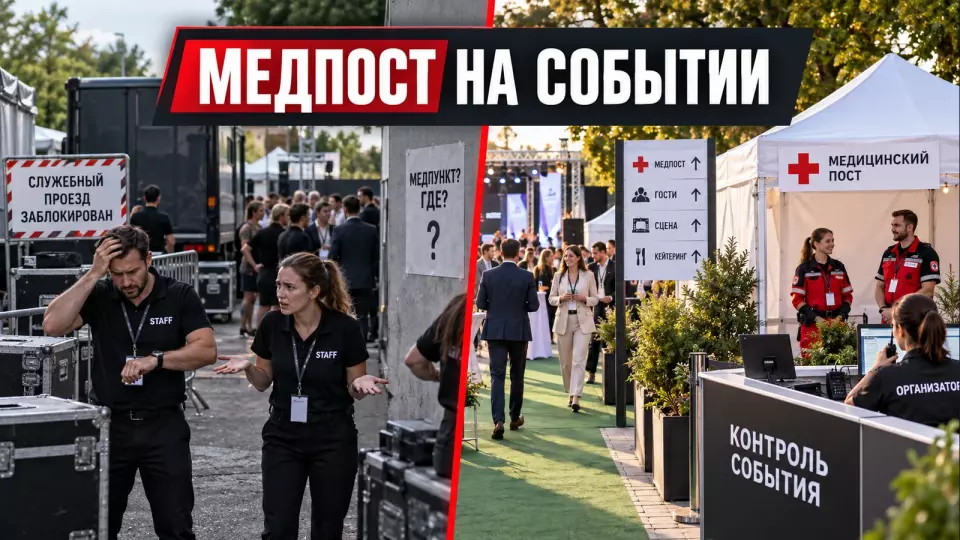
A single central post does not always cover a large area. If sports zones are separated by a tree line, floors or checkpoints, travel time becomes part of the solution. A project may include a main post, a mobile specialist and first-aid points at individual activities.
For sporting events, we build the medical scheme into the design of the disciplines. It affects the placement of starts, finishes, recovery zones, water and transport.
How to Write a Brief for a Medical Contractor?
A good brief gives the contractor a map of the event, information about the audience and activities, a list of risks, and the venue rules. Then proposals can be compared by scope and readiness, not just by the price per shift.
Provide the inputs in one package.
- Specify the date, guest hours, setup and dismantling times.
- Attach a site plan with entrances, floors, lifts, gates and service roads.
- Describe the number of guests by hour and zone, not just the overall maximum.
- List physical activities, stage effects, catering and alcohol.
- Note accessibility requests and special conditions without unnecessary medical details.
- Show the access control, screening, parking and rules for emergency vehicles.
- Establish communication with the command centre, security, venue and the client's responsible person.
- Ask them to describe the team composition, qualifications, equipment, staff replacement and the procedure for calling 112.
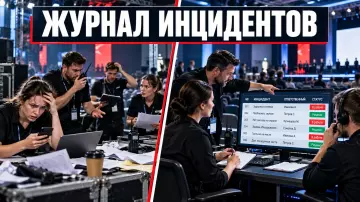
- Agree on the format of the incident log without publicly disclosing medical data.
- Determine which documents and reports the client accepts after the event.
If the project collects information about health, nutrition or special conditions, the client determines in advance the purpose, legal basis, access scope, storage period and deletion procedure. The form must include a link to the personal data processing policy and a clear way to withdraw consent when it serves as the basis for processing. Contractors are given only the amount of information they need for their work.
Ask the contractor to state their assumptions. If the calculation is based on free access while the site is restricted, that is a critical discrepancy. If a mobile team must cover two remote zones, there must be a measurable response time or a separate point.
Compare estimates based on the same brief. Otherwise, one provider includes a post, a vehicle and a reserve, while the other counts only the specialist's presence. A low price may be due to a smaller scope of work, not efficiency.
Route to the participant and exit from the venue
The medical route has two directions. A specialist must reach the participant quickly, and if necessary the person and the team must be able to walk or drive off the territory without conflicts with the guest flow, the stage and the build-up.
On the plan we mark the medical post, active zones, stairs, lifts, gates, screening, service corridors and the vehicle location. Each zone has a short name that security, the command centre, coordinators and medics all understand the same way. The wording "by the far stage" is not enough if there are several stages.
We check the route step by step.
- The coordinator receives the message and clarifies the zone.
- The command centre notifies the medical team and security.
- The nearest staff member clears the passage and meets the specialist.
- Security opens the required door, turnstile or gate.
- The command centre prepares the path for the external service if it has been called.
- Coordinators redirect the guest flow without publicly discussing the person's condition.
- After the person is handed over to the medical team, the organiser records the progress of the work: the time of the request, the transfer of information and the state of the route.
Escape routes and access for fire appliances must remain clear. The Ministry of Emergency Situations recommends checking premises and exits before a mass event and appointing responsible persons. We overlay the medical route on the same scheme so that the two plans do not contradict each other.
We link the detailed role map with the event command centre and radio communication. Medical data is not transmitted over the general channel. The radio carries the zone, the required action and the status of the route.
We publish our practice of preparing routes, the command centre and contractors in the Aventura Telegram channel. The channel helps to gather questions for the brief, but does not replace a medical decision on a specific project.
What to check with the venue and emergency services
The venue must show real access routes, internal rules and resources, not just give an address to call. The client verifies who meets the responders, how the gates open and where a person can be brought without moving through the crowd.
During the technical visit, we ask:
- is there an on-site medical room, first-aid kits and trained staff;
- who calls 112 and who meets the service at the entrance;
- which address, building, entrance and gate the dispatcher gives;
- does mobile coverage work in all zones;
- which doors and lifts are closed by the access control regime;
- where a vehicle can stand and whether it can leave immediately;
- how loud sound and stage effects are switched off;
- who manages guest flow and privacy;
- where water, sanitary zones and backup power are located;
- which internal rules apply to a sports or industrial venue.
We record the answers in the plan. An administrator's verbal phrase "we always open the gates quickly" does not replace a designated person and a working contact. If the route depends on several security posts, each one must know the scenario.
Before signing the contract, it is useful to conduct a technical audit of the venue. It reveals limitations before they affect the day of the event.
A sports programme needs a separate medical plan
A corporate tournament, run or sports day requires separate medical preparation. For physical education and sports events, a special procedure of the Ministry of Health applies, and the decision depends on the disciplines, the number of venues, the load and the composition of participants.
You cannot add sport to an ordinary corporate party and leave the medical plan unchanged. Even a simple relay race changes the nature of the load, the routes and the observation points. Water, warm-up, surface, refereeing, stopping a discipline and transport access become part of one scheme.
For each activity we record:
The table summarises the key points of the section: Field, What we describe. Use it as a quick reference when preparing the event.
| Field | What we describe |
|---|---|
| Load | duration, intensity, repetitions, contact level |
| Environment | surface, height, water, temperature, lighting |
| Participants | age groups, clearance, alternative role |
| Control | referee, instructor, stop criteria |
| Assistance | nearest point, access time, evacuation route |
| Backup | replacement discipline, postponement, reduced load |
The Ministry of Health procedure for sports events should be read by a relevant specialist, not by the programme coordinator. From 1 September 2026, Order of the Ministry of Health of Russia No. 484n applies. We give the specialist an exact scheme of disciplines and the venue, then integrate medical solutions into the creative and operational plans.
If the event is built around competitions, we design the corporate sports day together with safety, refereeing, water and medical support from day one.
How do you account for heat, alcohol and catering?
Heat, alcohol and catering change risk through dehydration, physical strain, guest behaviour and special diets. These factors need to be brought together in a single plan, because in practice they are often managed separately by different contractors.
The WHO has issued a dedicated tool for assessing heat risk at mass events. The temperature forecast is not the only thing that matters in it. The tool takes into account duration, shade, water, physical exertion, crowd density, communication and the readiness of the medical system.
For an open-air venue we set decision thresholds: when activity is reduced, breaks are added, the route is changed or the programme is moved. The threshold is confirmed by the project's relevant specialists. A coordinator must not make a medical decision based on a feeling that "it still seems tolerable".
Alcohol requires separate work on timing and transport. The medical team must know where the bar line is, when it opens and which active blocks are still running. You cannot schedule sports activity after the main alcohol part and assume the risks are the same.
Catering provides a map of points, operating hours, labelling and special diets. We do not include diagnoses in the general list for coordinators. A participant gets a clear way to communicate the required condition in advance, and the serving team sees only the information needed for safe service. We connect the contractor for event catering to the overall routing and medical post plan.
Rehearsing the Medical Scenario
During the rehearsal, the team checks the message, communication, access to the area, meeting the external service, managing guest flow and recording the incident.
The WHO recommends using tabletop and practical exercises to test readiness. At an event, a short scenario with a simulated participant is sufficient. It must not imitate a diagnosis or require coordinators to make medical decisions.
We run the test step by step.
- An observer reports the problem to the coordinator.
- The coordinator names the exact area and stays in touch.
- The command centre calls the medical team on the approved channel.
- Security clears the route and opens access.
- A dedicated staff member meets the external service at the gate.
- Guest flow is redirected without panic or public details.
- The team checks the route to the vehicle or handover point.
- After the test, the team records the time, obstacles and those responsible for fixes.
The check must take place under the conditions that will exist on the day of the event. An empty hall does not show dense registration. Open service doors do not show the real access regime. If the programme runs in the evening, we test lighting and access at the same time.
We include the scenario in the overall event crisis management plan. Then the medical part does not conflict with evacuation, weather, power outages and other command centre decisions.
What should you sign off with the contractor after the event?
The client signs off on readiness before opening, work according to the agreed plan, and a report without personal data after completion. Details about people's condition remain with the medical side and are processed according to its rules.
Before opening, we check the presence of the agreed team, equipment, post, vehicle, contacts, radio communication and knowledge of the route. If the contractor changes a specialist, the replacement must comply with the contract and go through the same introductory briefing.
During the event, the command centre records the progress of work: request received, medics dispatched, route clear, external service met, area returned to normal operation. Diagnoses and unnecessary personal information do not go into the general log.
After the project, we request:
- actual hours worked and shift composition;
- number of requests without personal data, broken down by type of situation;
- points and periods of increased load;
- access, communication or navigation issues;
- consumables used under the contract;
- recommendations for the plan of the next event;
- confirmation that the contractor has completed and closed the documents under the contract.
Such a report helps improve the project without violating privacy. If several requests arose in one area due to heat or a queue, this is a signal for the organiser. The solution could be shade, water, a change in timing or route, rather than increasing the number of medics without analysing the cause.
Client checklist
A medical plan is ready when the decision has been confirmed by the relevant specialists, the route has been checked on site, the roles are known to the command centre, and the contractor has received the same brief as security, catering and the technical team.
Risk assessment
- the audience and programme are described by zone and time;
- physical exertion, heat, alcohol and special conditions are taken into account;
- the time to access external help has been verified;
- the decision is not based on a universal figure without a source.
Contractor
- the brief includes the site plan and the event scenario;
- the composition, qualifications, equipment and replacements are described;
- the working schedule covers opening, the programme and guest departure;
- the reporting format has been agreed.
Venue
- the post, vehicle and routes are marked on the plan;
- gates, lifts and closed doors have been checked;
- zone addressing is the same for all services;
- fire lanes and evacuation routes are clear.
Team
- the command centre, security and coordinators know the reporting procedure;
- medical data is not broadcast on the general channel;
- a designated person meets the external service;
- the test scenario has been run through and the comments closed out.
Programme
- sports activities have a separate perimeter;
- stop criteria have been confirmed by the responsible persons;
- water, shade, food and transport are linked to risk;
- programme changes reach the medical team.
Medical support should not be a formal line in the budget. It works when the specialists, the venue and the command centre see the same event map.
Frequently asked questions
Start with the question of what could happen and how quickly the team would get help. For an intimate meeting at a well-equipped city hotel there is usually a short route to the emergency services and the venue staff. A country family day, a sports tournament or a programme spread across several floors require a different assessment.
This table describes the hazards, the audience, the environment and the readiness to respond to an incident. It is needed before requesting a price, because the medical contractor must see the real operational task along with the number of guests.
The roles need to be separated in advance. A first-aid kit at the registration desk does not in itself mean that the team can quickly spot a problem, call for help and meet it at the entrance. The presence of a doctor also does not remove the need for the work of security, coordinators and the command centre.
The choice depends on the risk scenario and the response time. A medical post is convenient as a permanent point, a mobile specialist moves between zones faster, and a duty brigade adds transport readiness. These solutions can be combined.
A good brief gives the contractor the event map, information about the audience and activities, a list of risks and the venue rules. Proposals can then be compared by composition and readiness, not just by the price of a shift.
The medical route has two directions. The specialist must quickly reach the participant, and if necessary the person and the brigade must be able to leave or drive off the territory without conflicts with the guest flow, the stage and the rigging.
If you need to put together a plan like this, submit a request via the form. At Aventura, we will link the medical plan with the venue, programme, catering, security and the work of the team.
Sources
- EMERCOM of Russia: organisational and legal aspects of providing first aid
- EMERCOM of Russia: first aid kits
- Ministry of Health of Russia: information constituting medical confidentiality
- Federal Law No. 152-FZ on personal data
- Order of the Ministry of Health of Russia No. 484n on medical care at sports events
- WHO: universal tool for mass event risk assessment
- WHO: heat risk assessment at mass events
- WHO: guidance on conducting exercises
- EMERCOM of Russia: fire safety at events with mass gatherings of people
Contents
Was this article helpful?