Five levels of sponsor communication: from aggregate metrics and managed mailings to voluntary contact with context and a next step.
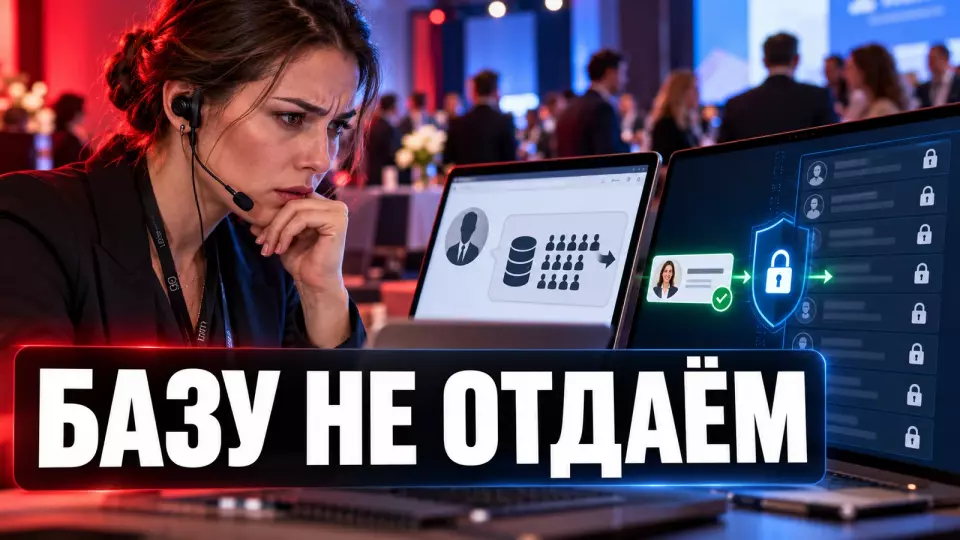
A sponsor wants a measurable result, while the organiser does not want to hand over the registration database as a file. These interests do not contradict each other. Contact can be built as a sequence of permitted actions: show an offer, get a response, open a meeting, transfer selected fields and record the next step.
An unrestricted export looks simple only until the first check. After a spreadsheet is downloaded, the organiser has almost no control over copies, retention periods, new mailings and deletion of the contact after consent is withdrawn. The participant, meanwhile, may not understand why registering for an event turned into emails from several companies.
At Aventura, we first define the goal of the sponsorship package and use aggregate anonymised metrics to confirm reach. A meeting request creates an introduction. The conversation continues after a voluntary transfer of contact details with clear context. This approach preserves the commercial value of the partnership and does not turn a shared database into a commodity.
Leave a request - let's discuss your task
We'll clarify the event format and suggest the next step.
What does a sponsor get instead of a shared database?
The sponsor gets access to pre-agreed touchpoints and results instead of a file with everyone who registered. These can be impressions, responses, meeting requests and voluntarily shared leads, that is, contacts with the topic of interest and the next step. The organiser keeps control over the channel and the terms of the campaign. The participant decides for themselves when to disclose their data.
A shared database is often seen as the main tangible asset of a package. But the spreadsheet itself does not prove interest. It may contain people who are not a fit for the offer, who did not see the integration and did not give separate consent to be contacted for marketing. The sponsor gets volume, but not context.
A workable alternative starts with a rights map. In it we set out what the partner may show to the audience, who they may send a request to, which action unlocks a contact and what data will go into the report. We use the same approach when preparing a brand's participation in a festival: rights to placement, communication and data are described separately.
The sponsor still gets clear commercial results:
- confirmed reach of the offer;
- clicks through to the material or product page;
- questions and requests for more information;
- accepted meetings;
- contacts that participants shared voluntarily;
- the status of the next step after the conversation.
This set is stronger than a random export. It shows a person's journey from contact with the integration to a meaningful action.
Five levels of contact: from reach to voluntary lead
This five-step model helps sell sponsorship value without giving every package the same access. The first level provides aggregated visibility, the second opens controlled communication, the third allows requesting a meeting, the fourth transfers a contact at the participant's initiative, and the fifth records an approved next step. Each new level requires a more explicit action from the person.
The table summarises the key points of this section: Level, What the sponsor gets, What the organiser keeps. Use it as a quick reference when preparing your event.
| Level | What the sponsor gets | What the organiser keeps | Participant action |
|---|---|---|---|
| Aggregates | impressions, visits, clicks, general topics of interest | personal list and raw events | not required for personal transfer |
| Controlled message | access to a selected segment through the organiser's channel | addresses, phone numbers and segment composition | open, click through, reply or opt out |
| Meeting request | opportunity to propose a topic and a slot | contact until the request is accepted | accept or decline the meeting |
| Voluntary exchange | selected contact fields | the rest of the form data | click a button, confirm the exchange via QR code (quick response code) or send a business card |
| Voluntary lead | contact with the topic of interest and the next step | data outside the stated purpose | agree on material, a call, a demo or a quote |
The levels do not have to work only in order. At an exhibition stand, a person may share a business card right after a demo. In a conference app, they will first see a message and then accept a meeting. The main rule is the same: a contact opens up a clear action by the person within a specific mechanic; the participant's status alone does not grant access to data.
Set a separate package value for each level. For an image partner, reach and page visits may be enough. For a product sponsor, meetings and material requests matter more. A general status by itself should not mean an automatic right to download all participants.
Where should registration and sponsor communication be separated?
The split happens at the moment when the goal shifts from organising the event to promoting a partner's offer. The registration form collects data for access, the programme, service and security. Sponsor communication requires a separate check of the legal basis. If the team relies on consent, the individual must see in advance the specific recipient, purpose, channel and the composition of the data being transferred.
Article 5 of Federal Law No. 152-FZ ties processing to specific, pre-defined and lawful purposes. The scope of data must match these purposes and must not be excessive. Article 9 requires consent to be specific, substantive, informed, conscious and unambiguous, and to be given separately from other confirmed information. That is why the formula "by registering, you agree to everything" does not solve the problem.
For direct promotion of goods, works and services via communication channels, the Russian framework requires prior consent. This follows from Article 15 of Law No. 152-FZ and Article 18 of Law No. 38-FZ "On Advertising". A subsequent opt-out does not replace consent before the first advertising message. The applicable legal basis, the wording of the form and the evidence of obtaining it should be checked with a specialised lawyer.
In practice, we separate three streams:
- Registration: the data without which participation cannot be arranged and the stated service cannot be provided.
- Service communication: the programme, route, changes, access and organisational notifications.
- Sponsor contact: a message, meeting, material or transfer of selected fields to a specific recipient.
If consent serves as the basis, a separate action must explain who will receive the data, why, which fields exactly will be transferred and how to opt out of further contact. Consent cannot be hidden inside the general registration text. The button label also matters, but a single label is not enough: the notice, the form, the logging and the ability to prove the person's choice all need to be checked.
"Continue" hides the consequence. "Share my company work email with Company N to send a presentation" describes it directly.
We cover the purpose of fields and different purposes in detail in the material on event participant registration. This logic is useful even before choosing a platform: first the team defines the stream, then it configures the form and access rights.
If you need a production plan with registration, partner integrations and data control, discuss organising a business event. We will build the mechanics before the form opens and rule out questionable data exports in advance.
Roles of the Organiser, Sponsor and Platform
What actually happens matters more than the names of the parties in the contract. You need to check who determines the purpose of processing, selects the data, configures the audience, sends the message, receives the contact and uses it after the event. A single platform may perform a technical operation for the organiser and separately be responsible for its own processes.
In a simple controlled model, the organiser holds the registration database and sets the campaign rules. The sponsor prepares an offer within the package. The platform delivers the message to the selected segment and records actions. Until the participant responds, the sponsor does not see the address and does not receive the list of people.
After the contact is voluntarily transferred, the scheme changes. The sponsor may carry out the agreed follow-up: send the promised material, schedule a call or enter the lead into the CRM system. This action must remain within the purpose and channels that the participant saw. For this stage, the term, the withdrawal route and responsibility for deleting or blocking further messages are defined separately.
The table summarises the key points of the section: Party, Practical area of responsibility, What to check before launch. Use it as a quick reference when preparing the event.
| Party | Practical area of responsibility | What to check before launch |
|---|---|---|
| Organiser | registration, segment, package rights, texts, access and reporting | purpose, data composition, transfer rules and retention period |
| Sponsor | content of the offer and further work with the voluntary lead | whom they write to and why, what they promise, where they store the contact |
| Platform | delivery, selection interface, event log and export restrictions | roles in the contract, access settings, logs and deletion |
This table does not replace legal qualification. The specific contract, interface and data flow should be reviewed by a relevant specialist. The article provides an organisational framework, not individual legal advice.
At Aventura, we add an operations map to the contract. It shows the data source, the recipient, the basis, the permitted action and the owner of the next step. This way, the wording can be compared with the actual platform configuration.
How does messaging work without disclosing contact details?
The organizer forms an eligible segment and delivers the sponsor's advertising message through its own channel or platform only after verifying the recipient's prior consent. Service notifications about the event go out in a separate stream. The sponsor knows the audience criteria but does not see the list of recipients, addresses or phone numbers. The participant sees the sender and the offer, after which they can go to the material, reply, request a meeting or demand that communication stop; after such a request, advertising messages and the corresponding processing must stop immediately.
This mechanic is conveniently assembled as a short process:
- The sponsor formulates the goal, audience, message and call to action.
- The organizer separates advertising from service notifications and verifies the recipient's prior consent.
- The team builds the segment using the minimum number of attributes.
- The platform or organizer sends the message without disclosing the list.
- The participant takes an action, ignores the offer or withdraws consent.
- The sponsor receives an aggregated result and only voluntary contacts.
A Grip press release dated October 7, 2026 describes a similar product model, Audience Campaigns: the organizer sells targeted reach without handing over the list of participants. As of the release date, the feature was in early access for selected Grip Manage clients. What matters to us here is the underlying principle. Access to an audience and access to its contacts can be separated technically and commercially.
The segment, too, should not reveal more than necessary. Industry, professional role or a chosen topic is often enough. You should not automatically add the exact time of attendance, a rare job title, full questionnaire responses or movement history. The narrower the group, the higher the risk of guessing who is in it.
Agree on the frequency and sending window in advance. Several partners may each comply with the limit individually but together create a stream that looks like spam. The organizer sees the overall load and therefore must manage the campaign calendar centrally.
Meeting requests and contact exchange initiated by the participant
A contact is opened after a mutual action. The sponsor sees a limited profile or a relevant card and proposes a specific topic. The participant accepts, declines or leaves the request unanswered. Only after acceptance does the system reveal a minimal channel for coordinating the conversation; the transfer remains tied to the stated purpose and does not open general access to the profile.
A good request explains the value of the meeting. The wording "discuss a demo of a solution for distributed teams" is better than a neutral "let's get acquainted". It is easier for the person to evaluate the offer, and easier for the organiser to distinguish genuine business interaction from mass messaging within the app.
We recommend limiting the number of requests and giving the participant a simple way to decline. An unaccepted request does not become a lead. A decline also should not be passed on as a personal negative signal for a new campaign. General statistics on requests sent, accepted and meetings held are enough for the sponsor.
We cover a similar journey in the article on B2B business workshops with scheduled meetings. The value here comes from a prepared conversation with a topic, an owner and an outcome status. A list of available profiles alone does not provide that.
At a stand, the initiative may look different. The participant shows a personal QR code, taps "share contacts" or sends a digital business card to the sponsor's staff member. Before confirmation, the screen should name the recipient, the purpose and the fields. Simply being at the stand does not replace that choice.
For projects with an exhibition area, it is useful to link this mechanic in advance with organising exhibitions and stands. Then the QR code, the work of promotional staff, the demo scenario and the follow-up contact are designed as a single chain.
What counts as a lead after a badge scan?
A lead emerges after a confirmed handover of contact details together with the topic of interest and the next action. A scan may mean entering the hall, receiving a piece of material, taking part in a prize draw or a brief introduction. If every event is called a lead, the report will grow, but the sponsor won't understand who to continue the conversation with and about what.
First, assign a meaning to each signal:
The table brings together the key points of this section: Signal, What it confirms, What it does not confirm. Use it as a quick reference when preparing an event.
| Signal | What it confirms | What it does not confirm |
|---|---|---|
| Profile view | the person saw the page or material | interest in a call or in handing over contact details |
| Click | the person opened the selected follow-up | consent to any future messages |
| Badge scan | the configured action at the point took place | the same purpose for all scanning scenarios |
| Accepted meeting | the person agreed to a conversation | indefinite use of the contact |
| Business card handed over | the selected fields went to the specified recipient | the right to extend the purpose without a new basis |
| Next step | the parties agreed on a specific action | an automatic sales success |
Scanning should be visible and clear: the stand staff member explains what will happen after the action. The confirmation screen shows the fields. The system stores the time, the recipient and the version of the notification. If the person only wanted to receive a file, that request should not be turned into consent to calls on other topics.
In the article about the exhibition stand as a funnel, we link the contact to the content of the conversation. This link is especially important with a large flow of visitors: without a note, the sponsor will see only a name a few days later and won't remember the promise.
Lead card: minimum data and context
A lead card should contain only the data needed for the promised follow-up, plus brief context from the conversation. A working channel, company, role, topic of interest, agreed next step and responsible employee are usually more useful than a full registration form. The fewer unnecessary fields, the easier it is to use the card for its intended purpose and to manage access.
The scenario determines what the card contains. Sending a presentation may require only a name, work email, chosen topic and the name of the material. A scheduled meeting needs a time slot and a coordination channel. A quote may require a brief description of the task, but not a person's history of visits across the entire event.
We use the following procedure:
- Record the source of the contact: meeting, stand, form, QR code or reply to a message.
- Specify the exact recipient on the sponsor's side.
- Save the purpose and the fields submitted.
- Add the topic of interest in the participant's own words or as a neutral category.
- Record the promised action and deadline without inventing a readiness-to-buy score.
- Assign the owner of the next contact.
- Save the status of follow-up, decline or promise fulfilled.
Do not copy every answer from the registration form into the card "just in case". A field should help deliver the stated action. If the team cannot explain why the sponsor needs a city, a personal phone number or a list of attended sessions, it is better not to pass that field on.
Context reduces both commercial and organisational risk. The employee sends the material they promised, not a generic email sequence. We also apply these follow-up principles in post-conference content: a personal reply and mass communication serve different purposes.
How do you put together a sponsor report without a list of people?
The report is built around an action funnel, and individual rows are included only for leads who shared their details voluntarily. The sponsor sees reach, response, meetings, contact exchanges and completion of next steps. The organiser does not add a list of people who simply received a message, visited a page, declined a request or walked past the stand.
Start with the questions the report needs to answer. It should show whether the audience saw the integration, whether the offer was relevant, which actions people chose, how many meetings took place, which topics prompted a request to continue, and where the chain stopped because of the interface, the schedule or the content of the offer.
A workable report structure:
- placements and display periods;
- number of messages delivered without a list of recipients;
- opens or views, if the platform counts them correctly;
- clicks on the call to action;
- meeting requests sent and accepted;
- meetings held;
- contacts shared voluntarily;
- topics of interest grouped into broad categories;
- agreed next steps;
- a description of the methodology and counting limitations.
Do not add impressions, scans, meetings and leads together into a single total figure. These events have different value. Do not call the sum of metrics unique people if one participant could have taken several actions.
Aggregated metrics also need checking. A rare job title, a single company in a category and an exact visit time can identify a specific person. We merge groups that are too narrow and remove detail that does not help decision-making. There is no universal threshold for all projects, so it is set after assessing the audience and the risk of the report revealing which person is meant.
If reporting is part of a larger conference programme, it is better to include it in the overall plan for organising a conference. Then the sponsor's metrics are linked to the schedule, the app, the stands and registration, rather than being compiled manually after the event.
The agreement, the interface and the activity log
A secure setup only works when the agreement, the user interface and the technical log describe a single flow. The agreement defines the purposes, roles, data and restrictions. The interface gives the person a clear choice. The log proves which message they saw, what they did, which fields were shared and how the team handled any subsequent opt-out.
It is convenient to run the check before launch:
- Map the data flow from registration to the report and any follow-up contact.
- For each operation, state the purpose, the owner, the recipient and the minimum fields.
- Compare the map with the agreements of the organiser, the sponsor and the platform.
- Check the wording of forms, buttons, QR screens and meeting requests.
- Restrict roles, exports and employee access.
- Set up a log of versions, actions, transfers and opt-outs.
- Walk through the test journey as a participant and as a sponsor representative.
- Make sure the report does not expose individuals through overly narrow segments.
The minimum log stores the internal identifier of the participant and the sponsor, the notification version, the purpose, the set of fields, the validity period, the channel, whether the transfer took place and the status of any subsequent opt-out. The retention period is set for each specific process. It should not be assigned automatically just because the platform allows data to be stored for a long time.
Recommendations from Roskomnadzor published on Consultant.ru advise minimising the list of data, storing incompatible categories separately and separating identifiers from interaction history. The European Data Protection Board (EDPB) and the UK Information Commissioner's Office (ICO) provide separate guidance for the European Union and the United Kingdom: purpose, legal basis, transparency and protection must be designed before communication starts. These materials do not replace a review under Russian law.
This does not mean that one setup suits every company and country. You need to take into account the applicable law, contracts, storage location, transfer or processing of data outside the country, the content of the offer and the actual actions of the parties. A specialist lawyer should be engaged for the final legal assessment.
At Aventura, we can put together the operational side: the sponsor's rights map, contact points, team roles, platform requirements and the report structure. The main principle remains simple: do not hand over a shared database if the commercial objective can be achieved through a controlled action by the participant.
Frequently asked questions
The sponsor gets access to pre-agreed touchpoints and results instead of a file with everyone who registered. These can be impressions, responses, meeting requests and leads shared voluntarily, that is, contacts with a topic of interest and a next step. The organiser keeps control over the channel and the terms of the campaign. The participant decides when to disclose their data.
This five-step model helps sell sponsorship value without giving every package the same access. The first level provides aggregated visibility, the second opens controlled communication, the third allows a meeting to be requested, the fourth passes on a contact at the participant's initiative, and the fifth records an authorised next step. Each new level requires a more explicit action from the person.
The separation happens at the point when the purpose shifts from organising the event to promoting a partner's offer. The registration form collects data for access, the programme, service and security. Sponsor communication requires a separate check of the legal basis. If the team relies on consent, the person must see in advance the specific recipient, the purpose, the channel and the composition of the data being transferred.
What actually happens matters more than the names of the parties in the contract. You need to check who determines the purpose of processing, selects the data, configures the audience, sends the message, receives the contact and uses it after the event. A single platform may perform a technical operation for the organiser and separately be responsible for its own processes.
The organiser builds an eligible segment and delivers the sponsor's advertising message through its own channel or platform only after verifying the recipient's prior consent. Service notifications about the event go out as a separate stream. The sponsor knows the audience criteria but does not see the list of recipients, addresses or phone numbers. The participant sees the sender and the offer, after which they can go to the material, reply, request a meeting or demand that communication stop; after such a request, advertising messages and the related processing must stop immediately.
The contact is disclosed after a mutual action. The sponsor sees a limited profile or a relevant card and proposes a specific topic. The participant accepts, declines or leaves the request unanswered. Only after acceptance does the system disclose the minimum channel for coordinating the conversation; the transfer remains tied to the stated purpose and does not open general access to the profile.
Leave a request and we'll discuss your task
We'll clarify the format of the event and suggest the next step.
Sources
- Article 5 of Federal Law No. 152-FZ: principles of personal data processing
- Article 9 of Federal Law No. 152-FZ: consent to personal data processing
- Article 15 of Federal Law No. 152-FZ: direct promotion via communication channels
- Article 18 of Federal Law No. 38-FZ: advertising via telecommunications networks
- Consultant.ru: Roskomnadzor recommendations for personal data operators
- EDPB: Process personal data lawfully
- Grip: Audience Campaigns press release of 7 October 2026
- ICO: Plan direct marketing
Contents
Was this article helpful?