The entire program, guest and speaker allocation, ambiance and decorations, technical equipment, brochures, badges, stands, branding materials, catering, transportation, accommodation, advertising, media... The list could go on and on. And behind all this are event managers – the people on whom the success of the event depends. People who are responsible for everything.
Are you getting ready for a long-awaited corporate party? Or planning a business trip to a conference? Or perhaps you're looking forward to an exciting team building? Whatever the events, participants and guests usually find them action-packed and fun. But not everyone thinks about the tremendous amount of work the organizers did before the event.
How to get everything done? How not to miss anything, forget anything, or be late? After all, sometimes the slightest glitch, 'hiccup', malfunction, or force majeure can spoil the impression of the entire event. And some events take months to prepare, with hundreds and thousands of participants involved!
Therefore, to organize and systematize all preparation issues, organizers use supporting materials. These are documents, checklists, plans, and estimates — in short, everything that visualizes the process and helps avoid misunderstandings. The team at Aventura event agency decided to share their secrets and show event preparation from the inside. These materials and documents will help you organize a perfect event, for example, if you decide to hold an event on your own. Our article will be useful primarily to marketers, heads of PR and HR departments.
Brief
This is one of the most important stages. When communicating with the company's head, it is important to understand the goals and objectives of the event, grasp the concept and the main idea, so that you can later implement it as accurately as possible. Sometimes these wishes are expressed between the lines, and you need to feel them.

|
|
|
The brief consists of several blocks. For example, we use the following structure:
- Basic event information (date, time, city and venue, occasion, key message (expected results), event goal, format (corporate event, opening, team building, conference, seminar, presentation, press conference, promotional campaign, sponsorship, off-site event, new product launch, other).
- Audience (total number of participants, average age, composition: employees %, partners %, VIP guests %, press %, of which: men %, women %).
- Venue preferences (restaurant, countryside complex, hotel complex, nightclub, conference hall, open-air venue, exhibition centre, VIP area available, other).
- Logistics support (guest transfers, logistics for travel from different cities, accommodation arrangements, parking availability, special conditions).
- Catering format (banquet, standing buffet, seated buffet, coffee break, picnic (barbecue), cocktail reception).
- Technical requirements (lighting, sound, stage structures, video equipment (LED screens, plasma panels, projection equipment), decoration, decor, special effects (laser show, light show, 3-D projection, etc.).
- Advertising and image support (gifts, souvenirs, invitations, badges, branded bags, pens, notebooks, T-shirts, caps, certificates, awards, banners, posters, other).
- Event programme
- Official part (management speech, employee speech, partner speech, awards ceremony, presentation film, image video)
- Show programme (host/MC, show ballet, DJ, live music, original genre, pop 'star', pyrotechnic show (fireworks), show acts, other)
- Additional (photo-video, filming of excursions, interpreter, venue branding, guest registration, other)
- PR support (media outreach, organizing a press conference, social media promotion, writing PR posts, internal corporate PR).
- Estimated event budget (excluding VAT)
- Contact information of the client (full name, position, contacts).
Event concept presentation
A presentation is a visualized event concept — how you see it based on previous discussions. It is a concise preliminary event programme reflected in several succinct slides. It should not include all the information; tell about the brightest and most interesting moments, nuances and 'tricks'. Inspire them with your idea through the slides so that the manager believes in you and your concept.

|
| Example of an event presentation |
In a presentation, you can outline the event's goals and objectives, its format, style, and branded elements, briefly describe the script, its main stages, highlights, and entertainment programme. At each stage, show the expected result, how specific objectives will be met, and how the concept will be implemented. Don't forget to mention the project's uniqueness, creativity, and innovations. If any special conditions are required, this can also be noted.
A successful presentation is the key to the successful implementation of your idea. The ideal option would be to offer alternative concepts (2–3). The manager will appreciate your efforts and responsible approach to work.
Event budget estimate
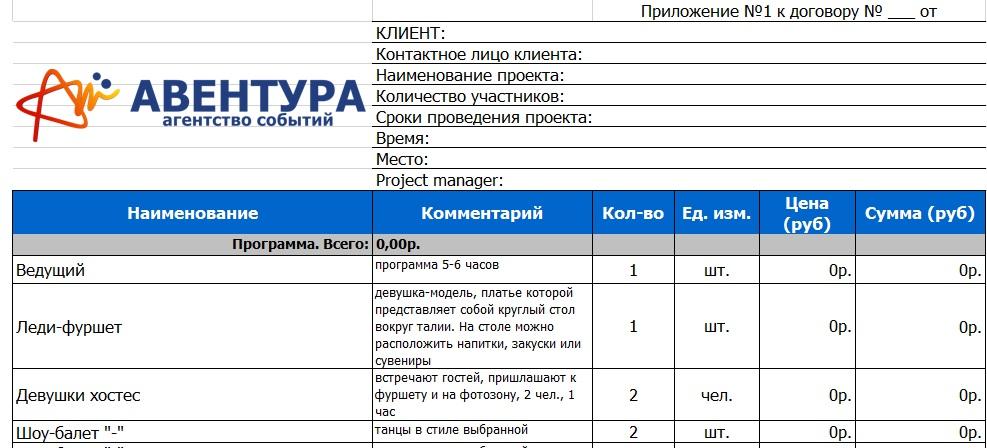
A budget estimate is a preliminary list of expenses required to implement this project. It is needed so that the manager can assess the upcoming costs. Usually the estimate is calculated at the maximum, and during the approval process it is adjusted: reduced or, conversely, increased. In any case, before drawing up an estimate it is important to know what budget can be counted on.
The estimate must specify main and additional expenses: venue rental, payment to hosts, artists, and the sound engineer, equipment rental, transport, decoration, props, gifts for guests, catering, etc. If you seek help from an event agency, the estimate should include the cost of organizing the event: script development, administration, staff work, and more.
It is important to think everything through in advance in order to take every detail into account. Otherwise, the allocated budget may not be enough. If some points of the estimate are not entirely clear, it is worth discussing possible budget fluctuations with the manager. Sometimes a percentage for unforeseen expenses is included in the estimate.
|
| Sample event budget estimate |
Contracts, invoices, and service acceptance certificates
Every stage of preparing for an event must be supported by documents. Initially, this means a contract with the event agency. This document governs your cooperation within the legal framework. Therefore, it is very important to set out in it all clauses, nuances, duties, and responsibilities of each party. If misunderstandings arise (which, unfortunately, sometimes happen), the contract is your main protector.
Outline all possible cooperation scenarios, including force majeure situations, as well as boundaries. The same applies to contractor companies if you organize the event yourself. Every agreement and every service must be documented — by a contract or a receipt. Do not forget about small expenses either; keep receipts for all purchases.

|
| Signing the contract |
Event timeline with contractor contacts
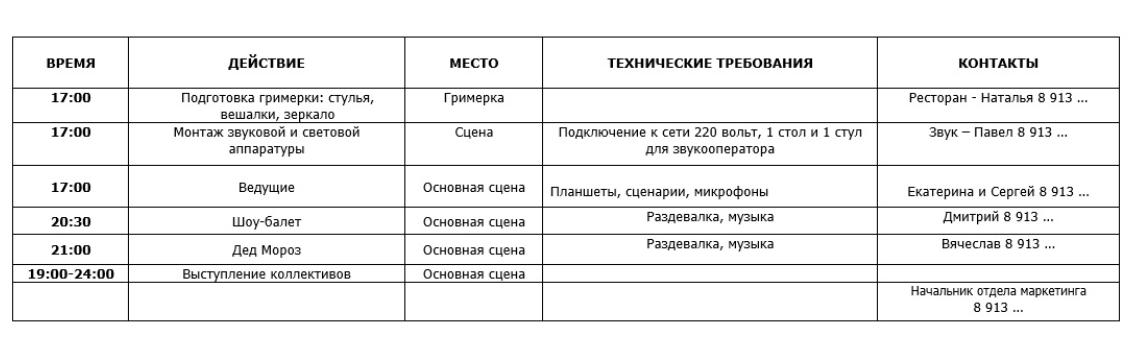
An event timeline is an important internal document for the organizer, where all stages of the event and the actions of participants are set out minute by minute. It is drawn up in chronological order, taking into account the time for setup and dismantling. The timeline makes it possible to assess the duration of each technical moment of the event.
|
| Sample timeline |
It includes stage preparation work, the actions of the hosts, artists' performances, time for speeches, award ceremonies, breaks, entertainment elements, the buffet, etc. The mandatory items of the table are the time, action, location (stage, dressing room, hall), the person responsible with their contact details (so that they can be contacted quickly in case of a delay), and notes (technical requirements, necessary props, and other nuances).
The timeline controls the course of the programme and helps keep within the required time without stretching any individual stage. The more detailed the timeline, the better coordinated every member of the organizing team is.
Checklist
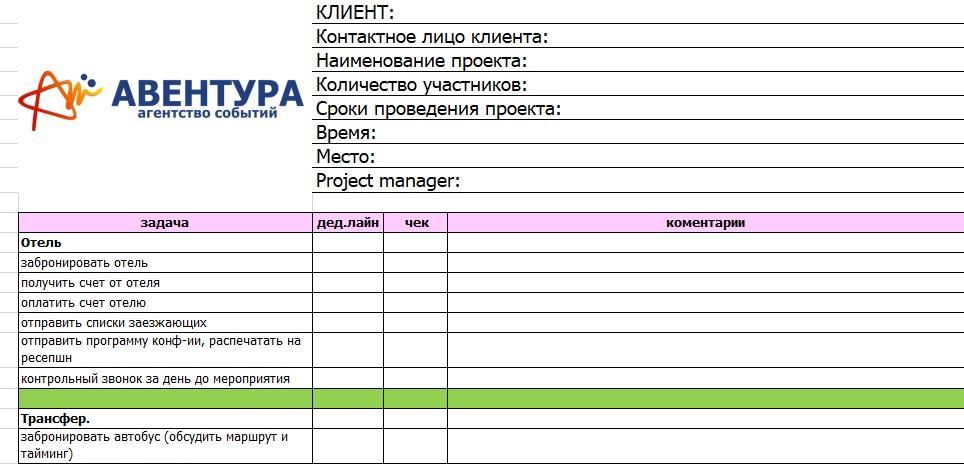
A checklist is a detailed list of everything needed for the event, a so-called to-do list. It makes it possible to see what has already been done and prepared and what has not, what needs to be done first, and what can be postponed.
The checklist can constantly change, expanding with new items. For convenience, it is formatted as a table by blocks or thematic groups: hosts, show programme, lunch, gifts, printed materials, transport, hotel, etc. Opposite each item there is a completion mark, a deadline, and notes.
|
| Sample checklist |
How to create a checklist correctly?
-
Create a table with the necessary goals and break them down into tasks
-
Set deadlines, add a column for task completion, and don't forget about comments
-
Keep your wording unambiguous, short and clear
-
Highlight all the most important things with colors and bold text
-
Customize the list for each project
-
Cross out minor items you can do without. Checklists should not be long.
-
Don't forget the list of everything needed to deliver the project (what is important to take with you: a list of all sorts of little things)
Keeping “1000 little things” in mind and not missing a single detail – this is the main purpose of a checklist.
Technical sheet
This is a list of the required equipment: stage, lighting, sound, etc. It sets out all requirements for the external side of the event and for technical equipment. It is drawn up based on the script, which gives rise to additional conditions (for example, video streaming equipment, internet access, a stage with a projection screen, mobile barriers, etc.). It also sets out the security requirements for the event: metal detectors, cameras, walkie-talkies and the like.
Event script
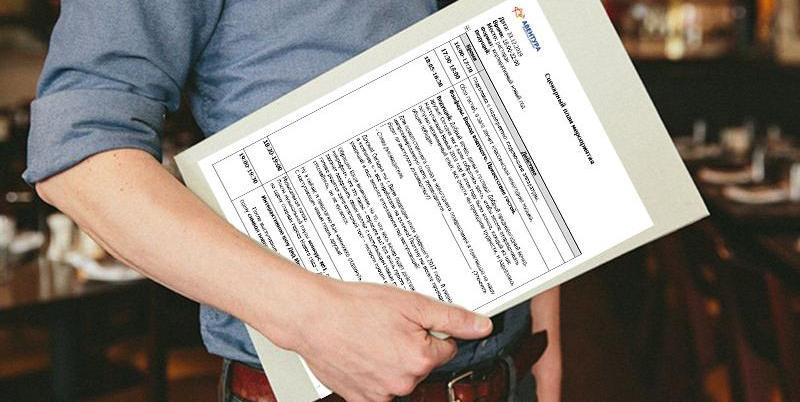
It can be brief (a script outline) or detailed. The brief one sets out the main stages of the event and the actions of the hosts and other participants, with timings. A detailed script is a full description of the entire event, with the speech of each speaker, the competitions, entertainment acts and breaks set out. Following the script is an important nuance that helps you “keep everything and everyone under control”.
|
|
|
But don't despair if something does not go to plan. Rework the script as you go, change the order of the acts, replace one competition with another. Only you and your team know about this. Guests most likely will not even suspect that anything went wrong. But after the event is over, be sure to conduct a lessons-learned review and identify the causes so that such “failures” do not happen in the future.
As you can see, organizing an event is far from an easy task, so it is often best to entrust it to professionals. The specialists at the Aventura event agency always approach every stage of event planning and delivery with diligence. We carefully draw up each of the documents described above to prevent any force majeure. We hope our experience will be useful to you.
Was this article helpful?