A practical roadmap for opening a logistics centre: audiences, checkpoints, tour, ceremony, filming, team roles and Plan B.
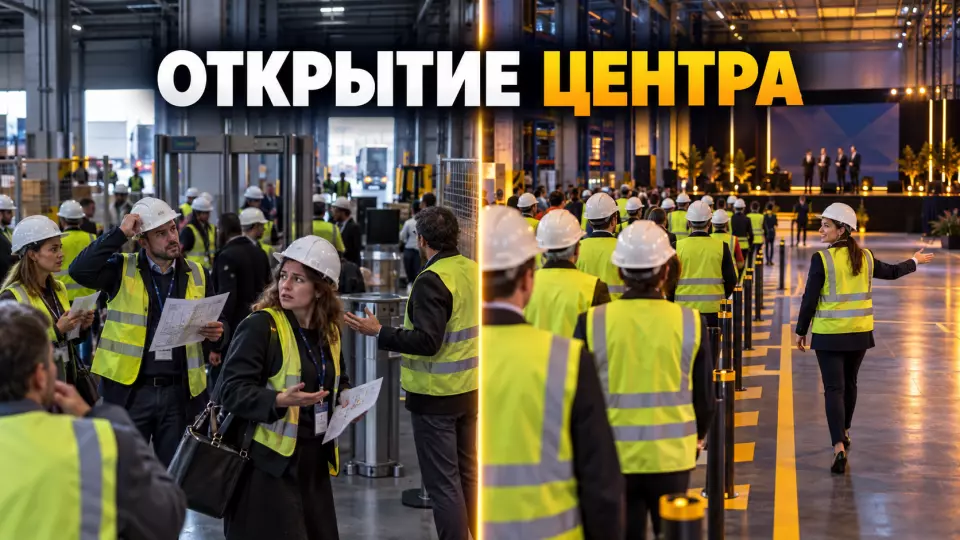
The opening of a logistics centre takes place at a facility where access control, transport flows and operating rules are already in force. That is why the ceremony cannot be planned separately from the route. A guest should move from the arrival point to registration without unnecessary waiting, understand the purpose of the launch, see the permitted part of the logistics chain and leave the facility in an orderly way.
At Aventura, we start a project like this not with the stage and decor. First we define the audiences, access boundaries and the processes that can be shown. Then we link the official part, tour groups, press, service and the facility's operations into a single scenario.
Leave a request — let's discuss your task
We'll clarify the event format and suggest the next step.
What should the opening of a logistics centre achieve?
The opening of a logistics centre should explain why the company, its clients or the region need the new facility. A working programme confirms this meaning through approved demonstrations of operations, conversations with management and a clear next step after the event. An open walk through the warehouse and a separate ceremony do not achieve this goal.
First, we formulate one main outcome for each audience. Management presents the facility's role in the company's development, while partners receive the context of joint work.
For employees, it is important to see the team's place in the launch. Media representatives need a verifiable statement, prepared speakers and approved footage.
An overly broad goal such as "show the centre" does not help build a programme. It leads to a long route and disputes about every zone. A more precise objective sounds like this: explain the centre's role, demonstrate several supporting stages and create conditions for a meaningful conversation with guests.
For an opening project, the logic of organising presentations and openings is suitable, but a restricted-access facility requires separate work on clearance and movement. If you need to compare approaches to a production and a logistics site, the material on opening a factory is useful. It examines in more detail the boundaries between the ceremony and the facility's operations.
Audiences and access boundaries
Different guests may have different goals, but access rules remain the same for the entire facility. We do not promise everyone the same depth of tour. Instead, we determine in advance what each group should understand, where it may be located, whom it talks to and what materials it receives after the opening.
The table summarises the key points of this section: Audience, Main outcome, What can be included in the programme. Use it as a quick reference when preparing the event.
| Audience | Main outcome | What can be included in the programme | What to agree in advance |
|---|---|---|---|
| Management and honorary guests | Understand the significance of the launch | Official block, key points of the route, group photo | Protocol, order of speeches, escort |
| Partners and clients | Link the facility to joint work | Approved operations, meeting with experts, business networking | Public statements, questions, confidential data |
| Employees | See the team's role | General ceremony and safe participation zones | Shift schedules, access, internal communications |
| Regional and industry representatives | Receive approved context | Protocol part and meaningful stops | Guest status, wording, order of comments |
| Media | Receive facts, comments and footage | Press point, speakers, approved filming route | Accreditation, equipment, comment topics, restrictions |
The matrix does not replace the guest list. It helps avoid mixing tasks. For example, a partner may need a business meeting after the tour, while a journalist needs a filming position before the main group starts moving. These blocks may run alongside each other in time but require different coordinators.
We also separate the mandatory part from the optional one. If an audience should not enter the operational zone, a meaningful substitute is prepared for them in an accessible room. This could be a diagram, a model, a video or an expert explanation. This option is better than an impromptu walk into an area that the facility has not approved.
How do you put together a guest journey from the gate to the exit?
A guest journey is designed as a continuous chain of decisions. A single line on a building plan is not enough for this. The chain includes the invitation, arrival, access, briefing, ceremony, tour, service blocks and exit. For each point we define the goal, the person responsible, the next transition, the constraint and the fallback option.
The working sequence looks like this:
- Invitation and confirmation. The guest receives the arrival time, the access route, and the requirements for documents, clothing and filming.
- Approach and drop-off. Transport arrives at the agreed point without crossing the site's operational logistics unless its services have approved it.
- Checkpoint (CP). The access service checks the details, while the coordinator helps the group gather in the permitted area.
- Registration. The team records actual attendance, issues badges and passes non-standard cases to the person responsible.
- Preparation for the route. Guests leave their outerwear, receive the permitted equipment and go through a short briefing.
- Official opening. Management explains the purpose of the launch, after which the technically checked central episode takes place.
- Division into groups. Group leaders check the composition and start moving only after the site gives permission.
- Content stops. Guests see the approved stages and listen to prepared speakers.
- Press block, negotiations or catering. The flows split according to the programme and do not block working passages.
- Gathering and exit. The team checks the groups, collects the issued equipment and accompanies people to the transport.
The British Health and Safety Executive (HSE) recommends separating pedestrian and vehicle routes wherever possible, and familiarising visitors with the rules before they are admitted to working areas. It also advises staggering movements in time if an increase in pedestrian flow is expected. That is why the tour time is agreed with the centre's working schedule and the speakers' timetable.
The route needs to be walked on foot before the programme rehearsal. A plan may not show a noisy point, a slippery section, oncoming flow or a door that cannot be left open. A full approach to checking transitions is covered in the article on the technical rehearsal of an event.
Registration, access and group allocation
The registration desk at the opening of the logistics centre records arrivals and helps guests with the programme. The decision on entry is made by the venue's security service. A single register links checkpoint data, actual registration and the composition of tour groups. We determine in advance who handles a disputed case so that it does not hold up the entire flow.
The current register records invited guests and separately notes those who actually entered the venue. This data is needed for moving groups and helps the responsible services account for visitors during an evacuation. The specific procedure is determined by the venue's documents and specialists.
It is better to separate the main flow from non-standard cases. A data error, a substitute participant, a late arrival, unauthorised equipment or an accessibility request may each require a separate decision. The coordinator does not promise entry and does not amend the venue's requirements at their own discretion. They refer the matter to the designated decision owner.
After registration, guests are divided into groups before they reach the first work area. Each group has a lead, a venue escort and a clear meeting point. The composition is not changed en route without confirmation. We cover the single register, backup check-in and queue management in more detail in our article on event participant registration.
If groups arrive from different locations, guest logistics and transfers are linked to access windows. A bus must not bring the next group before the drop-off area is free and the team is ready to receive people.
Leave a request - let's discuss your task
We'll clarify the event format and suggest the next step.
A Tour of the Logistics Chain
A tour at the opening of a logistics center reveals the main thesis through several coordinated stops. There is no need to show the maximum number of rooms. We put the points together into a clear overall story of the movement of goods or an order. The actual set of stops is determined by the facility, taking into account risks, operating hours and confidentiality.
The narrative can go from receiving to putaway, picking, inspection, packing and shipping. This is the exact sequence of operations used by the Amazon operator in its public description of a tour of a fulfillment center. This is an example of clear dramaturgy, not a universal standard for any warehouse.
For each stop we prepare a card:
- the question this point answers;
- the permitted process or object to show;
- the name and role of the prepared speaker;
- the group's location and the direction of the next movement;
- the permitted angle for photos and video;
- the data that can be mentioned publicly;
- the signal to end the explanation;
- a replacement if the point becomes unavailable.
A stop works when the guest understands the connection between the operation and the overall task of the center. Simply listing equipment rarely helps. It is better to explain which part of the flow the area demonstrates and why it matters to the client or the company. At the same time, the control system screen, client markings, documents and personal data must not appear in the narrative or the frame without permission.
The World Intellectual Property Organization classifies access control and limiting the number of people as reasonable measures to maintain confidentiality. Therefore, no-photography signs are useful, but they are not enough. You need a map of permitted areas, escorts and a clear review of materials. We discuss a separate procedure for media in the article about a press tour of a production facility.
Opening protocol and the central moment
The official opening of a logistics centre should be short, substantive and connected to what guests will see next. The host sets out the meaning of the event, management provides verifiable context, and the central moment creates a clear transition point to the tour. A long string of speeches tires guests and eats into the time the site has allocated for the tour.
The basic sequence can be put together as follows:
- The team confirms that key guests and the site are ready.
- The host welcomes the audience and explains how the programme will run.
- A representative of the client explains the main significance of the launch.
- If required, a partner or a regional representative speaks.
- Participants perform a pre-approved symbolic action.
- The photographer takes a group shot, after which the coordinators begin dividing guests into groups.
Corporate publications by Walmart and FedEx show that distribution centre openings can bring together management, employees, clients and government representatives. The programme also includes a technology story and a ceremonial finale. For us, this is an example of how meaningful roles are distributed. The guest list for each project is determined individually.
Besides ribbon cutting, there are other options for the central moment. It could be the launch of an approved visual panel, the unveiling of a branded element or another safe gesture. The choice is confirmed by the technical services. The moment is rehearsed with the people responsible for sound, visuals, the movement of participants and clearance to start the next part.
Halfway through the preparation, the timing and the meaning of each block are checked once again. We publish short breakdowns of business formats and teamwork in the Aventura Telegram channel.
How to separate people, equipment and service areas?
Guest and work flows must be separated physically, organizationally or by time. Registration, cameras, catering and the tour group should not share the same passage. The solution is tested on the actual site before installation. If stable separation is impossible, the venue defines a controlled window, changes the route or removes the point from the program.
HSE considers full separation of people and equipment preferable where possible. Among practical measures, the regulator names separate paths, barriers, markings and signs. These foreign recommendations do not replace Russian requirements and the assessment of a specific venue. They confirm a basic principle: driver attention and guest discipline should not be the only protection.
The table summarizes the key points of the section: Area or interface, Main risk to the program, Working solution. Use it as a quick reference when preparing an event.
| Area or interface | Main risk to the program | Working solution | Who confirms |
|---|---|---|---|
| Drop-off and checkpoint | The group intersects with work transport | Separate meeting point or agreed window | Venue representative and transport coordinator |
| Registration | The queue blocks the entrance | Waiting area and separate handling of non-standard cases | Access service and registration coordinator |
| Tour transition | Oncoming movement of equipment | Protected path, controlled crossing or rescheduled passage | Route manager |
| Press position | Cameras extend into the work passage | Marked positions and separate time for shots | Media coordinator and venue |
| Catering | Delivery conflicts with guest flow | Service window and separate receiving area | Venue and food supplier |
| Stage or screen | The structure obstructs the exit or route | Plan review and acceptance before guest access | Technical manager and relevant services |
Temporary infrastructure is accepted after inspection, not immediately after installation is completed. Municipal recommendations from Rother and Dover suggest documenting design data, installation, risk assessment, free exits and written confirmation of the safety of temporary elements. At a Russian venue, the set of documents is determined by applicable requirements and responsible specialists, and this article does not replace their decision.
If reception is needed after the route, the catering location and scheme are agreed before installation. Catering cannot be added to the last free corner. Delivery, storage, cleaning, staff movement and guest accessibility must be taken into account.
Command center, roles and team decisions
A project must have a single command center and separate function owners. At Aventura, we coordinate the programme, transitions and team communications, but we do not override the venue's decisions on access, security, operations and public data. Every critical block gets a primary owner, clear authority and a pre-assigned backup.
A public role model may look like this:
- the project manager is responsible for the overall programme and priorities;
- the venue representative confirms operating hours and the availability of areas;
- the route owner authorises movement and can stop a section;
- the protocol coordinator looks after key guests and the central episode;
- the registration coordinator manages the register and non-standard cases;
- group leaders verify composition and transitions;
- the media coordinator is responsible for accreditation, filming and speakers;
- the technical lead controls sound, video and temporary infrastructure;
- the command centre dispatcher records messages and decisions.
The team reports not everything it sees, but what requires a decision. A working message contains the location, the fact, the impact on the programme and the action needed. For example, a coordinator reports that one stop has been closed by the venue and the group needs an approved backup. They do not discuss the reason on the general channel if that information is not intended for the whole team.
For a complex opening, it is decided in advance who makes contentious and urgent decisions. The team distributes four authorities: to stop the route, to change the order of speeches, to authorise additional filming and to inform guests of a delay. We cover the detailed team communication scheme in the article on event command centre and radio communication.
Accessibility, Filming and Confidentiality
The entire guest journey is checked for accessibility, and filming is agreed with regard to people's rights and the venue's rules. A convenient entrance or a no-camera sign is not enough. You need to walk the chain from parking and registration to the main points, restrooms, gathering point and exit.
Official US Department of Justice standards describe an accessible route as a continuous connection between arrival, entrance and accessible spaces. We use this principle as a guide, but we do not transfer American dimensions into a Russian project. The specific parameters are determined by the applicable regulations and a site survey.
If a mandatory point is inaccessible to some guests, the solution is prepared before the final programme is sent out. You can change the main route or offer an equivalent format of the show in an accessible area. The coordinator must know the solution in advance, rather than looking for a freight lift or a detour in front of the group. More about the full participation journey is in the article on inclusive corporate events.
Two maps are prepared for filming. The first shows the permitted and restricted areas of the venue. The second determines which people can be filmed and for which materials.
Article 152.1 of the Civil Code of the Russian Federation links the publication and further use of a person's image to consent, except in cases provided for by law. Therefore, the phrase "anyone can be filmed at the event" is not suitable. The consent form and legal basis are checked by the client's lawyer.
We mark in advance the screens, labels, documents, serial numbers and access system elements that must not appear in the frame. For official content, you can arrange event photography and videography. The brief specifies the shot list and the procedure for reviewing files before publication.
How to prepare a Plan B and a run-through?
Plan B is built alongside the main scenario and tested on the actual route. Every change needs an observable signal, a person responsible for the decision, a fallback action, a message to guests and a condition for returning to the programme. A simple list of possible problems is not enough if the team does not know who is authorised to change the course of the opening.
It is worth preparing solutions for at least the following classes of changes:
- one of the tour points has become unavailable;
- the group was delayed at the checkpoint or registration;
- a speaker or guest of honour did not arrive for their slot;
- the screen, sound or central episode is not ready;
- journalists brought equipment that was not agreed in advance;
- the weather disrupted an outdoor transition or the operation of a temporary structure;
- the venue introduced an additional restriction;
- transport arrived earlier or later than the agreed window.
HSE recommends taking extreme weather, wind load, exits, traffic movement and the placement of temporary structures into account already at the site design stage. This means that a weather contingency changes more than just guest comfort. It can change the entrance, the waiting area, transitions, boarding transport and the very possibility of using a temporary structure. Threshold values are taken from the design and operating documents, not from general advice.
The run-through follows the guest journey. The team goes through disembarkation, the checkpoint, registration, briefing, the ceremony, stops, the press point, catering and the exit. After each observation, a person responsible and a deadline for re-checking are assigned. If you need to build a contingency through roles and authority, the material on the event crisis plan will be useful.
Final check before guests arrive
The team checks the readiness of every interface, not just the run of show. We verify the actual route, access, group composition, speakers' remarks, temporary structures, communications and contingency plans. If a critical area is not signed off, it is closed, replaced or opened later, but it is not included in the flow on a promise that "we'll make it."
The final process is best run in a single order:
- The venue's operations service confirms the available areas and movement regime.
- The registration coordinator receives the latest approved version of the register.
- Group leaders check the meeting points and transitions.
- The route owner walks the primary and backup paths.
- The technical lead signs off on sound, video and temporary elements.
- The media coordinator checks camera positions, speaker positions and restricted areas.
- The service team confirms water, cloakroom, catering and cleaning.
- The command centre holds a short briefing on changes and the conditions for stopping the route or an individual block.
- The project manager authorises the start of guest reception after the function owners have confirmed.
It is useful to include an organised exit in this check. Groups need to be assembled, issued equipment returned, and transport brought to the agreed window. The guest should understand where the official programme ended and whom to contact with a business question after the event.
Before launch, we bring the ceremony, the route and the team's authority into a single plan. Guests are shown only the agreed areas, while contentious decisions stay within the command centre. At Aventura, we can link the business programme, tour groups, protocol, filming and command centre operations into a single scenario that complies with the venue's rules.
The public materials below support the external principles of the article. International recommendations serve as guidelines for designing the route and programme, but do not replace Russian legal requirements. Corporate publications are given only as examples of programme content. Specific requirements are confirmed by specialist professionals and the venue's documents.
Frequently Asked Questions
The opening of a logistics centre should explain why the company, its clients or the region need the new facility. A workable programme confirms this meaning through an approved demonstration of operations, communication with management and the next step after the event. Free access to the warehouse and a separate ceremony do not achieve this.
Different guests may have different goals, but access rules remain the same for the entire facility. We do not promise everyone the same depth of tour. Instead, we determine in advance what each group needs to understand, where it may be, whom it talks to and what materials it receives after the opening.
The route is designed as a continuous chain of decisions. A single line on a building plan is not enough for this. The chain includes the invitation, arrival, admission, briefing, ceremony, tour, service blocks and exit. For each point we define the goal, the person responsible, the next transition, the restriction and the fallback option.
The registration desk at the opening of a logistics centre records arrivals and helps guests with the programme. The decision on entry is made by the facility's security service. A single register links checkpoint data, actual registration and the composition of tour groups. We determine in advance who handles a disputed case so that it does not hold up the entire flow.
The tour at the opening of a logistics centre reveals the main message through several agreed stops. There is no point in showing the maximum number of premises. We put the points together into a clear overall story of the movement of goods or an order. The actual set of stops is determined by the facility, taking into account risks, operating hours and confidentiality.
The official part of the opening of a logistics centre should be short, substantive and connected to what guests will see next. The host sets out the meaning of the event, management provides verifiable context, and the central episode creates a clear point of transition to the route. A long series of speeches tires guests and reduces the time the facility has allocated for the tour.
Leave a request — let's discuss your task
We'll clarify the event format and suggest the next step.
Sources
- HSE: separation of pedestrians and vehicles
- HSE: traffic management
- HSE: site design and weather conditions
- US Department of Justice: accessible route standards
- WIPO: trade secret protection
- Civil Code of the Russian Federation, Article 152.1: protection of a citizen's image
- Amazon: fulfilment centre tour route
- Walmart: distribution centre opening programme
- FedEx: distribution centre opening
- Rother District Council: site plan and temporary structures
- Dover District Council: inspection of temporary structures
Contents
Was this article helpful?