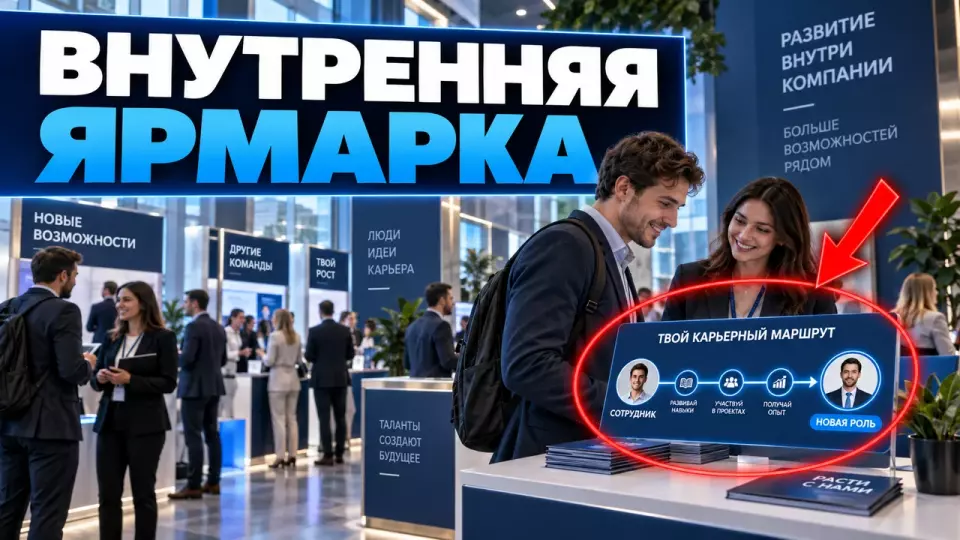
A practical scheme for an internal job fair: role map, program, safe conversation about transition, and the next step for the employee.
An internal job fair brings together employees, department heads, HR, and learning teams. The task is simple: to show a person real options within the company. They compare their skills with the role requirements and choose the next conversation. The company sees interest in transitions. The decision on appointment is made later, following the usual HR procedure.
At Aventura, we start such a project with the result and rules. Then we assemble the role map, employee route, consultation program, and handover of agreements after the event. Below is a scheme for a company with several departments or branches, without invented standards for timelines, number of zones, and budget.
How is an internal job fair different from an external one?
In short: an internal job fair works with people who already know the company and have working relationships with managers. They need a conversation about the role's tasks, transferable skills, and the transition process. An external fair helps a candidate get acquainted with the employer, while the internal format shows development options without automatically promising a new position.
A current employee faces a different risk. Interest in a neighboring department may be perceived as a signal of leaving the current team. Therefore, before the announcement, the company explains who will see the consultation request, when the current manager gets involved, and what decision can be made at the event itself.
The table summarizes the key points of the section: Attribute, Internal job fair, External job fair. Use it as a quick reference when preparing for the event.
| Attribute | Internal job fair | External job fair |
|---|---|---|
| Participant | current employee | candidate or student |
| Main question | how to transition or develop skills within the company | how to join the company |
| Next step | consultation, project, skill assessment | interview, internship, tour |
| Sensitive point | visibility of career interest | consent for further contact |
An external career day for an industrial company is built around candidates, professions, and moving to interviews. An internal job fair works with career paths within the organization. Its result can be a consultation, a trial project task, a meeting with a mentor, or inclusion in the talent pool.
Don't mix the two audiences in one program. An external candidate needs the conditions for joining the company. A current employee needs the requirements of the new role, the consequences of the transition, and a safe way to ask questions.
Results and rules before the announcement
The outcome of the internal fair is determined before selecting booths, the host and design. The company must decide what action is available to an employee after learning about a role: a consultation, a meeting with the manager, a skills assessment, or an application to a project. At the same time, HR sets the boundaries of the event, the procedure for reviewing interest, and response deadlines without promising a transfer.
hh.ru's forecast for 2026 highlights internal rotation, flexible career tracks, and internal training programs among employer directions. A single event does not create this system. It can make existing opportunities visible and bring the next steps together into one manageable process.
At the kick-off meeting, we answer five questions:
- which roles, projects, or professional tracks the company is ready to present;
- who can participate and how employees learn about the program;
- what action is allowed to be assigned at the venue;
- who sees an employee's interest and at what stage;
- who is responsible after the fair and in what form they provide a response.
The rules should be the same for all zones. If one team offers an employee a private consultation, while another asks them to publicly leave their name at the booth, trust in the format quickly disappears.
How to create a role map?
A role map links each internal opportunity with tasks, skills, entry conditions, and the next step. Job titles without this context produce a weak program. We ask role owners to explain the work outcome, typical tasks, and the available way to learn more, and HR checks the consistency and relevance of the descriptions.
First, separate open vacancies from project roles, temporary assignments, internships, and development programs. Each type has its own decision-making process. Employees should immediately understand where recruitment for a position is happening, and where the company is inviting them to a project or training.
For each role, we prepare a card:
- work outcome and main tasks;
- department and the role's place in the process;
- required and developing skills;
- work format and geography, if already approved;
- way to ask a question;
- available next step;
- owner of the response after the event.
The World Economic Forum examines changes in roles and skills up to 2030 based on data from over a thousand employers. For an internal fair, the principle itself is useful: showing the connection between skills, work, and specific tasks. The transition path is determined by the company itself.
The role map is reviewed by HR and direction owners. An outdated card is worse than an empty booth: an employee builds expectations on information that is no longer valid.
If you need to turn a list of internal opportunities into a clear program and participant journey, request a quote from us. We will clarify audiences, roles, consultation format, and venue.
We discuss corporate and business event practices in Aventura's Telegram channel.
Internal Fair Program
The program is for action, not a long series of presentations. The general kickoff explains the rules and route. Most of the time is spent on meetings at role zones, brief skills assessments, consultations, and getting to know projects. At the end, an employee records the next step, and the team checks that each agreement has an owner.
The program framework can be assembled like this:
The table gathers key points of the section: Block, What happens, Employee outcome. Use it as a quick reference when preparing the event.
| Block | What happens | Employee outcome |
|---|---|---|
| Common kickoff | goal, rules, confidentiality, navigation | clear participation order |
| Opportunity map | roles, projects, training, mentoring | selection of interesting routes |
| Direction zones | conversation with manager and team representative | understanding of tasks and requirements |
| HR consultation | transition process and available steps | realistic decision route |
| Practical trial | short task or analysis of a work case | understanding of the role content |
| Final point | sign-up for consultation, project, or skills assessment | confirmed next step |
Not every role requires a booth. Related areas can be combined into one zone if the employee can easily see the differences. For a rare position, it is better to schedule short individual meetings by appointment.
A general presentation by the manager is useful when it explains the reason for developing internal transitions and company rules. It does not replace a conversation about specific work. Leave most of the time for questions and meetings.
Employee's route through zones
The route begins before entering the venue. The employee receives the program, rules, and a way to choose areas of interest. On site, registration confirms participation, navigation leads to the right zones, and the final point saves the agreement. One route does not fit everyone, so we provide for independent choice and coordinator assistance.
We design the path from invitation to response after the event. At each step there is an employee question and a team action.
- Before the event, the employee sees the roles, rules, and meeting format.
- At registration, they choose areas of interest without announcing it publicly to the whole room.
- The coordinator helps plan the route and avoid queues.
- In the role zone, the employee gets answers about tasks and entry criteria.
- In the consultation zone, they clarify the process of transition or development.
- At the final point, they confirm the next step and response channel.
- After the event, the owner of the agreement updates the status.
For multiple branches, you can hold a common broadcast of the start, while leaving consultations local or scheduled by time slots. We covered the principles of a common program and local versions in the article about a series of corporate events in different cities.
Don't force the employee to go through all zones. In our experience, an overloaded route prevents a calm conversation with a role representative. It's better to show direction cards in advance and offer to choose a few priorities.
How to conduct a safe conversation about a transition?
A safe conversation starts with clear boundaries. The department representative explains the work and requirements but does not promise an appointment. HR describes the procedure and how interest is shown. An employee can ask a question without publicly announcing a decision. After the fair, the company follows the stated procedure and does not leave a request without a status.
In the role representative's brief, we record:
- what can be communicated about tasks and conditions;
- which decisions are not made at the venue;
- how to answer questions about salary, schedule, and location;
- where to pass on an employee's interest;
- how to act when a personal HR matter arises;
- when the current manager gets involved.
A difficult personal question is not discussed at the booth. The coordinator moves it to a separate channel. This procedure protects privacy and does not hold up other participants.
For development conversations, mentors and leaders of professional communities can be involved. Their role is to help the employee understand the skills gap and a possible preparation path. The format should not duplicate Corporate Mentor Day: the fair shows several routes, while mentoring continues the chosen path.
Microsoft publishes a code of conduct for its events and a channel for reporting issues. For an internal fair, the principle of clear rules known in advance is useful. The company writes the text according to its own procedures and corporate culture.
What data is needed for registration?
Internal registration collects only what is necessary for the program, access, and assigned action. Do not transfer information already held by the employer into the form without a clear purpose. Before launch, HR and legal counsel determine the legal basis for processing, the recipients, retention period, and consent form if required.
Article 5 of Federal Law No. 152-FZ ties the processing of personal data to predetermined purposes and requires not collecting unnecessary data. Article 9 regulates consent. For an internal career fair, separately check data on career interest, consultation sign-up, transfer of the list to the venue, and information about special needs.
Registration may have statuses: invited, confirmed participation, selected tracks, signed up for consultation, attended, next step assigned. The status must not reveal career interest to people who do not need it for their work.
A free-text field 'tell us everything about your limitations' creates unnecessary risk. For accessibility, it is better to provide a channel of communication with a limited group of responsible persons and explain the purpose of the request. Information that may reveal health status is also checked according to the rules for processing special categories of personal data. The specific form and applicable requirements for employee data are determined together with the company's legal counsel.
The technical scheme of statuses, login, and backup scenario can be cross-checked with our guide to event participant registration.
Accessibility, safety, and rules
The accessibility of the internal fair covers the venue, route, sound, materials, digital registration, and the ability to report needs. Safety includes people flows, installation, power supply, evacuation, and team actions in case of a failure. We also set rules for respectful communication, a clear support channel, and the procedure for responding to a participant's request.
W3C recommends checking the accessibility of the entrance, rooms, stage, and restrooms, using microphones, providing materials in adaptable formats, and asking about needs in advance. One protected PDF is not suitable for everyone. Role cards should also be prepared in digital form with a clear structure.
The British Health and Safety Executive suggests planning arrival and entry, movement within the venue, and exit separately. This is an engineering recommendation, not a Russian legal norm. Site requirements, evacuation solutions, and clearances are checked by the responsible specialists of the company and the venue.
Before opening, walk the employee route with different scenarios: independent visit, pre-arranged consultation, coordinator assistance, late entry, and accessibility request. A note is closed after re-checking.
Team and technical run-through
The internal fair has owners of content, career process, and venue. HR is responsible for transition rules and role relevance. Department heads explain the work. The event team manages the program, flows, technology, and coordination. Before opening, the team rehearses entry, navigation, consultation, and recording the next step.
Roles can be conveniently divided as follows:
The table summarizes the key points of the section: Role, Responsibility. Use it as a quick reference when preparing the event.
| Role | Responsibility |
|---|---|
| Career process owner | participation and transition rules |
| Role map editor | unified format and card relevance |
| Department heads | role content and work answers |
| Program coordinator | timing and zone load |
| Venue coordinators | navigation, queues, participant assistance |
| Data owner | access, transfer, and retention periods |
| Technical manager | sound, screens, network, and backup |
| Safety manager | site requirements and incident actions |
On the run-through, the team checks the actual configuration. The employee goes through registration, chooses a direction, finds the zone, signs up for a consultation, and receives confirmation. Role representatives test the cards and answers to difficult questions.
A detailed run-through order is in the article about technical rehearsal of an event. For the fair, add checking the visibility of career interest and status transfer after the event.
What to measure after the event?
Metrics of an internal job fair show the path from interest to the assigned action. Attendance describes reach, but not the quality of the career process. Count the selected routes, held consultations, assigned steps, responses on time, and actual follow-through. Retention and productivity cannot be attributed to a single event without longer-term observation.
The table summarizes the key points of the section: Level, What to count, What question it answers. Use it as a quick reference when preparing the event.
| Level | What to count | What question it answers |
|---|---|---|
| Reach | invitations, registrations, attendance | whether the program reached the audience |
| Interest | selected roles and projects | which routes are clear to employees |
| Contact | conversations and consultations | whether people received a meaningful answer |
| Action | meetings, trials, project applications | whether the next step was assigned |
| Fulfillment | responses and decisions within the stated deadline | whether the process works after the event |
| Experience | rating of the route, accessibility, and clarity of rules | what to fix in the next version |
Separate measured fact from interpretation. An increase in consultations shows the use of the format. It does not prove a reduction in turnover. The outcome can be influenced by role content, manager decisions, pay, geography, and the speed of the HR process.
The logic of choosing indicators can be supplemented with a guide on corporate event KPIs. For management, prepare a chain from goal to completed actions and a list of decisions that require an owner.
What to provide for the estimate?
In short: for a preliminary estimate we need the goal, audience, geography, list of roles, meeting format, and the working range of participants. Also provide requirements for registration, confidentiality, accessibility, equipment, and reporting. The exact budget appears after checking the venue, number of zones, program duration, team composition, and backup solutions for critical blocks.
Prepare the input:
- the goal of the internal job fair and the expected next step;
- departments, branches, and categories of employees;
- roles, projects, and development programs;
- the estimated range of participants;
- the format of participation for managers and HR;
- requirements for booking consultations;
- rules for visibility of career interest;
- city, venue, or criteria for its selection;
- requirements for accessibility, security, and data;
- report format and the parties accepting the result.
At Aventura, we can organize an internal job fair from the kickoff meeting to on-site work: design the program architecture, create a zone map, set up registration, prepare the team, and link agreements to the report.
Frequently asked questions
For a current employee, the risk is different. Interest in a neighboring department may be perceived as a signal of leaving the current team. Therefore, before the announcement, the company explains who will see the consultation request, when the current manager gets involved, and what decision can be made at the event itself.
The outcome of an internal job fair is determined before choosing booths, host, and design. The company must decide what action is available to an employee after learning about a role: consultation, meeting with a manager, skill assessment, or application to a project. At the same time, HR sets the boundaries of the event, the procedure for considering interest, and response timelines without promising a transfer.
A role map connects each internal opportunity with tasks, skills, entry conditions, and the next step. Job titles without this context make for a weak program. We ask role owners to explain the work outcome, typical tasks, and available ways to get acquainted, while HR checks the consistency and relevance of descriptions.
The program is for actions, not for a long series of presentations. The opening session explains the rules and route. Most of the time is spent on meetings at role zones, brief skill analyses, consultations, and project introductions. At the end, the employee records the next step, and the team checks that every agreement has an owner.
The route starts before entering the venue. The employee receives the program, rules, and a way to select areas of interest. On-site, registration confirms participation, navigation leads to the desired zones, and the final point saves the agreement. One route does not fit all, so we provide self-selection and coordinator assistance.
A safe conversation starts with clear boundaries. The department representative explains the work and requirements but does not promise an appointment. HR describes the procedure and the visibility of interest. The employee can ask a question without publicly announcing a decision. After the job fair, the company follows the stated procedure and does not leave a request without a status.
Planning an internal career day for employees? Request a budget and preparation plan. In your request, please specify departments, roles, city, and expected number of participants.
Sources
- hh.ru: labor market forecast for 2026
- World Economic Forum: The Future of Jobs Report 2025
- W3C WAI: Making Events Accessible
- Federal Law No. 152-FZ
- HSE: Crowd management controls
- Microsoft Event Code of Conduct
Contents
Was this article helpful?