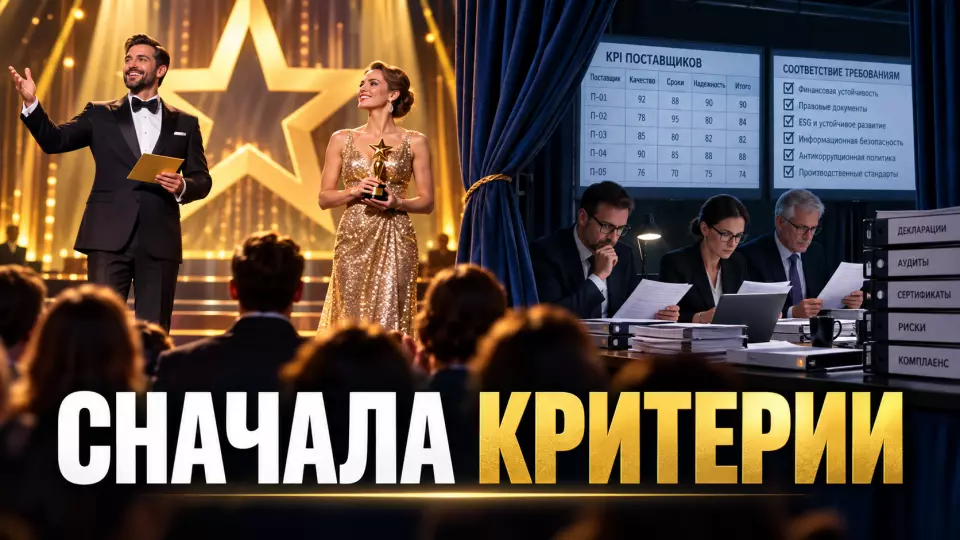
A practical Supplier Awards framework: how to link supplier evaluation with a transparent selection process, an awards ceremony scenario, and a follow-up development program.
A supplier awards program works when recognition is based on verifiable results, and the ceremony explains exactly what the company is thanking its partners for.
If you first come up with a spectacular finale and then collect the criteria later, the team will start arguing about why a particular supplier won.
At Aventura, we view Supplier Awards as the final point of the annual supplier management cycle. Such an awards program requires procurement data, business decisions, compliance checks, and a ready ceremony scenario. That's why we first define the rules, data owners, and expected outcomes. Then we design the stage, trophies, and content.
Leave a request - let's discuss your project
We'll clarify the event format and suggest the next step.
What is Supplier Awards and why does a company need a supplier awards program?
In short: Supplier Awards is a corporate program for recognizing suppliers for confirmed results, contribution to supply chain sustainability, and quality of collaboration. It combines annual evaluation, jury decision, public explanation of achievements, and further exchange of practices. For a company, it is a way to highlight strong working models without replacing tender, audit, or commercial decision with an award.
Official programs of large industrial companies show several recurring objectives. Siemens Mobility links the award with result recognition, motivation, and dissemination of best practices. General Motors recognizes suppliers for safety, innovation, and supply chain sustainability, and with a separate award highlights actions that exceeded expectations at a critical moment.
In the working brief, we distinguish four outcomes:
- recognition - the company clearly states the partner's achievement;
- benchmark - other suppliers understand which practices are valued;
- experience sharing - winners analyze a practice that other suppliers can use;
- next cycle - participants receive rules, feedback, and a calendar for further work.
Supplier Awards does not replace Supplier Day. Supplier Day more often explains the company's needs, introduces the market to procurement, and organizes focused meetings. The award evaluates the result already achieved over a designated period. The formats can be combined into one summit, but the participation rules and objectives of the two parts are better separated.
The table summarizes the key points of the section: Attribute, Supplier Awards, Supplier Day. Use it as a quick reference when preparing the event.
| Attribute | Supplier Awards | Supplier Day |
|---|---|---|
| Objective | recognize a confirmed result | discuss future needs and working rules |
| Input data | metrics and cases from the past period | procurement plans, requirements, and market questions |
| Main participants | nominees and jury; data owners | procurement and business customers; current or potential suppliers |
| Outcome | decision protocol and awards; feedback | agreements and meetings; plan for further work |
| Place in the cycle | wrapping up results | preparation for future interaction |
This separation also helps invited suppliers. They understand in advance where the company discusses future needs and where it sums up the results of the past period. The customer team conducts business meetings, nominee evaluation, and public recognition under different rules.
The Award as Part of the Annual Supplier Cycle
The award rules are finalized before work on the ceremony begins: the evaluation period, owners of indicators, participant categories, and the procedure for resolving disputes. If this is postponed until the final stage, exceptions will have to be manually resolved before announcing the winners.
First, we create a responsibility matrix: who approves the goals, owns the data, checks compliance, forms the jury, and authorizes case publication. The organizational team does not choose the winner. We prepare a single package of materials and a checkpoint calendar for the responsible persons.
The working cycle can be structured as follows:
- Approve the Supplier Awards goals and the link to the supplier development program.
- Define the evaluation period, allowable categories, and participation rules.
- Agree on nominations, criteria, weights, and stop-factors.
- Assign data owners and the application form or nominee dossier.
- Conduct formal verification, scoring, and calibration of points.
- Compile the list of finalists and undergo compliance review.
- Record the jury's decision and prepare communications.
- Hold the ceremony, hand over materials, and collect feedback.
- Update the criteria and calendar for the next cycle.
The logic of business event organization is suitable for overall coordination: a single command center, decision log, document versions, and personal owners. The evaluation content remains with the client. We link it with registration, script, venue, technical production, and guest journey.
How to choose nominations and criteria?
For a working format, we at Aventura recommend five to eight nominations related to company priorities. Comparable results are evaluated using a common model. Exceptional contributions are moved to Special Recognition with a separate written justification.
Toyota groups basic supplier expectations around safety, quality, delivery and production, cost, and technological capabilities. In Siemens Mobility and General Motors programs, innovations, logistics, safety, and supply chain sustainability are found.
For most B2B programs, the following set is suitable:
The table summarizes the key points of the section: Nomination, What we evaluate, What evidence we request. Use it as a quick reference when preparing the event.
| Nomination | What we evaluate | What evidence we request |
|---|---|---|
| Supplier of the Year | balanced result on key indicators | summary of key performance indicators (KPI) for a single period |
| Quality Excellence | quality, complaints, process stability | quality data and corrective actions |
| Delivery & Operational Excellence | accuracy and stability of deliveries | agreed delivery indicators |
| Innovation & Technology | implemented solution with confirmed effect | description of implementation and result |
| Safety | occupational and production environment safety | data and preventive measures |
| Responsible Supply Chain | sustainability and responsible procurement | audits, confirmations, improvement plans |
| Resilience | work in crisis or supply chain disruption | facts of actions and recovered process |
| Special Recognition | exceptional contribution outside the main model | separate decision with written justification |
The criterion should answer three questions: what we measure, for what period, and where the evidence lies. The wording "for reliable partnership" is too vague for the main category. It can be kept as a communication theme, but the jury's decision should be based on specific indicators and the described case.
Leave a request - let's discuss the task
We will clarify the event format and suggest the next step.
Data, Application, and List of Finalists
Nominees can only be compared if the period, metric definitions, and data sources are the same for all. KPI scores should be calculated separately from the case evaluation. Discrepancies between evaluators are resolved using test applications.
An external or internal application should not become a presentation contest. Slide design does not compensate for incomplete data. The dossier indicates the category and evaluation period, metrics and their sources, data owner, and a brief validated case. Corrective actions, compliance status, and the approved wording for publication are recorded separately.
The list of finalists is compiled in steps:
- Publish participation rules, criteria, weights, and evaluation period.
- Check completeness and eligibility of applications.
- Record metric sources and units of measurement.
- Separate KPI scores from qualitative case evaluation.
- Conduct a test evaluation and discuss discrepancies.
- Create a ranking within each category.
- Check stop factors before submitting materials to the jury.
- Keep a record of scores, exceptions, and manual adjustments.
The Natura 2000 Award rules demonstrate how pre-announced criteria and a unified scale simplify formal evaluation. For a corporate award, this is a methodological reference: it is easier for the team to verify the decision and explain it to suppliers.
Who is on the Jury and How to Avoid Conflicts of Interest?
The jury includes representatives from procurement, quality or operations, finance, sustainability, compliance, and the business owner. Before viewing the list of finalists, each member discloses any conflict of interest. If there is a direct connection with a participant, the evaluator recuses themselves, which is recorded in the minutes.
Independent evaluation is ensured by declarations of interest, recusals, and written minutes. In the Access City Award, jury members act in a personal capacity and sign a declaration of no conflict of interest. In EPSRC policy for secondees, actual and perceived conflicts of interest are considered separately: they are declared, recorded in the minutes, and taken into account when determining a person's participation in the decision.
The jury's working rules include:
- a single package of materials, review deadline, declarations of interest, and recusal rules;
- a ban on unilaterally changing others' scores;
- a calibration meeting on disputed criteria;
- written justification for exceptions to the ranking and a final protocol;
- a list of attendees and recorded replacements of evaluators.
The chair manages the discussion but should not turn their position into additional weight. The secretary oversees materials, versions, and minutes. If the decision diverges from the automated ranking, the jury states the reason: data error, applied stop factor, or a separately approved exception.
The jury composition may be disclosed after the decision if security and confidentiality requirements allow. Before the final, it is more important to protect participants from pressure and avoid informal promises to nominees.
Compliance before going on stage
Important: The award must not influence an ongoing tender or price, order volume, or the supplier selection decision. Before winners are announced, compliance checks sanctions and other applicable restrictions; investigations; significant violations; open corrective actions. Gifts and trips; accommodation and hospitality are checked against the policies of both parties and applicable law.
The UK Bribery Act guidance lists six pillars: proportionate procedures, top-level commitment, risk assessment, due diligence of partners, training, and regular review.
The joint guidance of the Organisation for Economic Co-operation and Development (OECD), the United Nations Office on Drugs and Crime, and the World Bank also recommends a risk-based approach, internal controls, partner due diligence, and channels for reporting violations.
These foreign documents serve as a methodological guide and do not replace verification of Russian and other applicable law.
Before producing trophies, we ask the client to confirm:
- the award is separate from current procurement decisions;
- there are no promises of commercial advantage to the winner;
- the cost of the gift and hospitality is acceptable to the recipient;
- the involvement of a government or quasi-government counterpart is checked separately;
- expenses and travel rights are handled transparently;
- there is a fallback procedure if a risk is identified after the finalist list is approved;
- the public wording does not disclose price, technology, or contract terms.
A symbolic trophy and business recognition usually raise fewer compliance questions than an expensive gift. However, the format is still checked against the policies of both parties, the recipient's status, applicable law, and any connection to current procurement decisions. For a cash award, trip, or valuable prize, separate rules, tax checks, and written confirmation of no link to a commercial decision are required.
How to assemble a ceremony script for 60-90 minutes?
For each nomination, we allocate a short block: the criterion, the list of finalists, the winner's confirmed result, and the award presentation. In our script model, one or two case studies add substance. Long corporate reports are better moved to the business part.
The meaning of the awards determines the program structure and the number of times people come on stage. For the script assembly, we use director's script: it links the host's words, videos, music, lighting, routes of the award presenters, photos, and a backup in case the winner is delayed.
For a 60-90 minute ceremony, we recommend the following framework:
- Opening. The host states the purpose and safety rules; reminds about accessibility.
- Business context. The manager explains the role of suppliers and the year's priorities.
- How they were selected. We briefly show the period and criteria; name the jury members.
- Nomination block. We show the criterion and the list of finalists; name the confirmed achievement and the winner's name. Inside, you can include our recommended three- to five-minute case study or separately explain Special Recognition.
- Awarding. We plan the entrance and presentation; then photos and a short remark without long improvisation.
- Finale. We thank the participants; name the calendar of the next cycle and the further program.
- Networking and content zone. Interviews and photos within the agreed rights.
For the ceremony, you need a host who confidently works with a business audience and does not turn supplier achievements into entertaining jokes. Suitable specialists can be found among business event hosts, and the final choice should be made after an interview and reading a script excerpt.
Each video and introduction answers the question: what did the supplier do and why is it important. The phrase "for outstanding contribution" without a fact sounds empty. It is better to name the confirmed improvement without disclosing confidential data.
Accessible venue and technical production
We check accessibility along with lighting, sound, and stage routes. Before the event, we walk the path from the entrance to the hall, stage, restroom, and networking area, collect guest requests, and rehearse entrances for those who need support.
Section508.gov recommends incorporating accessibility from the start of planning: invitations and registration include a way to request accommodations, documents are prepared in an accessible format, and the platform and microphones are checked in advance. Web Content Accessibility Guidelines WCAG 2.2 apply to the registration website, program, and digital materials.
During the venue walkthrough, we check:
- barrier-free entrance, parking, and navigation;
- seating for guests in wheelchairs;
- ramp or lift to the stage;
- audibility, microphones, and live subtitles;
- slide contrast and font size;
- quiet zone and clear staff routes;
- backup option for remote participation;
- safe placement of trophies, stands, and cameras.
In the venue catalog, you can select halls by capacity and event type, but accessibility and service routes are verified in person. It is convenient to supplement the rehearsal plan with our material on technical rehearsal of the event.
During the run-through, we simulate four failures: no winner, an error in the title, video delay, and microphone failure. For each, we pre-record a backup action.
What to agree on for photos, videos and publication of results?
Filming, publication of recognizable images and use of the supplier's materials are checked separately. The grounds and scope of rights depend on the applicable law, contract, filming context and publication channels. The client agrees on consent forms, contract with the filming team and rules for using logos, quotes and cases with the lawyer and the person responsible for personal data.
In the U.S. Copyright Office guidance, it is indicated that the original author of a photograph is usually the photographer, unless a special rule or agreement applies. In the European Commission's guide for EU-funded external actions, consent for the use of recognizable image, voice and other personal attributes, as well as clearing rights for third-party materials, are provided. We use these sources as a checklist. For a Russian project, rights and consents are executed according to applicable law and contracts with the participation of the project lawyer.
The permission matrix includes:
The table collects the key items of the section: Object, What needs to be confirmed, Who agrees. Use it as a quick reference when preparing the event.
| Object | What needs to be confirmed | Who agrees |
|---|---|---|
| supplier's name and logo | channels, term and type of publication | authorized representative of the supplier |
| figure or case | exact wording and confidentiality level | data owner and communications |
| photo and interview | consent, channels and possible refusal of a close-up | participant and client |
| trophy and winner's sign | rules and term of use | owner of the Supplier Awards program |
| music, graphics, video | licenses and right of public performance | producer and project lawyer |
If the supplier is not ready for publicity, the ceremony can still recognize the result in a closed format. The communication plan should provide for such an option without pressure on the winner.
Before filming, draw up a plan for releasing materials. Indicate what we publish on the day of the event, what we edit later and who approves each version. To do this, you can link photo and video filming of the event with the editorial calendar. Additional logic is discussed in the article about content after the conference.
After the ceremony: 24 hours, 30 days, and the next cycle
After the ceremony, the team hands over the approved materials to the winners, publishes the results, and gathers feedback. In our recommended model, the first actions are carried out within 24 hours, the review is conducted within 30 days, and then the criteria, data, and calendar for the next cycle are updated.
Within 24 hours:
- send the winners the agreed wording and photos;
- publish a single list of results on the official channel;
- thank the nominees and jury members;
- check captions, subtitles, alt texts, and rights;
- record questions, errors, and requests for removal of materials.
Within 30 days:
- provide structured feedback to participants where required by the rules;
- conduct a survey of suppliers, jury, and internal KPI owners;
- review accessibility, technical failures, and communication reach;
- turn winners' best practices into short case studies;
- link identified gaps to development programs without mixing them with the commercial decision.
Before the next cycle:
- review criteria and weights;
- update declarations of interest;
- verify data comparability;
- publish changes and the calendar before nominations open;
- save the conclusions into the brief and event crisis plan.
Frequently Asked Questions
Official programs of major industrial companies show several recurring objectives. Siemens Mobility links the award to recognition of results, motivation, and dissemination of best practices. General Motors recognizes suppliers for safety, innovation, and supply chain sustainability, and has a separate award for actions that exceeded expectations at a critical moment.
The award rules are set before working on the ceremony: evaluation period, KPI owners, participant categories, and the procedure for resolving disputes. If this is deferred until the final stage, exceptions will have to be manually resolved before announcing the winners.
For a workable format, at Aventura we recommend five to eight categories linked to the company's priorities. Comparable results are assessed using a common model. Exceptional contributions are placed in Special Recognition with a separate written justification.
Nominees can be compared only if the period, definitions of indicators, and data sources are the same for everyone. KPI scores are best calculated separately from case assessment. Discrepancies between evaluators are resolved using test applications.
The jury includes representatives from procurement, quality or operations, finance, sustainability, compliance, and business owner. Before viewing the list of finalists, each discloses any conflict of interest. If directly connected to a participant, the evaluator recuses themselves, which is recorded in the minutes.
The UK Bribery Act guidance lists six pillars: proportionate procedures, top-level commitment, risk assessment, due diligence on partners, training, and regular review.
At Aventura, we can deliver Supplier Awards as a single project: from ceremony architecture and guest journey to script, venue, technical production, rehearsal, and release of materials. Request a quote via the form to discuss the number of nominations, format, and guest list.
Sources
- General Motors: 2025 Supplier of the Year and Overdrive Awards (for 2024 results)
- Siemens Mobility: Supplier Award 2020
- Toyota: Supplier Sustainability Guidelines
- European Commission: Natura 2000 Award selection and evaluation
- Access City Award 2025: Rules of Contest
- UKRI: Managing conflicts of interest
- UK Ministry of Justice: Bribery Act 2010 guidance
- Section508.gov: Accessible Meetings
- OECD, UNODC and World Bank: Anti-Corruption Ethics and Compliance Handbook for Business
- W3C: Web Content Accessibility Guidelines (WCAG) 2.2
- U.S. Copyright Office: What Photographers Should Know about Copyright
- European Commission: Communicating and raising EU visibility - Guidance for external actions
Contents
Was this article helpful?